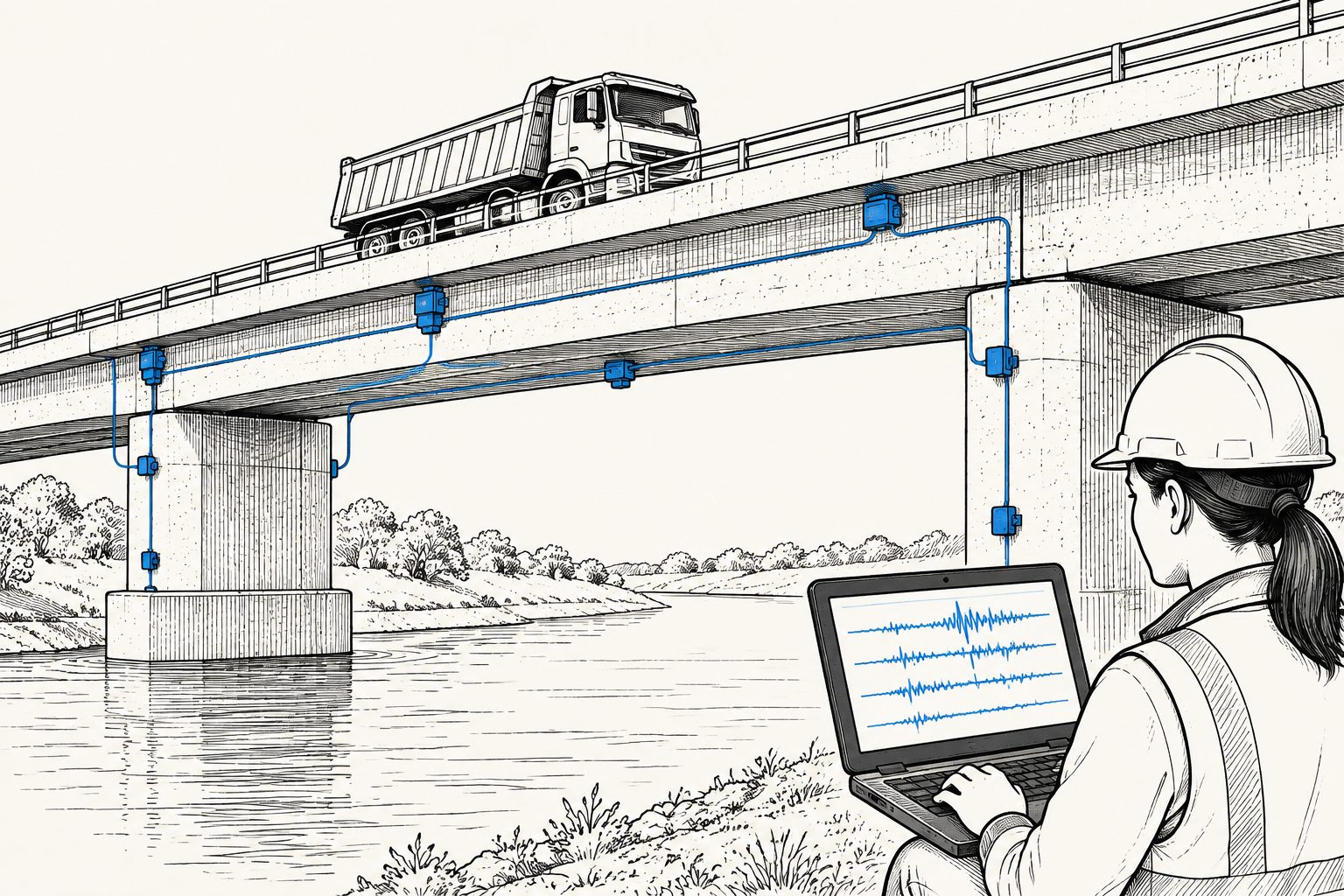
The public dataset records how a 1972 prestressed bridge responded to parked and moving trucks.
The tests covered long-term loading with added masses, trucks parked at three positions and repeated truck crossings at speeds of up to 13.9 meters per second. Loaded and unloaded trucks weighed 21,250 and 12,340 kilograms, respectively, in the dynamic tests; the parked-truck tests used the 21,250-kilogram vehicle.
The published data include synchronized readings from the bridge’s monitoring system, laser checks of vehicle positions and passage times, and tracked changes in vibration frequencies during the reference and long-term tests. The researchers documented the bridge, sensors, test cases and data structure, and made the data available through Zenodo.
What the tests recorded
The researchers produced a publicly available dataset from static and dynamic tests on an anonymized in-service prestressed concrete box girder bridge designed for Bridge Class 30. Its permanent monitoring system has 128 sensors, including instruments that measure acceleration, strain, tilt, displacement and temperature, along with weather stations.
The test program included long-term static loading with added masses of 680, 1,420 and 2,160 kilograms; short-term tests with a 21,250-kilogram truck parked at three bridge positions; and repeated truck crossings with loaded and unloaded vehicles at speeds of up to 13.9 meters per second. Plausibility checks supported the recorded parking positions and passage windows, vibration measurements and modal tracking, as well as repeatable strain and displacement patterns during very slow truck crossings.
Why the dataset matters
Publicly available, full-scale bridge load-test data are scarce. By documenting the bridge, sensor layout, loading conditions and data hierarchy, this release gives researchers material they can reuse to calibrate computer models, extract how bridge responses vary along the structure, track changes in the bridge’s behavior and develop methods for detecting unusual patterns.