A food-web model suggests losing these animals could leave far more biodegradable carbon in groundwater, with implications for drinking-water production.
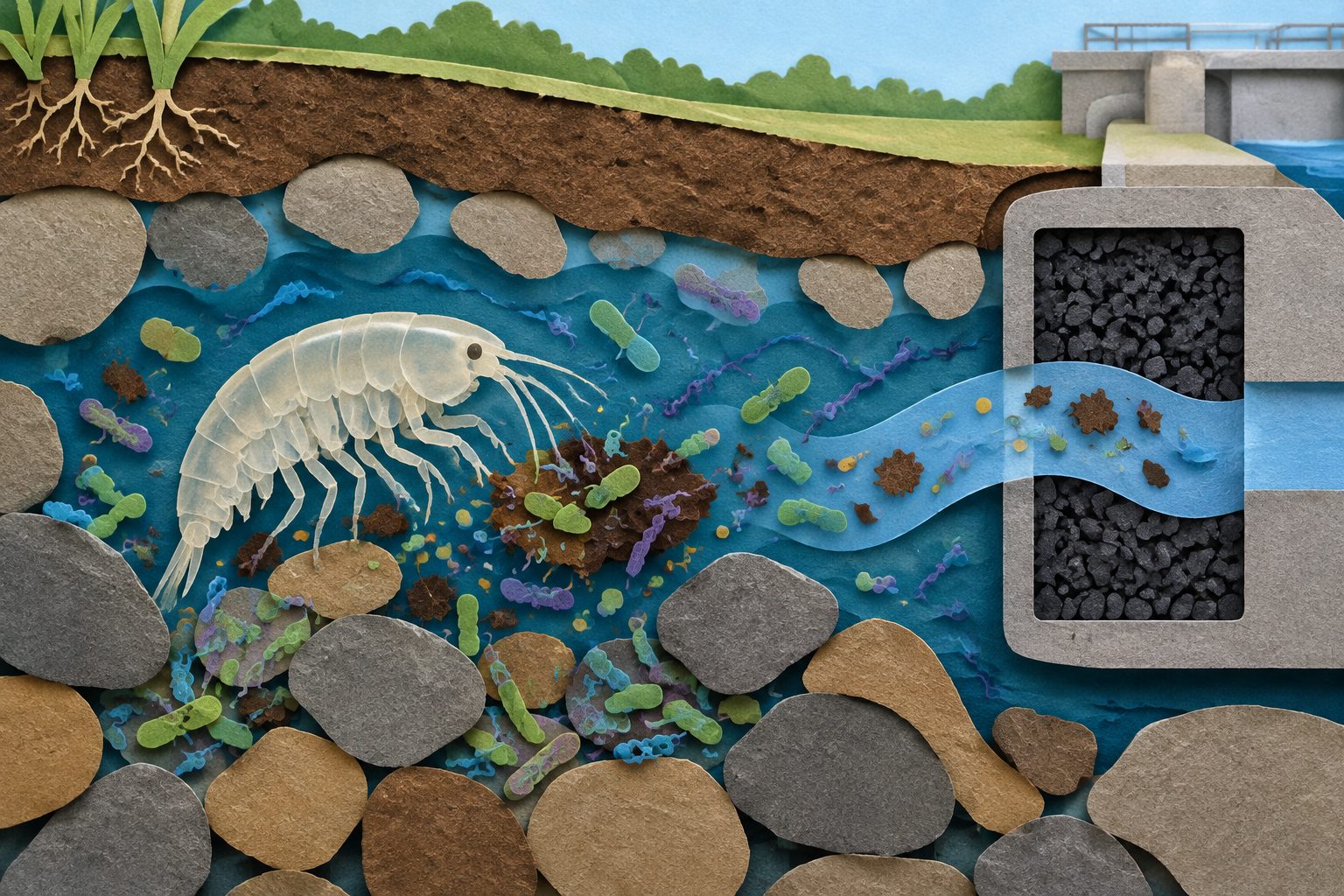
Researchers built a dynamic model of groundwater carbon processing using field data from four zones in a floodplain with different land-use and water-exchange conditions. The model included incoming organic carbon, microorganisms that consume its biodegradable fraction, and groundwater fauna that graze on those microorganisms.
They then compared scenarios with and without fauna and tested temperature increases of 1.5 and 3 degrees Celsius. In most scenarios, the amount of carbon remaining increased over time; in some no-fauna scenarios, it was up to 660 times higher than in the reference scenario.
How groundwater fauna changed carbon
The model showed that groundwater fauna promoted microbial growth and carbon degradation. When fauna were removed from the model, representing losses such as contamination or sudden temperature peaks, remaining biodegradable organic carbon increased substantially in some scenarios—up to 660-fold compared with the reference case.
The study examined four groundwater zones and additional scenarios with temperatures raised by 1.5 or 3 degrees Celsius. Faunal biomass declined in all scenarios that included fauna, and the modelled 3-degree increase brought some results closer to those of the no-fauna scenarios. The researchers describe the fauna-related service as substantial, while noting that its size differed among aquifer zones.
Why the animals matter
The findings suggest that groundwater animals contribute to the natural processing of organic carbon before water is used for drinking-water production. If active fauna help remove more biodegradable carbon, losing them could leave water producers needing more treatment, which the researchers say could make production less reliable and more costly.
The model also provides a way to examine how groundwater carbon processing might respond to temperature changes and other physical or chemical disturbances. The study does not establish how these effects would unfold in every groundwater system.
Model evidence and limits
This was a proof-of-principle modelling study, not a direct experiment that removed groundwater animals and measured the resulting water quality. The model was parameterized with field measurements from four zones in the Johannisaue floodplain near the River Fulda, including data collected between 1978 and 1984, and it satisfactorily reflected the available field values.
The model represents a simplified food web containing incoming organic carbon, microorganisms and fauna grazing on those microorganisms. The researchers say knowledge of groundwater processes and dependencies remains incomplete, making parameter choices important. The scenarios were based on one catchment and a 3.5-year observation period, so the results should not be treated as measurements for all aquifers.