Metal atoms lingered around interstellar comet 3I/ATLAS far from the Sun
Observations found nickel and iron emissions persisting as the comet traveled from 1.88 to 4.35 times Earth’s distance from the Sun.
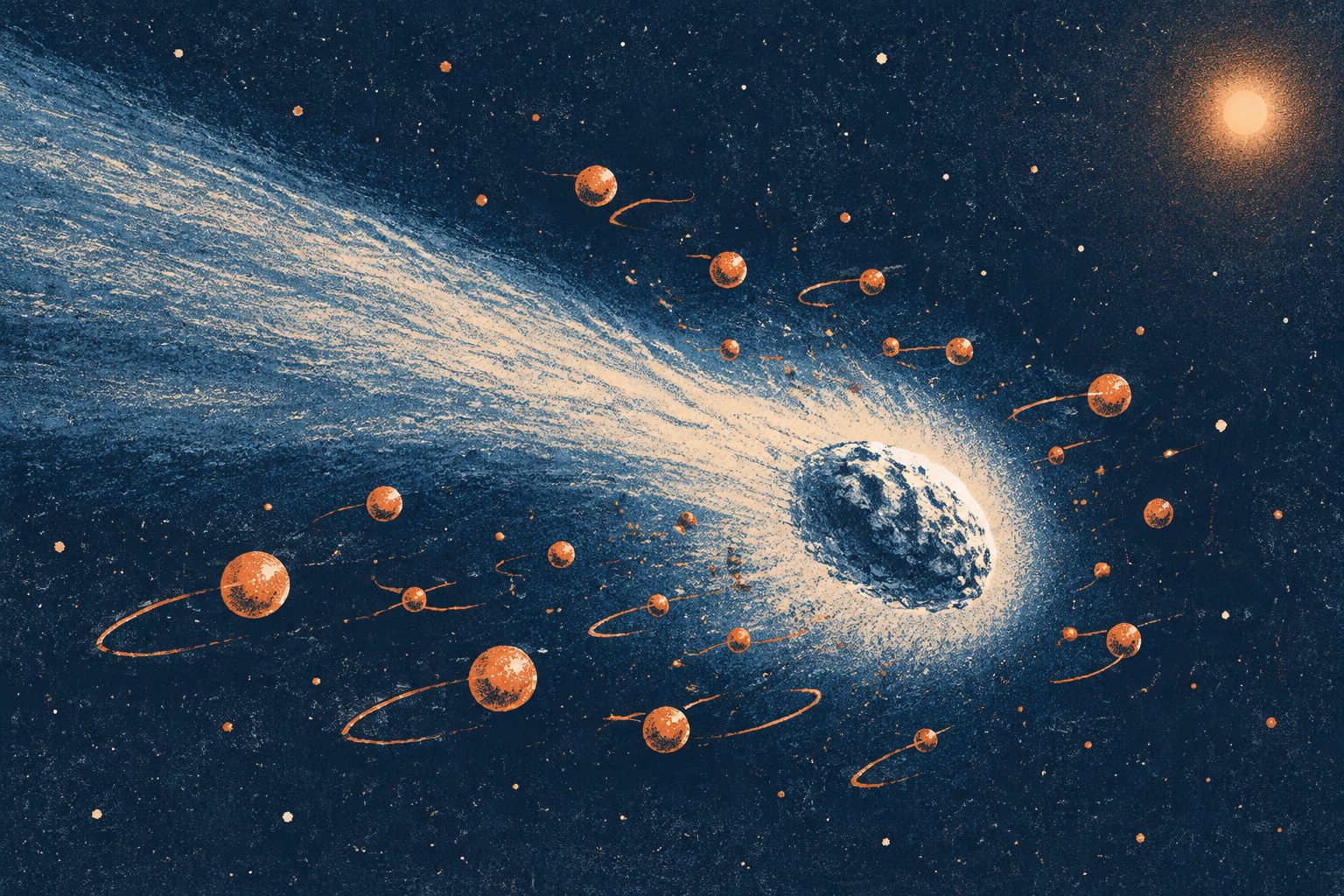
Editorial illustration — not from the study.
Using high-resolution observations from the Very Large Telescope, researchers tracked nickel and iron emissions from 3I/ATLAS after its closest approach to the Sun. The emissions remained detectable as the comet moved from 1.88 to 4.35 astronomical units from the Sun, with nickel generally more abundant than iron. Metal production near 2 astronomical units was at least 10 times higher than in typical Solar System comets.
Production was stronger after the comet passed the Sun and declined more gradually as it moved away. Models in which nickel and iron atoms form when sunlight breaks apart nickel and iron carbonyl gases could reproduce the observations, including the high nickel-to-iron ratio. The study also considered a temporary heat source that might explain an unusually high nickel signal before closest approach.
What the comet released
The team analyzed high-resolution spectra taken with the Very Large Telescope between December 2025 and February 2026, while 3I/ATLAS receded from 1.88 to 4.35 astronomical units from the Sun. Nickel and iron emission lines were strong soon after closest approach and came from a compact region near the nucleus. Nickel dominated the detected metal production at every measured distance.
At about 2 astronomical units, the combined metal production rate was at least an order of magnitude higher than that of typical Solar System comets. Production rates were higher after closest approach than before it and fell more slowly with increasing distance from the Sun, particularly for iron. The nickel-to-iron ratio, extremely high before closest approach, moved toward values seen in Solar System comets near 2 astronomical units and varied less strongly with distance afterward.
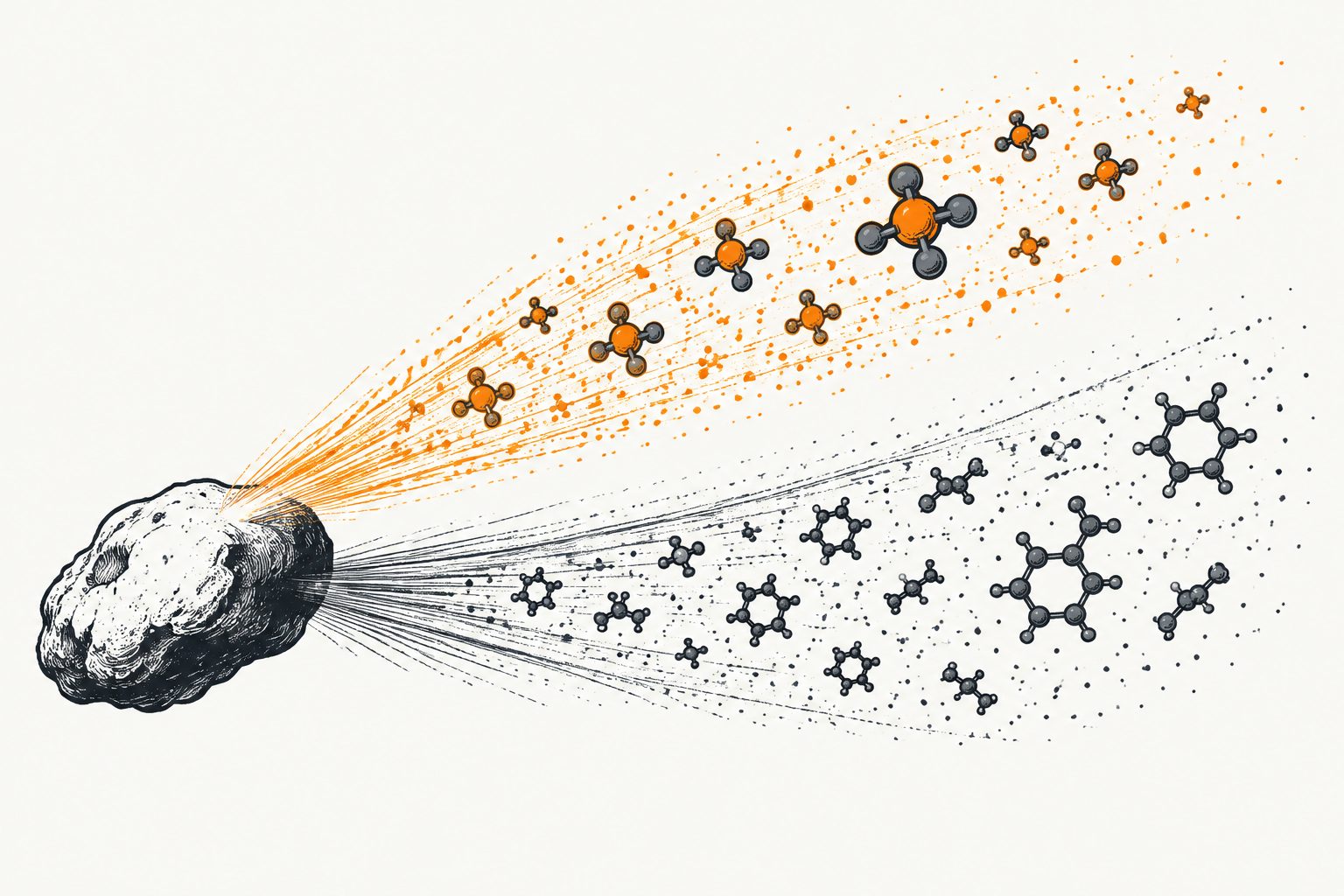
The researchers modeled the atoms as products of sunlight-driven breakdown of nickel tetracarbonyl and iron pentacarbonyl gases released directly from the nucleus. This model reproduced the measured production rates and high nickel-to-iron ratio, with nickel tetracarbonyl’s greater volatility helping explain nickel’s dominance. A modified thermal model also required a temporary heat source of about 100–140 kelvin to account for the early excess of nickel before closest approach.
Why the metals matter
The observations show that an interstellar comet can release nickel and iron atoms at distances where the study’s models do not expect ordinary surface heating alone to explain the emissions. The results point to metal-bearing gases released from below the surface as one possible explanation for the metals’ persistence far from the Sun.
Understanding how these atoms are released could help clarify the chemical makeup and thermal history of 3I/ATLAS, and whether similar metal-release processes occur in other comets. The findings also show that the comet’s activity differed before and after its closest approach to the Sun.
Evidence and open questions
The study is based on high-resolution spectroscopic observations of nickel and iron emission lines, combined with production-rate calculations and thermal modeling. The iron lines disappeared around 3.5 astronomical units, while only faint nickel lines were detectable at 4.35 astronomical units. Measurements from different spectrograph settings differed by about 20–40%, likely because of absolute-flux calibration uncertainties, although the nickel-to-iron ratios were not affected by that correction.
The carbonyl explanation fits the full set of observations, but carbonyl gases have not been directly detected in cometary comae. The proposed temporary heat source is also an interpretation rather than a direct measurement of the process responsible. Other mechanisms, including release from superheated metallic nanoparticles, remain possible. The authors say targeted mid-infrared observations and further thermal and compositional modeling are needed to distinguish among these explanations.
// Source
Astronomy and Astrophysics · 2026 · DOI: 10.1051/0004-6361/202660847
Researchers used a computer model of the XiHanShui River basin to estimate how much area-wide rain could signal a flood. The study identified warning rainfall levels of 108.1 millimeters at Pingluo and 128.5 millimeters at Tanjiaba.
Groundwater animals that graze on microbes may substantially increase the breakdown of biodegradable carbon, according to a quantitative food-web model. Scenarios without fauna left up to 660 times as much carbon as the reference case, although the result comes from modelling rather than a removal experiment.
Spectroscopy of interstellar comet 3I/ATLAS found that nickel and CN emission fade at different distances from the comet’s nucleus. Nickel was more centrally concentrated, a pattern that supports explanations involving short-lived parent molecules.