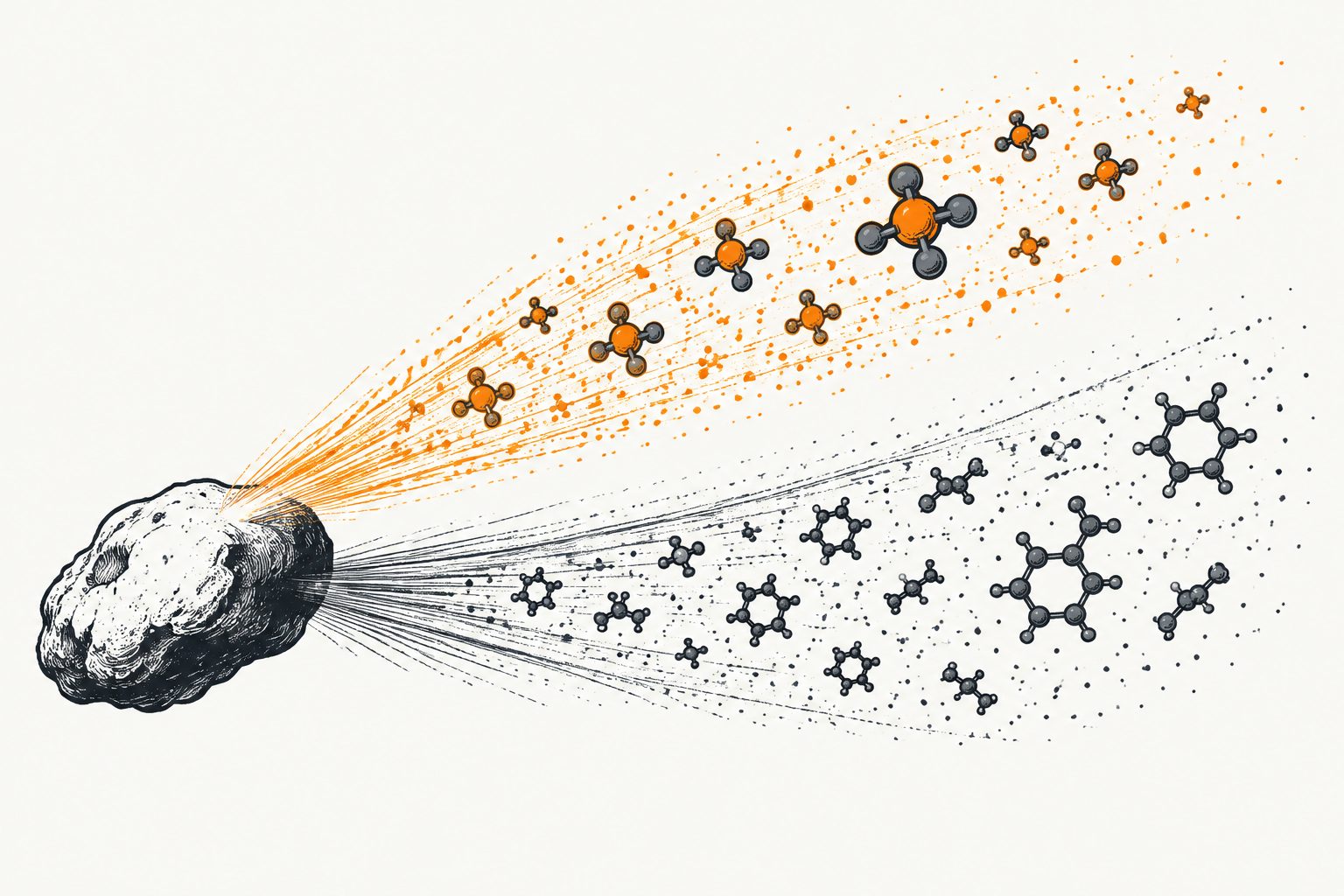
Keck observations found nickel emission closer to 3I/ATLAS’s nucleus than CN emission, offering clues to the gases released by the comet.
Researchers used blue-sensitive integral field spectroscopy from the Keck II telescope’s Keck Cosmic Web Imager on August 24, 2025, to study gas around 3I/ATLAS. They confirmed earlier reports of nickel and CN outgassing and measured how each emission was distributed with distance from the nucleus.
Nickel emission declined more quickly than CN emission, suggesting that the nickel comes from substances that break apart relatively easily. The researchers also saw uneven brightness in images of the comet, including along the direction toward and away from the Sun, which may be related to previously reported dust plumes.
Nickel stays closer in
The researchers measured characteristic e-folding radii, a measure of how quickly emission fades with distance, of 593.7 ± 14.8 kilometers for nickel and 841.0 ± 15.4 kilometers for CN. Because the nickel emission extended less far, it was more concentrated around the comet’s nucleus than the CN emission.
This distribution favors explanations in which nickel is released from easily dissociated substances, such as metal carbonyls or metal–polycyclic aromatic hydrocarbon molecules. The study also found evidence that the broadband, CN and nickel images were asymmetric, with brighter integrated emission aligned with the solar and antisolar directions. The authors say this may be evidence of dust plumes, rather than a demonstrated cause.
Why the pattern matters
The different spatial distributions of nickel and CN provide information about how gases are released and broken apart in an interstellar comet. The results support the idea that nickel emission comes from short-lived parent substances, whose lifetimes affect how far the emission extends from the nucleus.
Nickel detected in multiple interstellar comets could eventually help researchers investigate the chemistry and metal content of the planetary systems where these objects formed. The study’s measurements add a way to compare metal-bearing gases with other cometary substances as more interstellar comets are observed.
Evidence and open questions
The findings come from one set of blue-sensitive integral field spectroscopic observations made with the Keck II telescope’s Keck Cosmic Web Imager on August 24, 2025, when 3I/ATLAS was 2.75 astronomical units from the Sun. The study confirms nickel and CN outgassing and directly measures their radial emission profiles, but it does not establish which parent substance produces the nickel.
The observations provide a snapshot of the comet’s activity. Additional observations after perihelion are needed to determine how the nickel and CN distributions change over time and to enable further comparisons with iron and other volatile substances. The proposed link between the asymmetric emission and dust plumes is also presented as a possibility, not a confirmed explanation.
// Source
The Astronomical Journal · 2026 · DOI: 10.3847/1538-3881/aeaff7
Authors: W. B. Hoogendam, Benjamin J. Shappee, James J. Wray, Bin Yang, Karen J. Meech, Chris Ashall, D. Desai, Kevin Hart, Jason T. Hinkle, E. M. Hu, D. O. Jones, K. Medler
Institutions: Georgia Institute of Technology, University of Illinois Urbana-Champaign, Universidad Diego Portales, University of Hawaii System, NSF-Simons AI Institute for the Sky