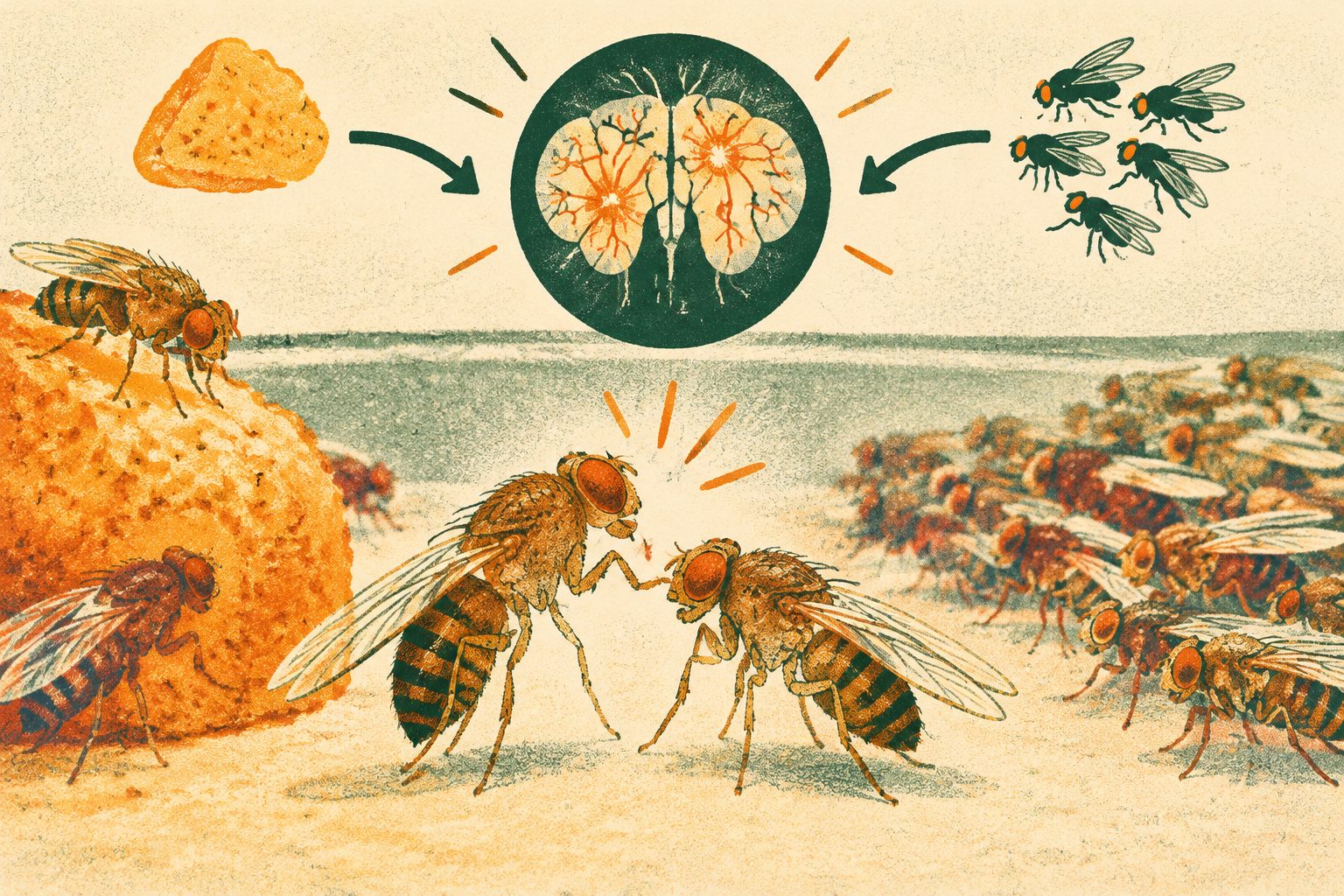
In Drosophila erecta, food smells start male courtship, while the movement of nearby flies strengthens it.
Researchers found that food smells directly raise male sexual arousal in Drosophila erecta, prompting males to search for and pursue potential mates. As flies gather and move on a food patch, that motion changes what each male sees and further increases his arousal, creating a feedback loop that coordinates courtship across the group.
This dependence on food cues is stronger in D. erecta than in the related Drosophila melanogaster. Comparative analyses indicate that differences in how smell signals affect conserved courtship circuits set different arousal thresholds between species.
How food starts courtship
In Drosophila erecta, food volatiles act as a gate for sustained courtship. They first increase male arousal, encouraging males to sample their surroundings and pursue possible mates. The resulting movement of flies in the group provides a visual signal that further amplifies arousal, linking individual courtship behavior to the activity of the wider group.
The researchers also found that this strict reliance on food odor is not shared in the same way by Drosophila melanogaster: food odor can increase arousal in that species, but it is not required for vigorous courtship. Comparative circuit analyses linked the difference to species-specific arousal thresholds and to how smell input affects conserved neural pathways involved in courtship.
Why the setting matters
The study shows that courtship is not controlled only by communication between potential mates. In this fruit fly, mating behavior is coordinated with a food-rich setting where reproductive opportunities are more likely to occur, and the movement of the group helps reinforce the behavior.
More broadly, the findings show how environmental signals that are not sexual signals themselves can shape reproductive behavior. They also suggest that the strength of this effect can evolve differently among related species, depending on their ecological and social environments.
Evidence and open questions
The findings come from behavioral experiments in Drosophila erecta, together with comparative analyses of courtship-related neural circuits in related species. The reported mechanism connects food odor, male arousal, visual motion from other flies and coordinated courtship, but the provided excerpts do not give sample sizes or the full experimental design.
The researchers discuss the possibility that D. erecta's sensitivity to food odor is related to its reliance on seasonally available Pandanus fruit, but they explicitly state that it remains unclear whether this dependence is a direct adaptation to the host's seasonality. The results directly concern the species and conditions studied; their relevance to other animals or broader mating systems is not established here.
// Source
Nature · 2026 · DOI: 10.1038/s41586-026-11209-9
Authors: Philipp Brand, Katherine Keller, Rory T. Coleman, Noelle B. Eghbali, Sarah Zylka, Lucia L. Prieto-Godino, Vanessa Ruta
Institutions: Boston University, New York University, Rockefeller University, Howard Hughes Medical Institute, The Francis Crick Institute, Max Planck Institute for Brain Research