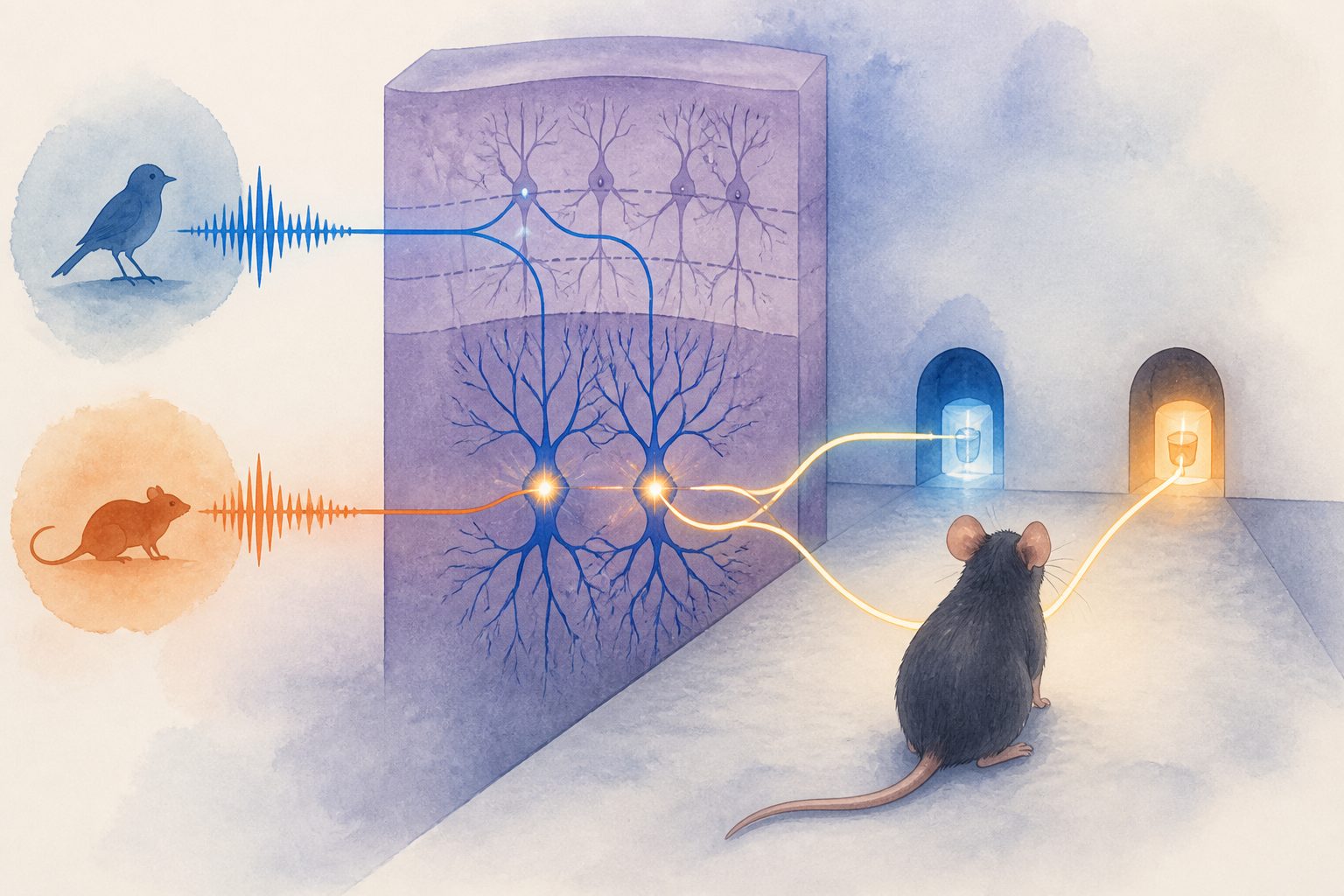
After training, one group of auditory-cortex neurons formed sound categories that depended on active behavior.
Researchers trained head-fixed mice to categorize amplitude-modulated noise according to its temporal rate while repeatedly imaging neurons in the auditory cortex. They compared deep-layer L5 extratelencephalic neurons with neurons in layers 2/3 and another deep-layer group, L5 intratelencephalic neurons.
With learning, the L5 extratelencephalic neurons changed their sound tuning and developed clear category responses. The same neurons showed this code during the task but not when the mice passively listened to the sounds, indicating that the representation depended on the behavioral context.
How sound categories formed
L5 extratelencephalic neurons developed pronounced changes in sound tuning as the mice learned the categorization task. They formed robust categorical responses, unlike the layer 2/3 and L5 intratelencephalic comparison populations.
The category responses appeared while the mice were engaged in the task and disappeared during passive listening on the same day. A generalized linear model, used to separate sound-related signals from choice-related signals, indicated that the categorical responses reflected sensory encoding rather than movement. All three neuron populations carried choice signals, but these signals were strongest in the L5 extratelencephalic neurons.