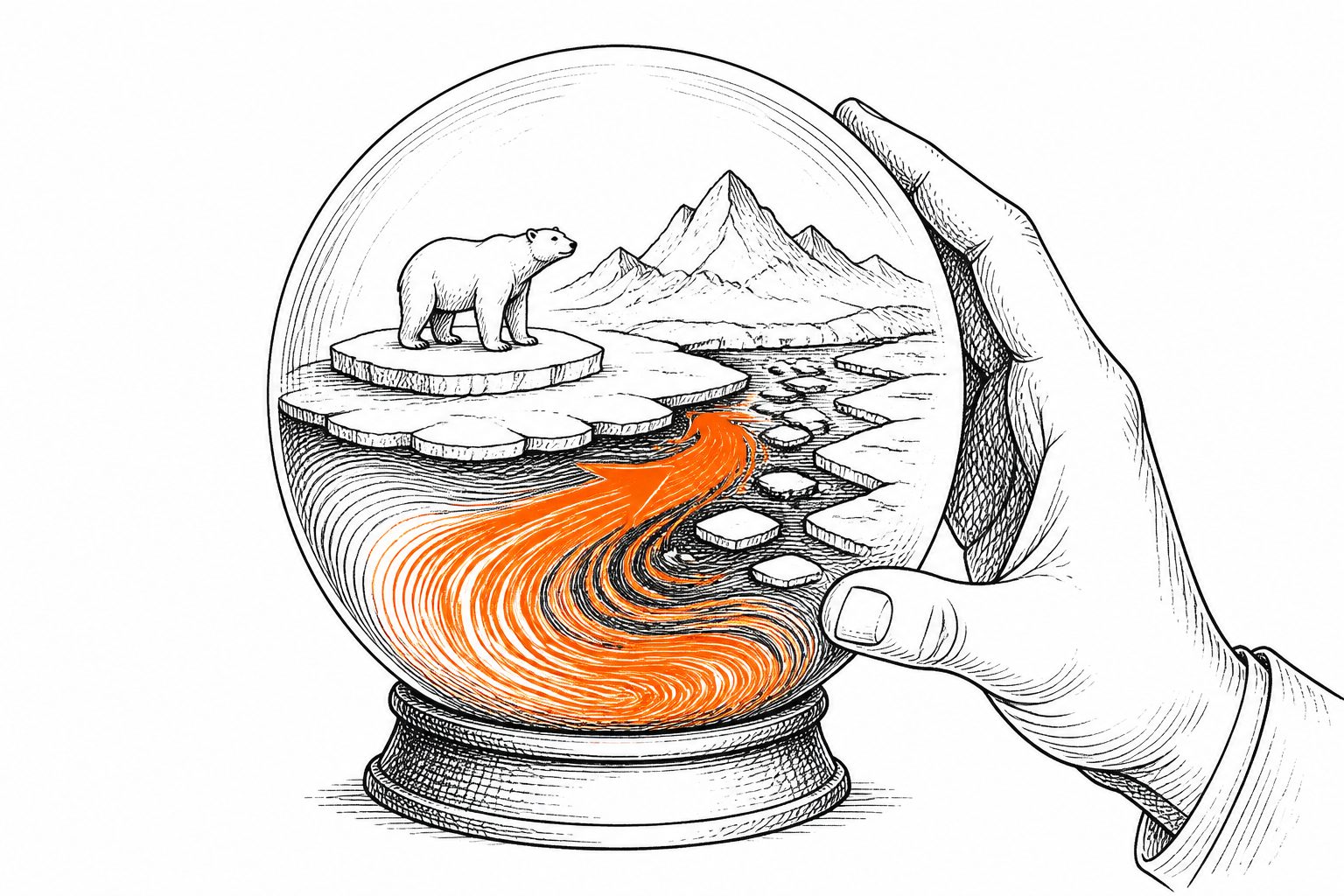
The model analysis highlights possible early shifts in winter Arctic sea ice, North Atlantic mixing and the Atlantic overturning circulation.
Researchers analysed projections from 54 climate models to look for unusually large, nonlinear changes in the ocean, sea ice and atmosphere. They identified 73 such events across five future climate pathways, including abrupt changes and transitions that develop over several decades.
The events were projected to occur earlier and at lower global warming than previous reviews had assessed. The strongest examples involved the disappearance of winter Arctic sea ice, the collapse of winter mixing in the northern North Atlantic and a possible transition of the Atlantic overturning circulation to a weak state.
The changes identified
The researchers created an automated, reproducible method to identify “strong nonlinear surprises” in CMIP6 projections. They defined these as either abrupt changes over decadal timescales or state transitions that develop over multiple decades and are too large to be explained by the external climate forcing alone without strong internal feedbacks.
Across 54 models and five shared socioeconomic pathways, the method found 73 events in 11 categories. Four categories involved abrupt changes and seven involved state transitions. About 45% of the events concerned sea-ice cover, 19% ocean currents, 29% mixed-layer depth—the depth over which ocean water is stirred—and 7% atmospheric systems such as the Intertropical Convergence Zone.
The analysis also identified linked cascades. In one, changes in sea ice, deep-ocean mixing, temperature and salinity interact. In another, the collapse of the subpolar mixed layer triggers a shutdown of the Atlantic Meridional Overturning Circulation, the large-scale system of currents that includes the flow associated with North Atlantic Deep Water formation. The timing distributions for each category indicated earlier changes and lower global temperature rise than previous reviews had assessed, especially for winter Arctic sea-ice disappearance and the North Atlantic changes.