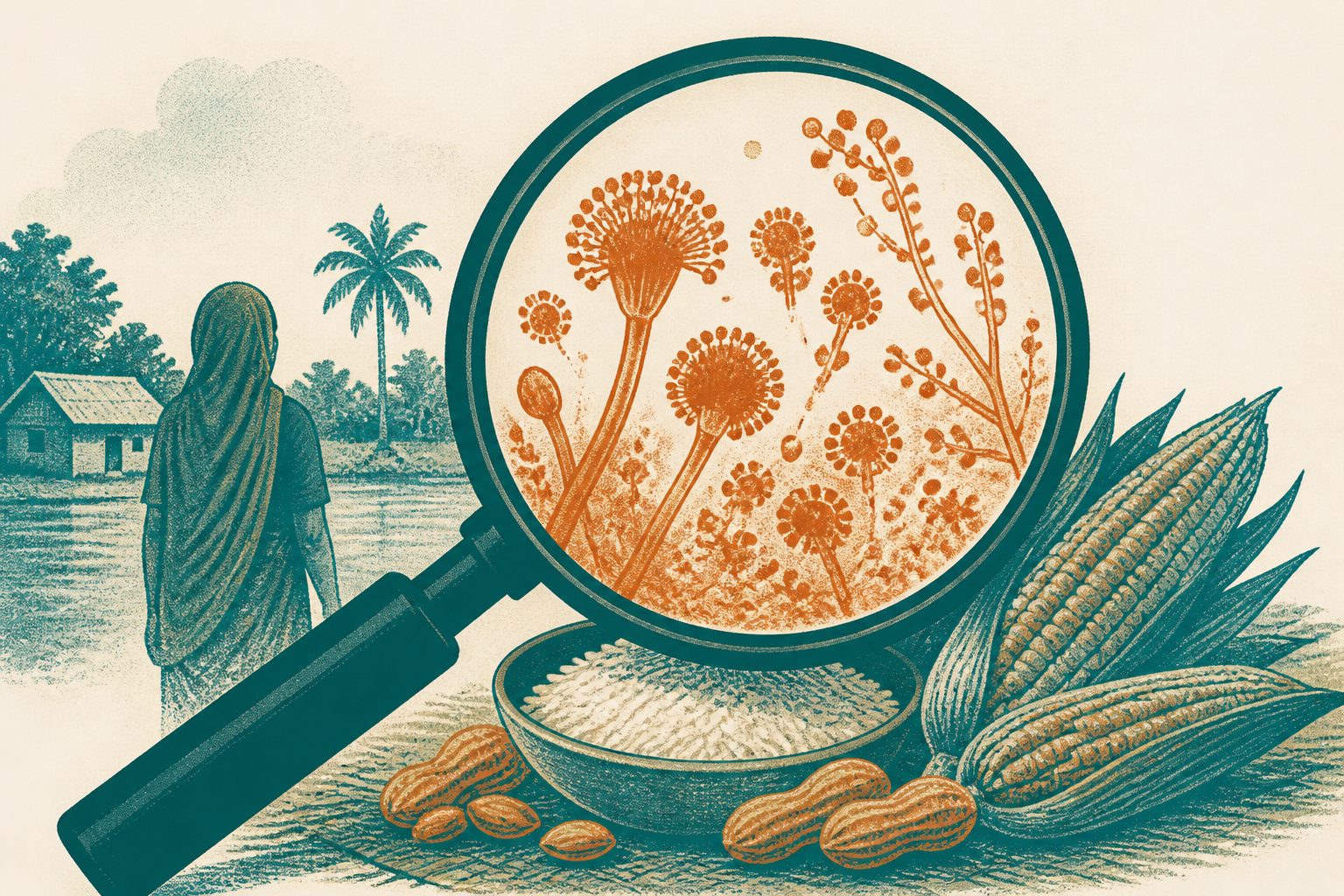
Women and children showed signs of exposure to multiple mold-made toxins, with estimated intake of some exceeding health guidance values.
Researchers analyzed blood samples collected in 2019 from 428 women and 284 children in rural Bangladesh. Every plasma sample contained at least two mycotoxins, and 84% of participants showed exposure to at least three.
Ochratoxin A and its related form appeared in nearly every sample, while citrinin and enniatin B were also frequently detected. Biomarkers of aflatoxin B1, a potent carcinogen, were found in nearly one-quarter of women and 4% of children with serum samples.
What the blood showed
The researchers tested 712 plasma samples and 578 serum samples using laboratory blood analysis. All plasma samples contained at least two mycotoxins, which are toxins made by some molds, and 84% of participants were exposed to at least three.
Ochratoxin A and its isomer 2′R-ochratoxin A were found in nearly every sample. Citrinin was detected in 91% of samples, and enniatin B in 92%. Beauvericin appeared in 6% of samples.
Aflatoxin B1-lysine, a blood marker of longer-term exposure to aflatoxin B1, was detected in nearly one-quarter of women and 4% of children with serum samples. Estimated daily intake of ochratoxin A exceeded health-based guidance values for up to 80% of women and 99% of children. Citrinin intake was considered a concern for 12% of women and 27% of children.
// Source
Environmental Health · 2026 · DOI: 10.1186/s12940-026-01330-7
Authors: Nicholas N. A. Kyei, Benedikt Cramer, Hans‐Ulrich Humpf, Michael Kuhn, Shafinaz Sobhan, Jannik Veerkamp, Sabine Gabrysch
Institutions: Berlin Institute of Health at Charité - Universitätsmedizin Berlin, Heidelberg University, University Hospital Heidelberg, University of Münster, Humboldt-Universität zu Berlin, Leibniz Association, Potsdam Institute for Climate Impact Research