
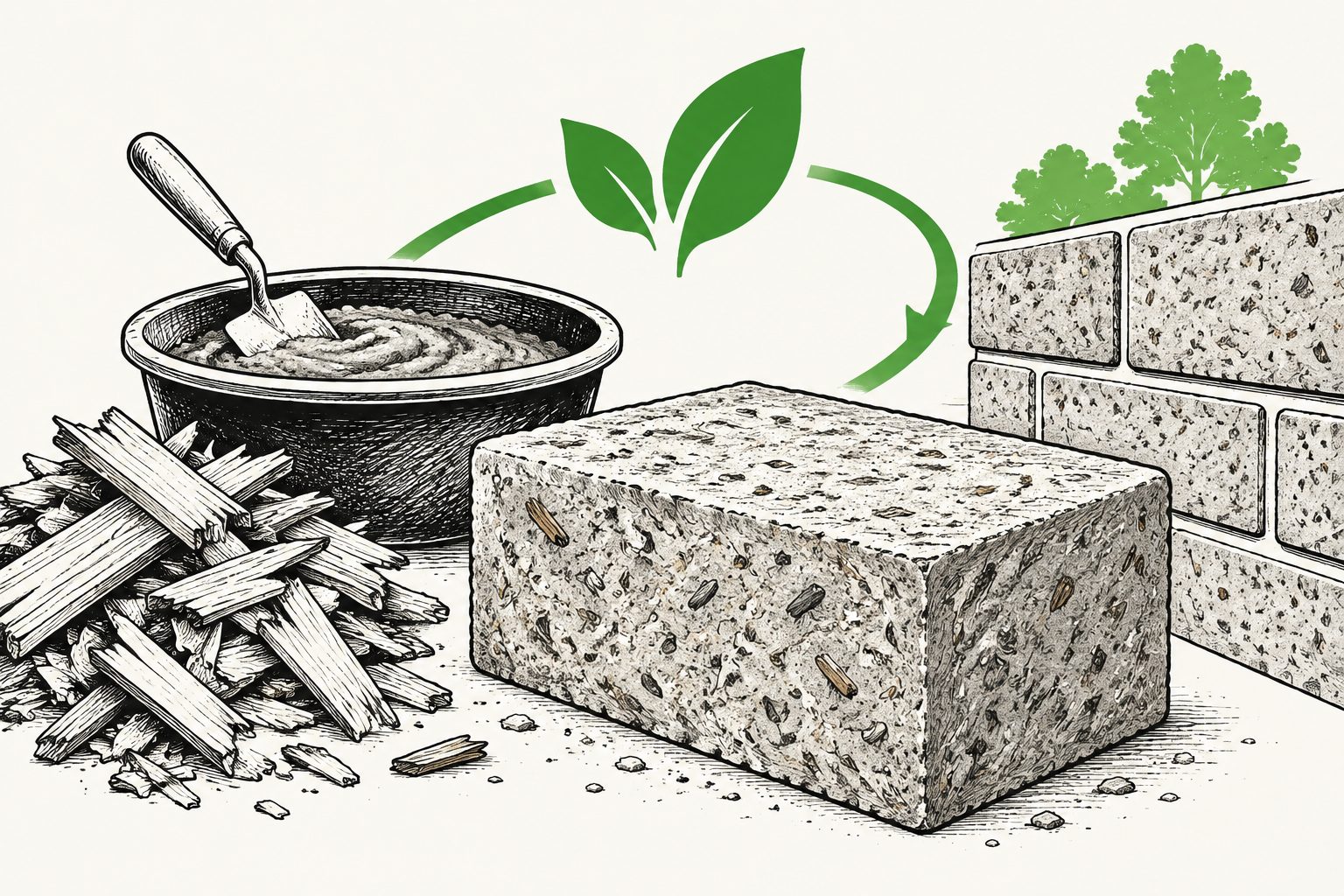
Researchers compared the environmental impacts of a conventional mortar, a mortar containing recycled wood aggregates, and a hybrid mortar in which the wood aggregates were impregnated with a bio-based phase change material. This material stores and releases heat, adding latent-heat storage to the mortar.
Engineering & Technology1 week ago
Bio-based recycled-wood mortar cuts modeled emissions by up to 82%
A life-cycle study found that adding a plant-based heat-storing material to recycled-wood mortar could lower greenhouse-gas emissions and energy demand, while sourcing choices affected land and water impacts.
What the mortar showed
In the modeled cradle-to-gate comparison, the hybrid mortar had up to 82% lower fossil greenhouse-gas emissions and 36% lower total energy demand than the conventional reference mortar. The study also normalized results by volumetric thermal capacity to compare materials in relation to their heat-storage capacity. Feedstock choice for the bio-based material changed the balance of impacts, especially for land use and water consumption.
Why the sourcing matters
The findings suggest that recycled materials can reduce the modeled environmental impacts of building mortars while also providing heat-storage functionality. They also show that the environmental profile of a bio-based ingredient depends on where its feedstock comes from, so lower emissions do not necessarily mean lower impacts across every category.
Evidence and limits
This was a cradle-to-gate Life Cycle Assessment covering production stages A1–A3, rather than a measurement of impacts from buildings in use or at end of life. The analysis used data from SimaPro and Ecoinvent and followed ISO 14044 and EN 15804. Because a public inventory for the commercial bio-based phase change material PureTemp 25 was unavailable, the researchers modeled coconut, palm, palm-kernel and soybean feedstock scenarios. They used the unweighted average of those scenarios as a central estimate; this average does not represent a physical mixture or equal proportions of oils. The results are therefore sensitive to the assumed feedstock and modeled production data.
// Source
Materials and Structures · 2026 · DOI: 10.1617/s11527-026-03301-3
Authors: Hala Salhab, Luciano Sambataro, António Caggiano, Sergio Nardini, Vincenzo Bianco
Institutions: Universidad de Buenos Aires, University of Campania "Luigi Vanvitelli", University of Genoa, Parthenope University of Naples, Sustainability Institute


