A 500,000-year dust record suggests population growth occurred during both long humid eras and shorter glacial rains.
Researchers reconstructed Arabian hydroclimate using several chemical and magnetic indicators in a high-resolution marine sediment core from the western equatorial Indian Ocean. The sediments mainly contain windblown material from the Arabian Peninsula, allowing changes in dust delivery to serve as a record of changing moisture and weathering conditions on land.
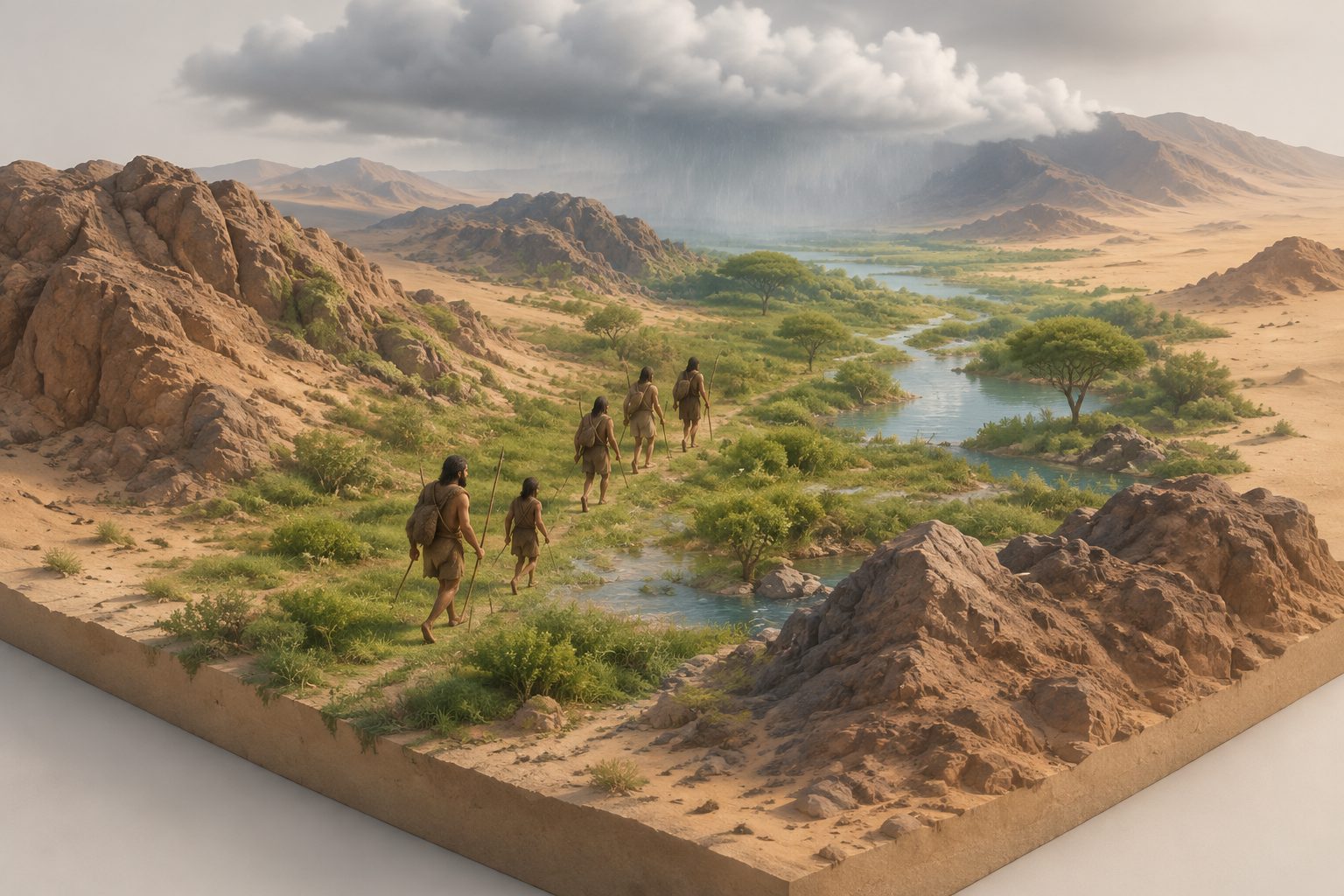
Low dust levels generally coincided with the long, wetter intervals known as Green Arabia periods. When these results were combined with hunter-gatherer demographic data, they indicated marked population expansions during prolonged wet periods. The record also identified shorter phases of intense rainfall during some glacial periods, when increased moisture availability and dust-producing material may have supported further expansions and dispersals.
Wet spells and population growth
The dust record covers about 500,000 years and shows repeated shifts between wetter and drier conditions in Arabia. The long Green Arabia periods were associated with lower dust delivery, consistent with more vegetation and stronger chemical weathering in the source regions. These wetter intervals coincided with major hominin population expansions.
The researchers also found evidence for brief, high-rainfall episodes during some glacial periods. These episodes produced unusually high dust levels, which the study links to greater moisture on land alongside a larger supply of particles that could be carried by wind. When considered with archaeological and hunter-gatherer demographic data, these episodes point to hominin expansions outside the traditionally recognized humid periods as well.
Evidence and caveats
The study is based mainly on indirect environmental evidence: a high-resolution, multi-proxy dust record from one marine sediment core in the western equatorial Indian Ocean. Its mineral and chemical signals were used to reconstruct dust from Arabia and changes in moisture and weathering over time, and the results were considered alongside archaeological evidence and hunter-gatherer demographic data.
This evidence shows associations between wetter conditions and hominin expansions; it does not directly record individual movements or establish that every wet spell led to dispersal. The researchers describe the dispersals during brief glacial wet phases as potential, and note that the environmental context of many Palaeolithic occupations remains poorly understood because long, continuous records are scarce.
// Source
Nature Communications · 2026 · DOI: 10.1038/s41467-026-78983-y
Authors: Liang Zhou, Zhaoxia Jiang, Sanzhong Li, Juan C. Larrasoaña, Andrew P. Roberts, Shi‐Xia Yang, Qingsong Liu, Liang Chen, Zhengxin Yin, Wanxin Liu, Yulong Guan, Yuzhen Zhang, Michael D. Petraglia
Institutions: Ocean University of China, The University of Queensland, Chinese Academy of Sciences, Consejo Superior de Investigaciones Científicas, Australian National University, Griffith University, Southern University of Science and Technology, Smithsonian Institution, Ministry of Natural Resources, National Museum of Natural History, Instituto Geológico y Minero de España, Laoshan Laboratory, Institute of Vertebrate Paleontology and Paleoanthropology, Universidad Pública de Navarra (UPNA), State Oceanic Administration