A search for life on rocky planets may need ultraviolet to infrared light
A study proposes that a future space telescope should cover a broad range of wavelengths to judge whether oxygen or methane could come from life.
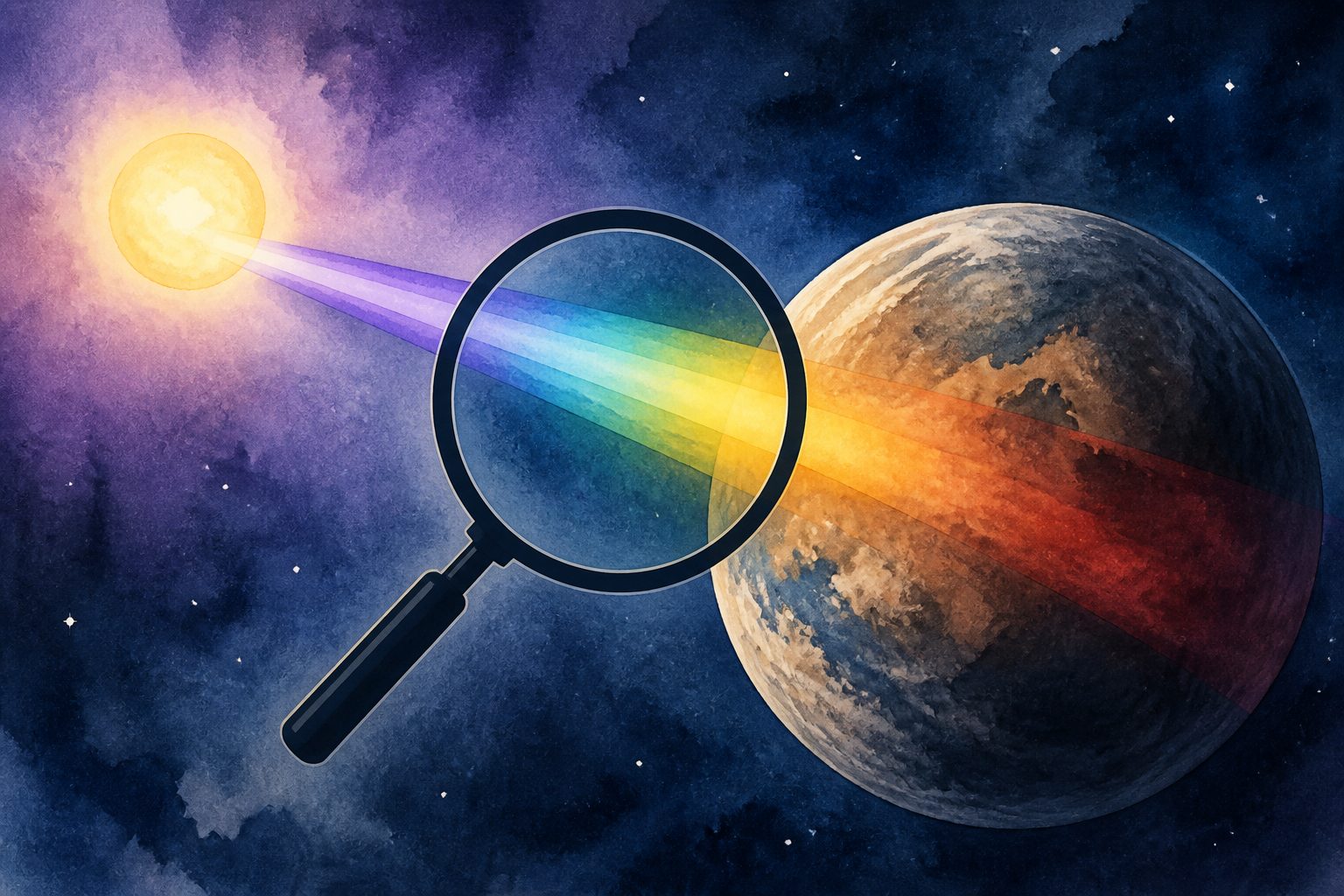
Editorial illustration — not from the study.
The study examines what a coronagraph on the proposed Habitable Worlds Observatory would need to measure when searching for life on Earth-like rocky exoplanets. It focuses on oxygen and methane, two widely discussed possible signs of life, and on the wider atmospheric and planetary context needed to interpret them.
The researchers recommend coverage from 0.26 micrometers in the near ultraviolet to 1.7 micrometers in the near infrared. They say spectra would also need signal-to-noise ratios of 20–40 across that range, with different levels of spectral detail in the ultraviolet, visible light and near infrared.
The needed light range
The researchers find that a broad wavelength range is needed to assess possible oxygen and methane biosignatures cautiously. The proposed minimum spans 0.26–1.7 micrometers, covering near-ultraviolet, visible and near-infrared light.
The short-wavelength limit is needed to identify ozone linked to biospheres resembling those on Earth during the Proterozoic Eon. The long-wavelength limit would help provide context for oxygen and methane by measuring other carbon-containing gases. The study recommends signal-to-noise ratios of 20–40 across the range, assuming spectral resolving powers of 7 in the ultraviolet, 140 in visible light and 70 in the near infrared.
Why broad coverage matters
A possible life-related gas can also be produced by chemical reactions driven by starlight or by geological processes. Broad spectral coverage would give researchers more information about a planet’s atmosphere and habitability, helping them assess whether oxygen or methane is plausible as a biological signal and examine known false-positive and false-negative scenarios.
The recommendations therefore concern more than simply detecting individual gases. They describe the range of observations the proposed observatory may need for a cautious search for Earth-like life on rocky exoplanets, if such measurements can be made for a statistically meaningful number of targets.
Evidence and caveats
This is a study of observatory and coronagraph requirements, based on examining how different wavelengths could help assess habitability and possible oxygen and methane explanations. It does not report a detection of life or a test of the proposed telescope in operation.
The authors state that the recommended capabilities would not unambiguously identify every Earth-analog biosignature or false positive. The plausibility of many false-positive scenarios and their atmospheric clues remains an active area of research. The conclusions also assume that the proposed observations are achievable for enough suitable targets to support a meaningful survey.
Chanel’s lipstick range expanded from 12 colors in 1960 to 55 in 2005 before contracting, according to a study of archived color charts. Across the years, yellow-leaning reds remained common, while very dark shades became more prominent after 1972.
A theoretical study proposes an experiment in which a mass placed in a quantum superposition could produce an effectively repulsive gravitational effect on another particle. The effect would arise from quantum interference and, if observed, would conflict with general relativity’s description of gravity as always attractive.
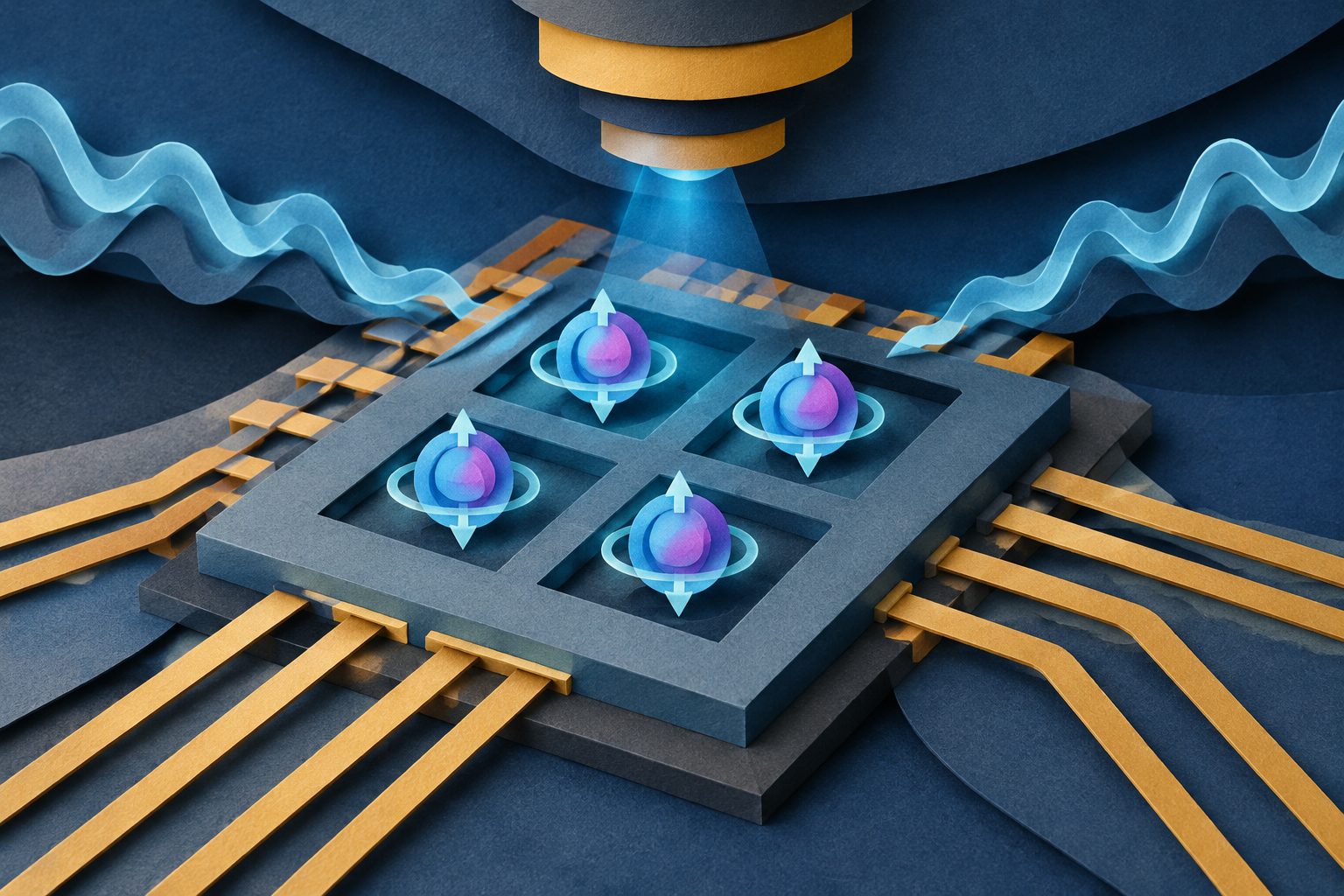
Researchers report that silicon spin qubits can perform precise operations in parallel, overcoming a major source of error during simultaneous control. In a five-qubit array, gate fidelities stayed above 99.99% for up to three qubits and above 99.9% when all five operated together.