Suicide attempts may link depressive symptoms in older Korean adults
A study found that suicide attempts occupied a potentially bridging position among depressive symptoms, although their importance differed by measure.
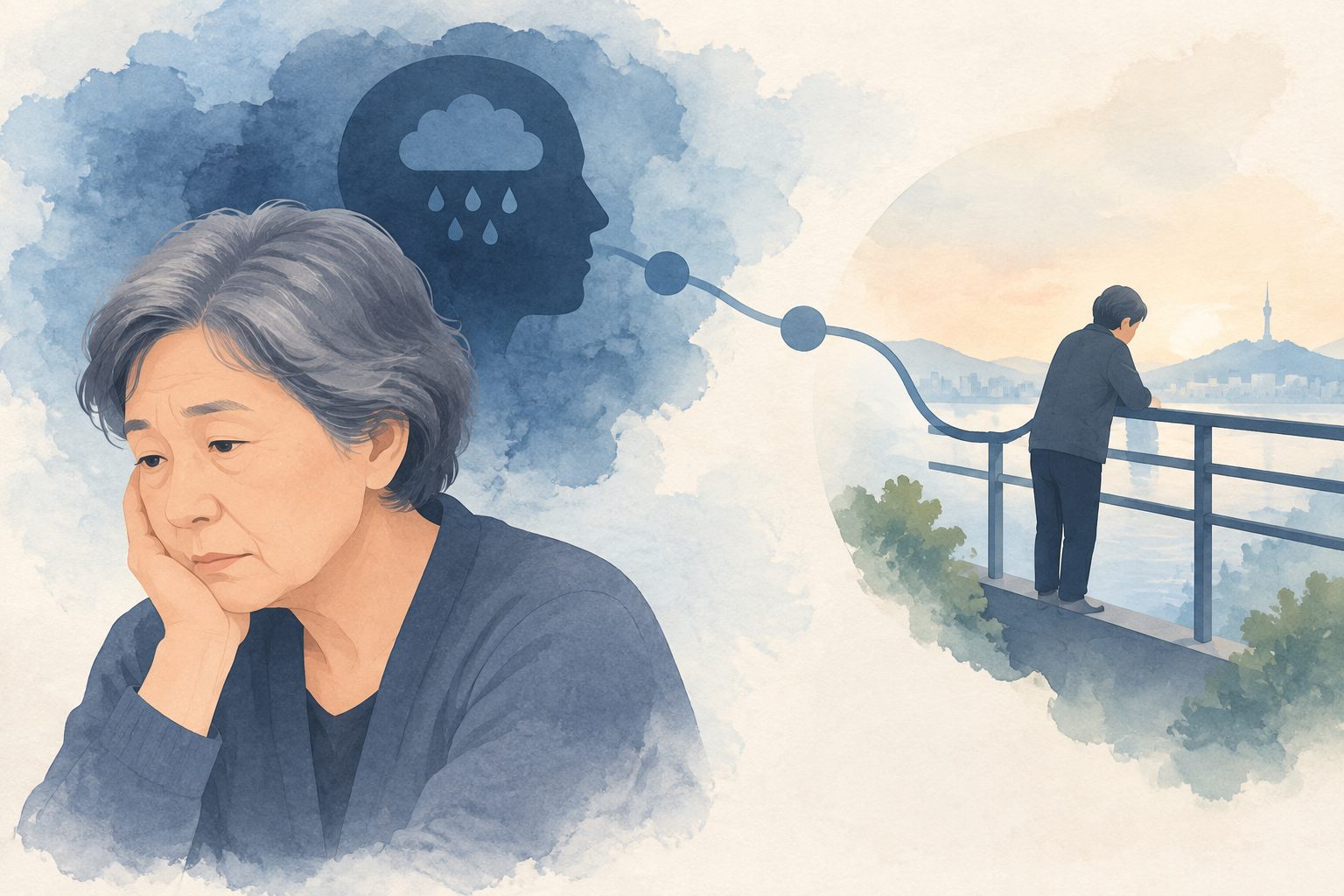
Editorial illustration — not from the study.
Researchers analyzed 16 depression symptoms reported by adults aged 65 and older in five South Korean regions. They identified two broad symptom groups: one involving affective and physical symptoms, and another involving atypical and suicide-related symptoms.
Suicide attempt had relatively high betweenness centrality, a measure of how often a symptom lies between other symptoms, and high predictability. Low energy, reduced self-confidence and concentration difficulties were also prominent by some measures. The network appeared denser among women, especially around suicide-related symptoms, but the study did not formally test whether the sex-specific networks differed.
How symptoms connected
The analysis identified two symptom clusters. One mainly included affective and physical symptoms such as depressed mood, low energy and appetite or weight loss. The other included atypical and suicide-related symptoms, including sleeping more, appetite or weight gain, suicidal thoughts and suicide attempts.
Suicide attempt showed relatively high betweenness centrality and predictability, suggesting that it may connect different parts of the symptom network and be closely related to neighboring symptoms. However, it appeared relatively peripheral in the network visualization and was not uniformly central across all measures. Low energy, reduced self-confidence and concentration difficulties had high degree and closeness centrality, meaning they were connected to many other symptoms or were relatively close to them in the network.
The network among female participants appeared denser, particularly around suicide-related symptoms. Older female participants also had higher symptom prevalence and a slightly higher mean age than the comparison group, according to the abstract.
Why the pattern matters
The findings suggest that depressive symptoms in older Korean adults do not all occupy the same role in relation to one another. Suicide-related symptoms may connect otherwise separate parts of the symptom pattern, while symptoms such as low energy, low self-confidence and concentration difficulties may be more broadly connected.
This supports paying attention to individual symptoms, sex-related differences and cultural context when considering screening and interventions for depression in later life. The study does not show that one symptom causes another or establish how well these patterns apply outside the populations studied.
Evidence and caveats
The study used data from a 2008 population-based survey of community-dwelling adults aged 65 or older in five South Korean regions. Researchers analyzed 16 binary, DSM-IV-defined symptoms from structured diagnostic interviews in 2,007 participants using symptom-network methods, including measures of connectivity, clustering and predictability.
Because the data were collected at one time, they cannot establish causal or time-ordered relationships among symptoms. Converting symptoms into present-or-absent categories may have missed milder experiences. The network analysis was exploratory and needs replication in longitudinal and clinical samples. The participants came from only five regions and were community-dwelling, so the findings may not generalize to institutionalized adults or people with severe medical conditions. The data also used diagnostic criteria from 2008, and differences between male and female networks were not formally tested.
People have fished for tuna for about 44,000 years and billfish for about 10,000 years, according to a global review of archaeological evidence. But sustained, intensive fishing in offshore and oceanic waters appears to have developed mainly during the past 200 years.
People considering whether to leave flood-prone coastal communities weigh disastrous flooding and rising costs alongside crime, healthcare and proximity to family and friends. In a survey of 182 respondents, most said they would not relocate, while others said they would move immediately or in the future.
A study of eight managers found that they preferred human coaches for reflective questioning, even though they welcomed that approach from a person. When the same coaching protocol came from an AI system, they wanted it to provide answers instead.