In a southern German drinking-water protection area, low-yield zones had more nitrogen left over and higher modeled nitrate levels than high-yield zones.
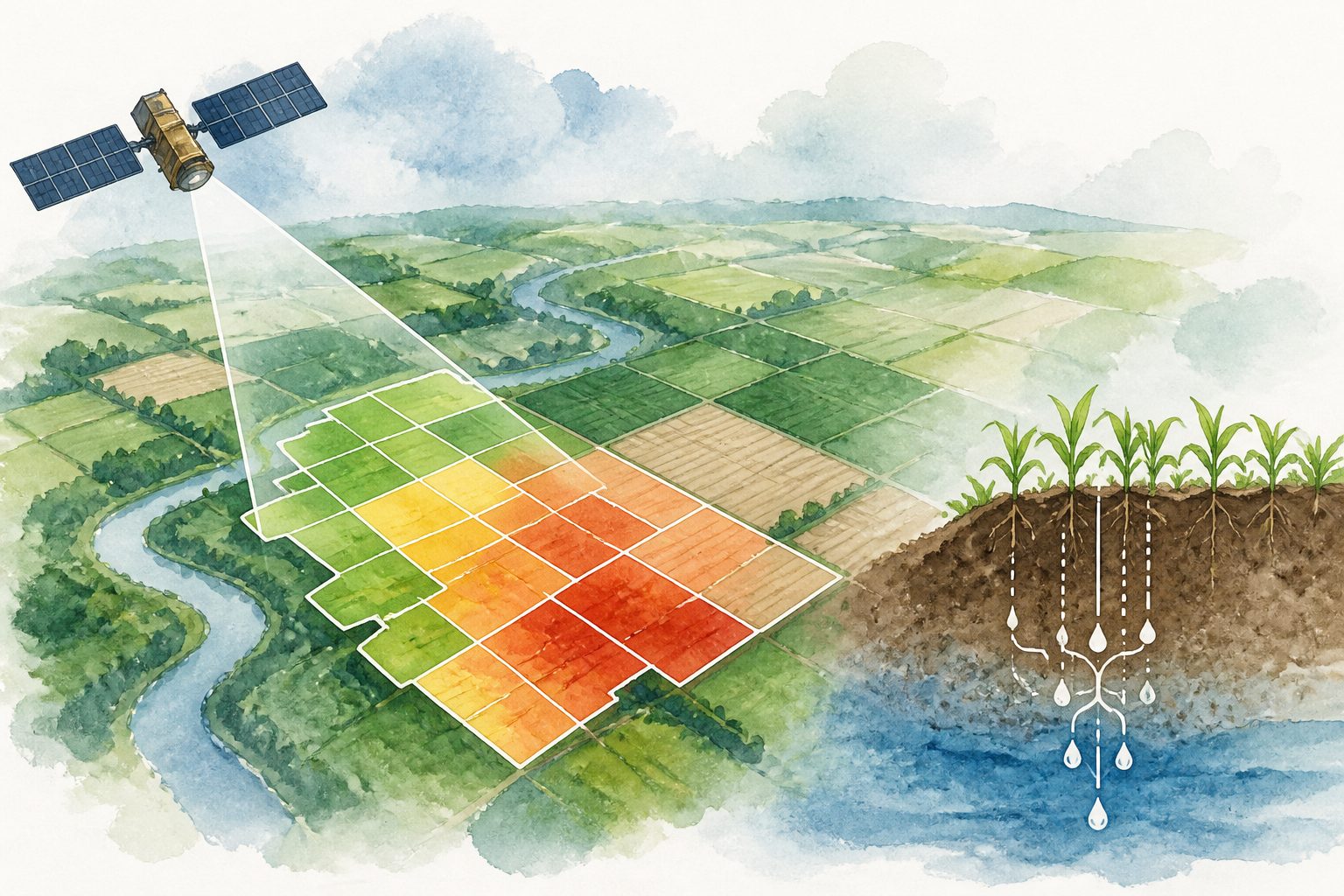
Researchers developed a framework to identify parts of fields that may contribute disproportionately to nitrate leaching. They used Sentinel-2 satellite images and information about soil, terrain, climate and fertilizer use to estimate how much nitrogen winter wheat absorbed in southern Germany.
Those estimates were combined with field-specific nitrogen balances and a model of water and nitrate movement through soil. In the validation field, low-yield zones had a nitrogen surplus of 98 kilograms per hectare and modeled nitrate concentrations of 120 milligrams per liter in seepage water, compared with 33 kilograms per hectare and 49 milligrams per liter in high-yield zones.
Where nitrate loss was highest
The satellite-based Random Forest model estimated wheat nitrogen uptake somewhat more accurately than a multiple linear regression model. It explained 74% of the variation in nitrogen uptake, with a root-mean-square error of 14.8 kilograms per hectare and a mean absolute error of 11.2 kilograms per hectare. The linear regression model explained 70% of the variation, with errors of 16.0 and 12.5 kilograms per hectare, respectively.
Across the mapped field areas, low-yield zones had lower nitrogen uptake but higher nitrogen surpluses, modeled nitrate leaching and measured nitrate–nitrogen stocks in deeper soil layers than high-yield zones. In Field A, modeled nitrate concentrations were 120 milligrams per liter in seepage water in low-yield zones and 49 milligrams per liter in high-yield zones. The modeled concentrations were associated with measured nitrate–nitrogen stocks, with an R² value of 0.68.
Evidence and caveats
This was a modeling and validation study based on georeferenced plots, Sentinel-2 satellite data, farm fertilization records and measurements of nitrate–nitrogen in deeper soil layers. The Random Forest estimates were tested against observed nitrogen uptake, and the nitrate model was checked against measured soil nitrate stocks; the reported validation for nitrate concentrations was from Field A.
The abstract does not give the number of fields or plots, and it does not establish how well the framework would work in other regions, crops, soils or seasons. The reported nitrate concentrations in seepage water were modeled values, while the comparison for model performance used measured nitrate–nitrogen stocks in deeper soil layers.