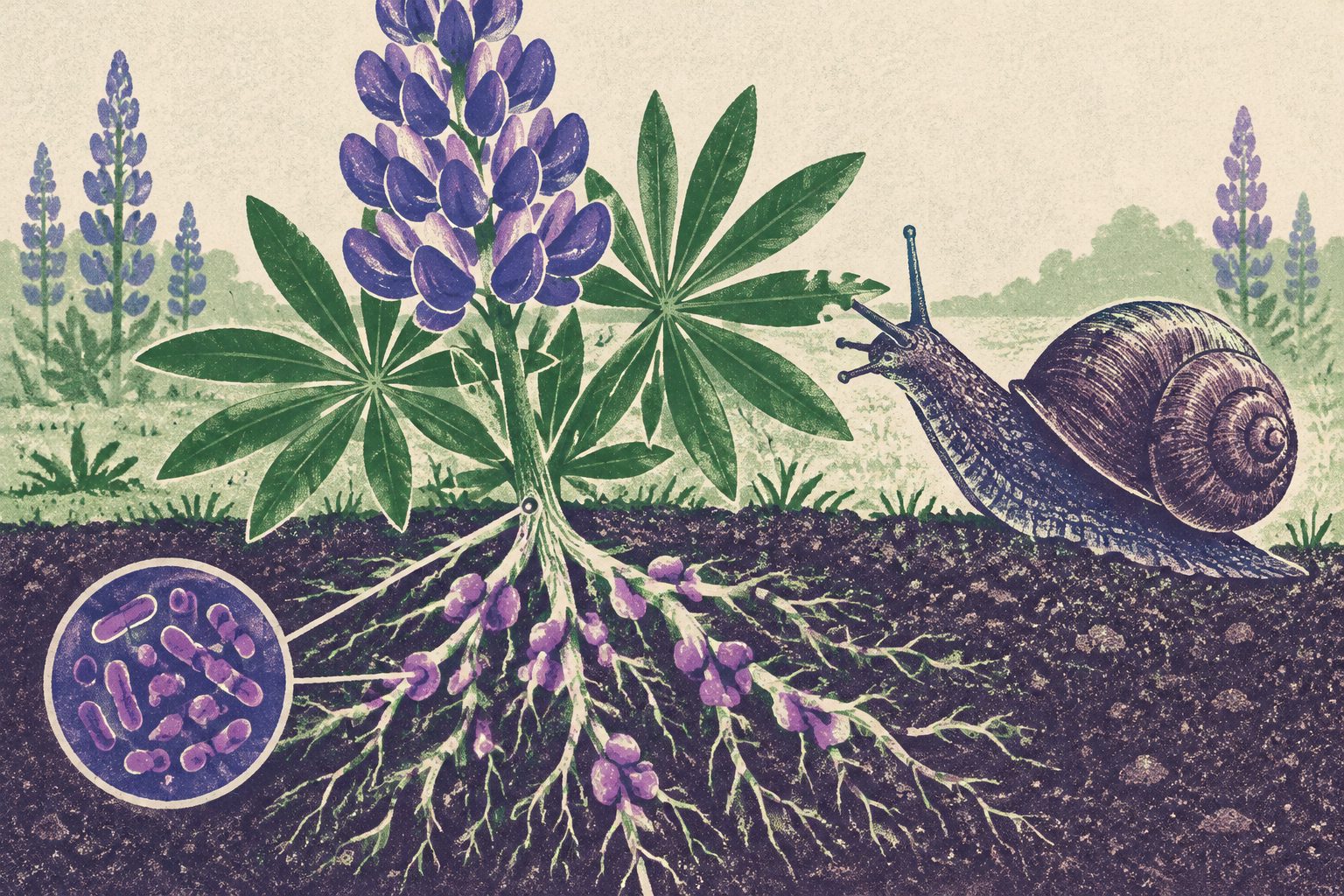
In a greenhouse study, rhizobia were linked to higher chemical defenses in Lupinus polyphyllus and greater resistance to snail herbivory.
Researchers grew Lupinus polyphyllus plants from native and invasive populations with either untreated or sterilized soil inoculum collected from three invasive sites. They measured growth, root nodules, leaf quinolizidine alkaloids—chemical compounds involved in plant defense—and resistance to the snail Arianta arbustorum.
Plants with more nodules had higher levels of leaf alkaloids, and higher alkaloid levels were associated with greater resistance to snail feeding. The source of the soil inoculum had small but detectable effects on some growth traits and total alkaloids, while invasive-origin plants outperformed native-origin plants in most measured traits.
How root bacteria changed defense
Nodulation positively influenced the amount of quinolizidine alkaloids in leaves, and plants with more of these chemicals showed greater resistance to snail herbivory. The researchers conclude that rhizobia improve chemical defenses, probably by increasing the nitrogen available to the plant.
Plants from invasive populations had greater growth, more nodules, higher total alkaloid levels and stronger resistance to snails than plants from native populations. Leaf alkaloid composition differed between native- and invasive-origin plants and also varied among leaves, roots and nodules. Soil inoculum source had detectable but small effects on plant height, leaf number and total alkaloids.
Evidence and caveats
This was a controlled greenhouse experiment using Lupinus polyphyllus from native and invasive populations and soil inocula from three invasive sites. It measured plant traits, nodulation, leaf chemicals, snail resistance and soil bacterial communities, allowing the researchers to examine links among these factors.
The results come from greenhouse conditions rather than field populations, and the abstract does not report sample sizes or effect sizes. The proposed role of increased nitrogen availability was not directly demonstrated in the reported measurements. The study therefore provides mechanistic evidence for a microbe–plant–herbivore interaction, but its relevance across other soils, herbivores and environments remains uncertain.