Review finds uncertain link between artificial sweeteners and bladder cancer
A pooled analysis found a small overall association, but high study variation and possible publication bias limit confidence in the result.
Moderate evidenceReviewInterpret with caution
Medical disclaimer: This article summarizes research findings and is for informational purposes only. It is not medical advice.
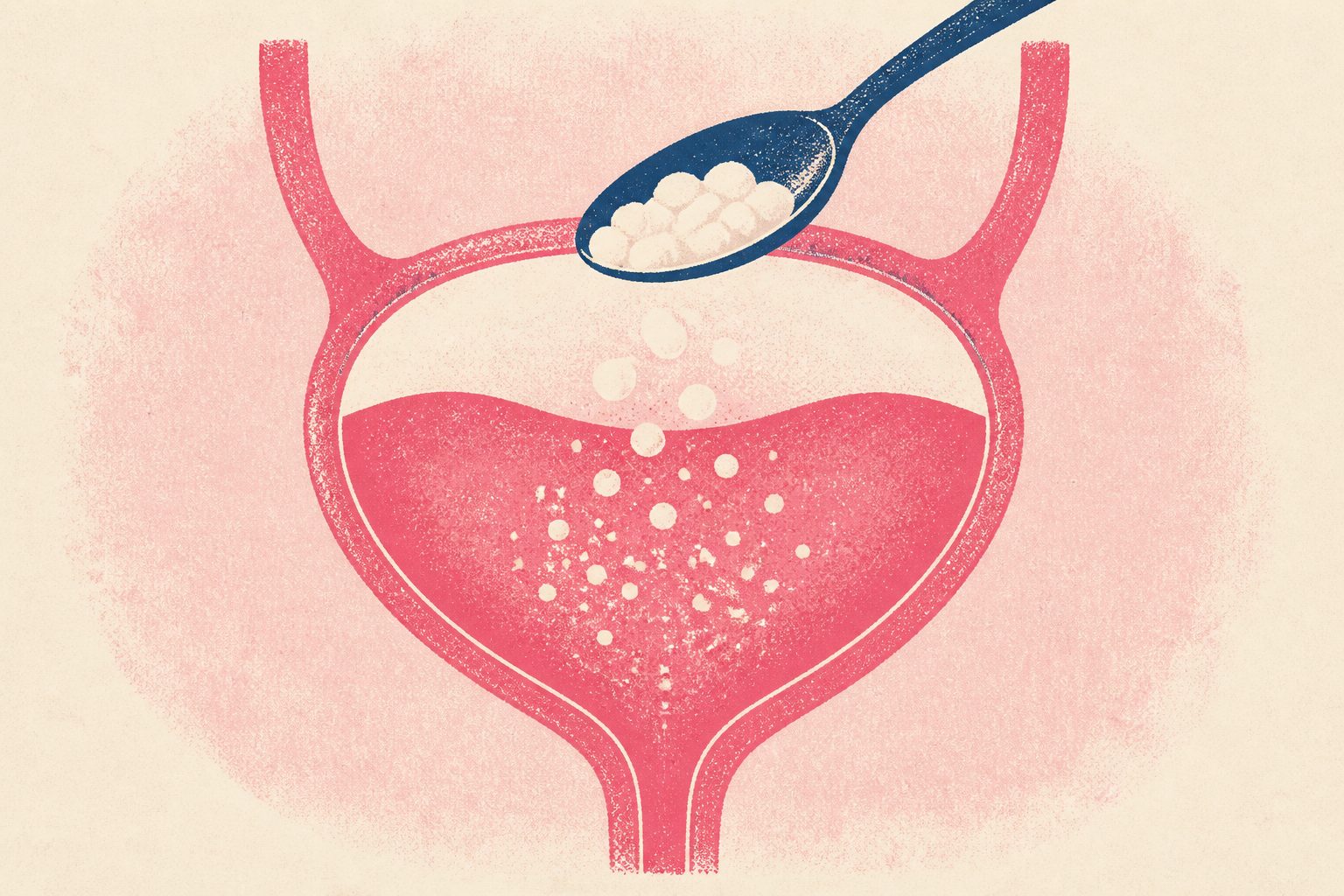
Editorial illustration — not from the study.
The review included 7,079 people with bladder cancer and 15,359 comparison participants. Overall, artificial sweetener use was associated with higher odds of bladder cancer, but the confidence interval reached 1.00, and the amount of variation between studies was very high.
When results were examined separately by sex, the increases were not statistically significant for either women or men. The authors also found evidence suggesting that smaller or selectively published studies may have influenced the overall result, and they called for further prospective research.
The question reviewed
The researchers conducted a systematic review and meta-analysis of observational studies published through June 2025. They searched PubMed, Embase, CENTRAL, and Web of Science, screened 1,312 records, and included 17 studies in the quantitative analysis. The studies together involved 22,438 participants: 7,079 people with bladder cancer and 15,359 controls. A random-effects statistical model was used to estimate the pooled association between artificial sweetener consumption and bladder cancer, with additional analyses by sex and tests for publication bias.
What the evidence shows
Across all included studies, artificial sweetener use was associated with higher odds of bladder cancer, with an odds ratio of 1.24 and a 95% confidence interval of 1.00 to 1.53. Because the interval reached 1.00, this result is borderline and should not be treated as clear evidence of an association. The studies showed very high heterogeneity, meaning their results differed substantially from one another, with I² of 91.43%.
The sex-specific analyses did not show statistically significant associations: the odds ratio was 1.06 for women, with a 95% confidence interval of 0.85 to 1.34, and 1.12 for men, with a 95% confidence interval of 0.82 to 1.54. Statistical tests indicated potential publication bias overall and among men, but not among women. These findings are observational associations and cannot establish that artificial sweetener consumption causes bladder cancer.
Who this may apply to
These findings may be relevant only to human populations reasonably similar to those represented in the 17 included observational studies. The abstract does not provide enough information to identify specific age groups, countries, consumption levels, or other groups to whom the results may apply. The findings do not establish risk for any particular individual and should not be interpreted as showing that artificial sweeteners cause bladder cancer. Further prospective studies are needed to clarify the relationship.
The significance
Bladder cancer and artificial sweetener use are questions of human health, so the topic may be relevant to the general public. However, the evidence is uncertain: the overall estimate was borderline, study results varied greatly, and possible publication bias could have affected the pooled result. The analysis does not determine whether artificial sweeteners cause bladder cancer, and it does not establish a specific risk for women or men.
Limitations & evidence assessment
The evidence came from observational studies rather than randomized trials, so differences between people who did and did not consume artificial sweeteners could explain part or all of the association. The analysis had very high heterogeneity, indicating substantial disagreement among the included studies. The authors found potential publication bias overall and among men, which means the available studies may not represent all relevant research. The abstract does not provide enough detail to assess the individual studies' methods, how artificial sweetener exposure was measured, or whether other bladder-cancer risk factors were fully accounted for. The total participant count was 22,438, but the number and quality of studies—not just the combined sample size—limit certainty.
Why this evidence level: This is a systematic review and meta-analysis of 17 observational studies, which combines evidence from human research. However, the results had very high variation between studies and signs of publication bias, so the findings do not establish that artificial sweeteners cause bladder cancer.
Evidence levels are editorial estimates derived from study metadata — they are not clinical appraisals.
// Source
Journal of Korean Medical Science · 2026 · DOI: 10.3346/jkms.2027.42.e2
This review examined human clinical evidence about GLP-1 receptor agonists and neovascular age-related macular degeneration, sometimes called wet age-related macular degeneration, in people with type 2 diabetes. The reviewed studies had conflicting results: one reported higher risk, another lower risk, and two large comparisons found no significant increase. The evidence is observational and does not show that these medicines cause or prevent the eye condition.
A prospective, multicenter phase II trial examined whether removing only the treated tumor area through the anus could preserve the rectum in people with locally advanced rectal cancer who responded well to chemoradiotherapy. Among 80 participants, three-year disease-free survival was 84.8%, and local recurrence occurred in 5.0% during the reported follow-up. Because everyone received local excision and there was no comparison group, the findings do not establish that this approach is as effective as more extensive surgery.
This retrospective human study compared a visual CT scoring method with an automated computer analysis for tracking fibrosing interstitial lung disease. Among 92 people followed with CT scans and lung-function tests, both approaches were associated with changes in lung function and signs of disease progression. The study does not show that either method improves treatment or patient outcomes.