Review examines lung disease linked to artificial-stone dust
Studies describe relatively young workers diagnosed with silicosis, while highlighting gaps in early detection, prevention, and prognosis.
High evidenceReviewSome caution advised
Medical disclaimer: This article summarizes research findings and is for informational purposes only. It is not medical advice.
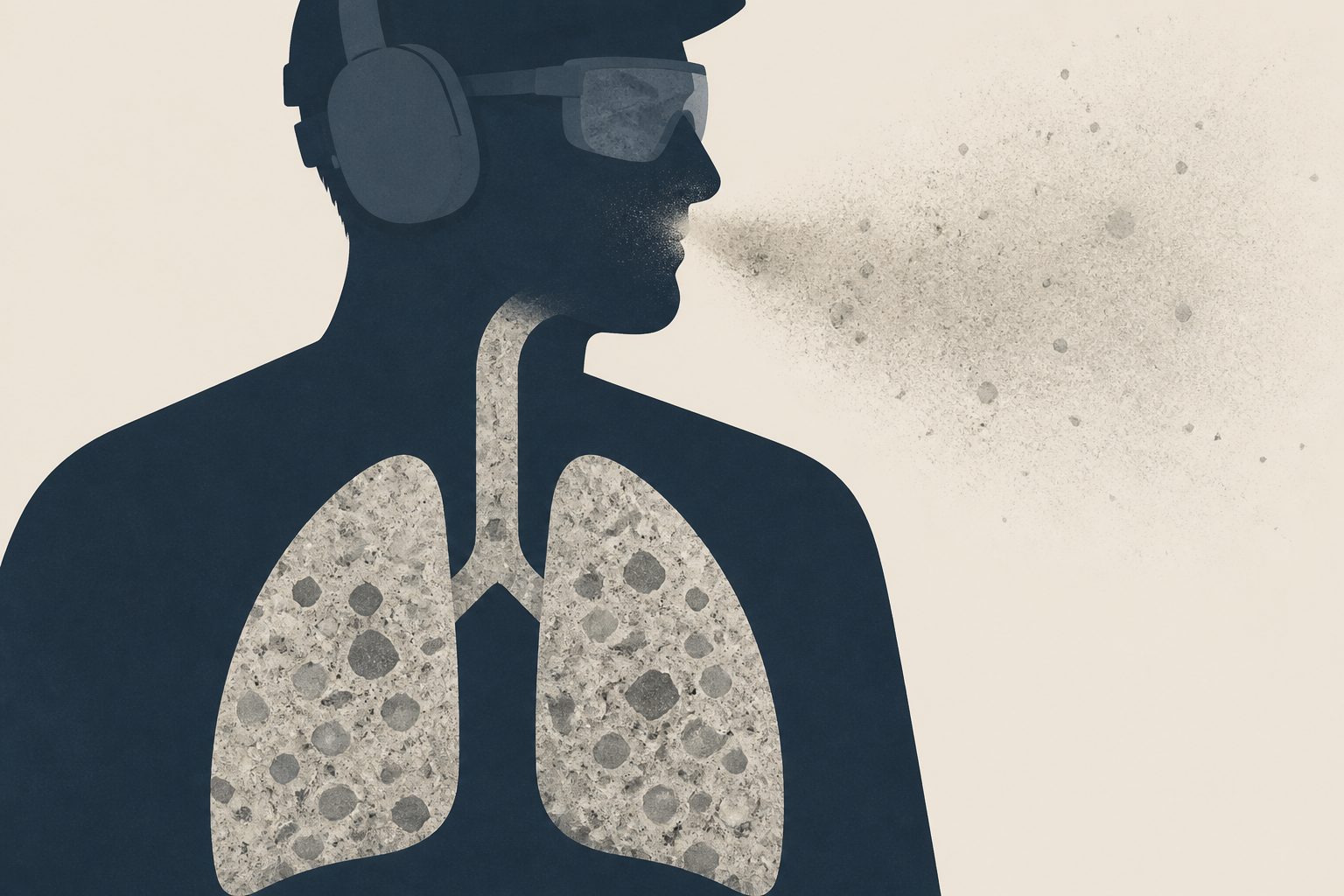
Editorial illustration — not from the study.
Researchers searched PubMed and Scopus for studies on artificial stone silicosis and summarized findings available at diagnosis. The review included reports describing workers' ages, exposure duration, symptoms and clinical findings, lung-function results, imaging, and workplace dust controls.
The patients described were relatively young at diagnosis, with a reported average age of 41.9 years and average exposure duration of 13.5 years. More than half of the reported cases had abnormal pulmonary function, but no reliable biomarker for screening was identified. The review also found limited objective information about workplace dust control and described several important unanswered questions.
What the review covered
The researchers conducted a systematic review using PubMed and Scopus and reported following PRISMA guidelines. They examined studies involving people affected by artificial stone silicosis, focusing on characteristics at diagnosis, including clinical findings, pulmonary function, chest imaging, occupational exposure, and workplace conditions. The abstract does not state the total number of patients represented across the studies or provide enough detail about the designs and quality of each included study.
What the review concluded
Among the analyzed reports, patients were diagnosed at a mean age of 41.9 ± 5.6 years after a mean exposure duration of 13.5 ± 4.1 years. Pulmonary function was reported as normal in 53.4% of cases at diagnosis. Among cases with abnormal respiratory measurements, reduced carbon-monoxide lung diffusion capacity, known as DLCO, was most common at 39.2%, followed by a restrictive pattern on spirometry at 33.3%.
Simple silicosis was the most common imaging finding, but an estimated 28.6% ± 15.5% of patients had severe disease involving progressive massive fibrosis. The review found no reliable biomarker for effective screening. The few industrial-hygiene studies that included objective measurements all reported inadequately controlled dust emissions and limited education about safe work practices. These findings describe patterns in the reviewed reports and do not establish that any single exposure or workplace factor caused an individual case.
Who this is relevant to
These findings may be relevant to workers with occupational exposure to dust from artificial-stone fabrication and to researchers or occupational-health professionals studying this disease. They do not necessarily apply to every worker, every artificial-stone product, or people without similar exposure, and the review does not establish individual risk or a diagnosis. Because this was a review of existing human studies rather than a new controlled clinical study, its findings describe reported patterns and knowledge gaps rather than providing individualized medical conclusions.
The significance
Artificial stone silicosis can affect workers during artificial-stone manufacturing or fabrication and may be diagnosed in relatively young adults. The review suggests that standard lung-function testing and chest radiography may not identify all disease early, but it does not establish which alternative tests would work or whether any screening approach improves health outcomes. The findings support the need for better information about workplace exposure assessment, prevention, early diagnosis, prognosis, and possible replacement materials; they do not by themselves show that a particular intervention or material is effective.
Limitations & evidence assessment
The abstract does not report the total number of patients, the number of included studies in detail, or how the quality and differing methods of those studies were assessed. The evidence summarized in a review may be affected by limitations, selection, or inconsistency in the underlying reports, and the abstract does not establish that the included evidence was comparable enough for all percentages to be interpreted as pooled estimates. Only PubMed and Scopus were searched, and objective workplace-hygiene data were available from few studies. The review also identifies major gaps: no reliable screening biomarker, limited evidence about effective preventive measures, and insufficient knowledge about prognosis and early disease.
Why this evidence level: Systematic review aggregating primary studies with explicit methodology.
Evidence levels are editorial estimates derived from study metadata — they are not clinical appraisals.
// Source
American Journal of Industrial Medicine · 2026 · DOI: 10.1002/ajim.70142
This systematic review examined randomized human trials of concurrent chemotherapy and radiation for locally advanced head and neck, cervical, esophageal, and non-small-cell lung cancers. Across the included trials, combined treatment was reported to provide better overall survival than radiation alone, but it also caused more severe short-term side effects. The review did not provide enough information in its abstract to show how many trials or patients were included.
Researchers pooled results from seven human studies comparing multiple-staged with single-stage removal and reconstruction of congenital melanocytic nevi, sometimes called congenital moles. Staged surgery was associated with fewer major wound complications and recurrences, as well as slightly shorter and narrower scars, but the studies did not find a clear difference in cosmetic or overall patient satisfaction.
A cluster-randomized human study in 210 adults with recently detected stage 1 hypertension in Uzbekistan compared salt-sensitivity testing followed by assigned medication choices with conventional management. After 12 weeks, more participants in the testing-guided group reached the study's blood pressure target, although the study was small, short, and conducted in only three primary care centers.