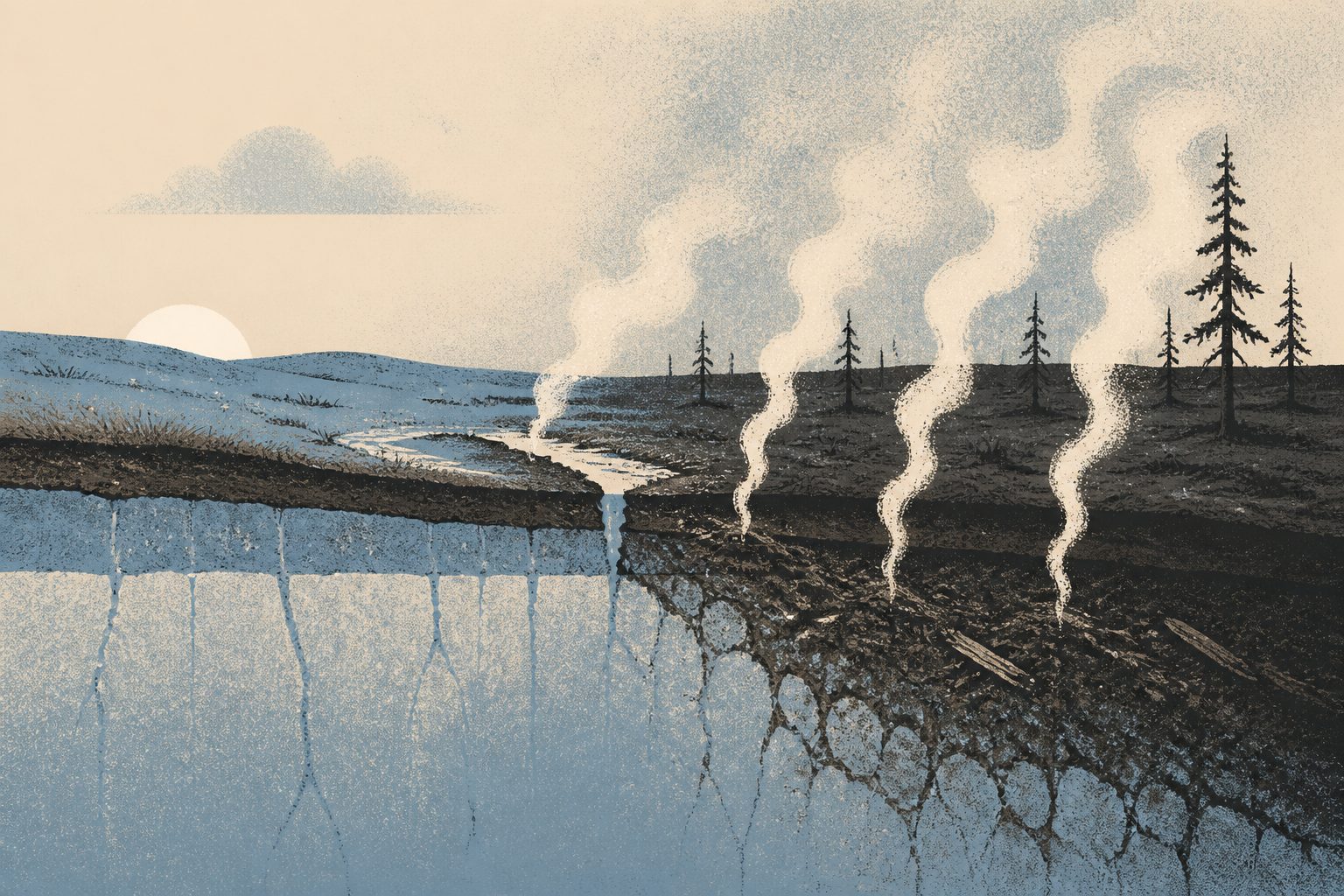
Model experiments show that cooling the climate does not immediately restore all the frozen water and carbon-bearing soil lost from thawed permafrost.
Researchers used an Earth system model to examine what happens to Northern Hemisphere permafrost when carbon dioxide emissions first increase and then fall. In idealized scenarios, the ground’s temperature and permafrost area did not respond in exactly the same way during cooling as during warming.
Some deep-soil changes persisted even after ground temperatures returned close to their starting values. The model also found that carbon released during this delayed recovery amounted to about 0.6%–41% of the carbon released from thawed permafrost in two of the scenarios examined.
How thawed soil recovers
The model showed that permafrost area eventually responded reversibly to warming and cooling, but the path back differed from the path during warming. This lag is known as hysteresis. In deep soil, some changes were irreversible: after ground temperature returned almost to its initial level, part of the originally frozen area had become a mixture of liquid water and ice rather than returning fully to its earlier state.
The researchers attributed the lag and persistent changes to delays in soil freezing and melting, linked to the soil’s ability to conduct heat and to the heat absorbed or released when water changes phase. The model indicated that thawed permafrost could continue warming and releasing carbon for decades after warming diminished. Recovery was slower at warming levels above 2 °C. In two experiments, the extra carbon dioxide released during this delayed cycle represented about 0.6%–41% of the cumulative carbon released from thawed permafrost.