Researchers tracked eye movements in two experiments while adults remembered naturalistic images across a three-second delay. A cue told participants whether a later image would test precise visual details or the broader category of the remembered scene.
Biology2 weeks ago
People’s eyes retraced natural scenes held in mind
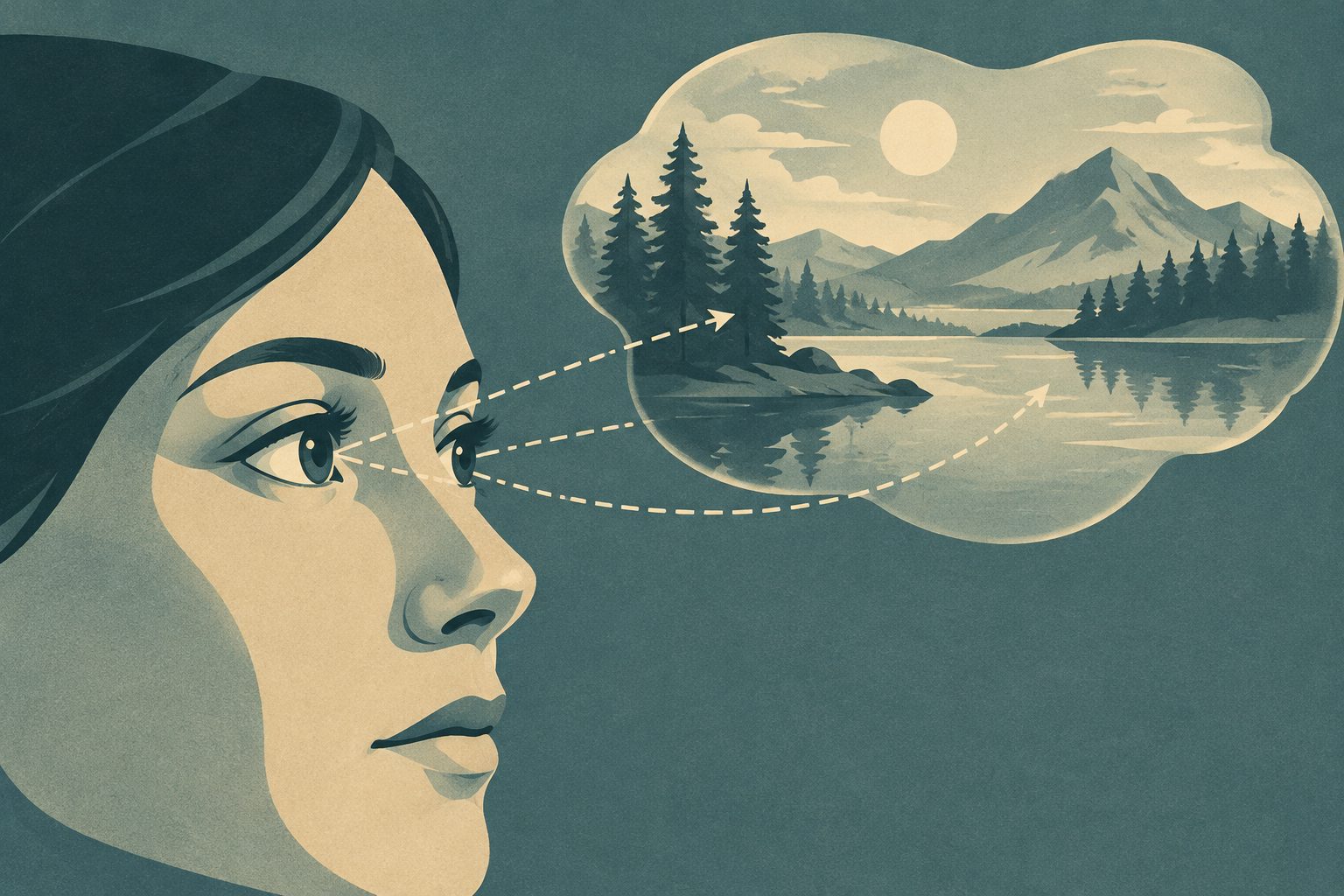
Eye movements repeated image-specific viewing patterns while people remembered complex scenes for a few seconds.
Eyes retraced remembered scenes
During the delay, participants’ eyes produced complex sequences that matched the way they had looked at the same image during encoding. This “gaze reinstatement” showed that eye movements carried information about which natural scene was being held in working memory, rather than only indicating a simple location or shape. The effect was stronger when participants had to remember visual detail instead of just the image category. Gaze representations also became more distinct as the test approached, suggesting that eye-related memory signals changed in anticipation of how the information would be used. The study reported an average task accuracy of 90.49%.
Memory reaches the eyes
The findings suggest that working memory is reflected not only in brain activity but also in the movements of the eyes. They extend evidence for eye-based memory signals from simple visual features to intricate patterns linked to real-world scenes, and show that these signals can adapt to the demands of an upcoming task.
What the study can show
The evidence comes from two controlled eye-tracking experiments involving adults with normal or corrected vision. The precue experiment recruited 42 participants and the retrocue experiment recruited 41; one participant in the precue experiment was excluded for data quality. Participants remembered researcher-selected naturalistic images for a few seconds and completed a match-or-non-match test, so the results show eye-movement associations during this task rather than proving that gaze reinstatement itself causes better memory. The study also does not establish how broadly the findings apply beyond this adult sample and laboratory task.
// Source
Journal of Neuroscience · 2026 · DOI: 10.1523/jneurosci.2151-25.2026
Authors: Yueying Dong, Lana Gaspariani, Anastasia Kiyonaga
Institutions: University of California San Diego