A model projects sharply different futures for the icefield under low- and high-emissions pathways.
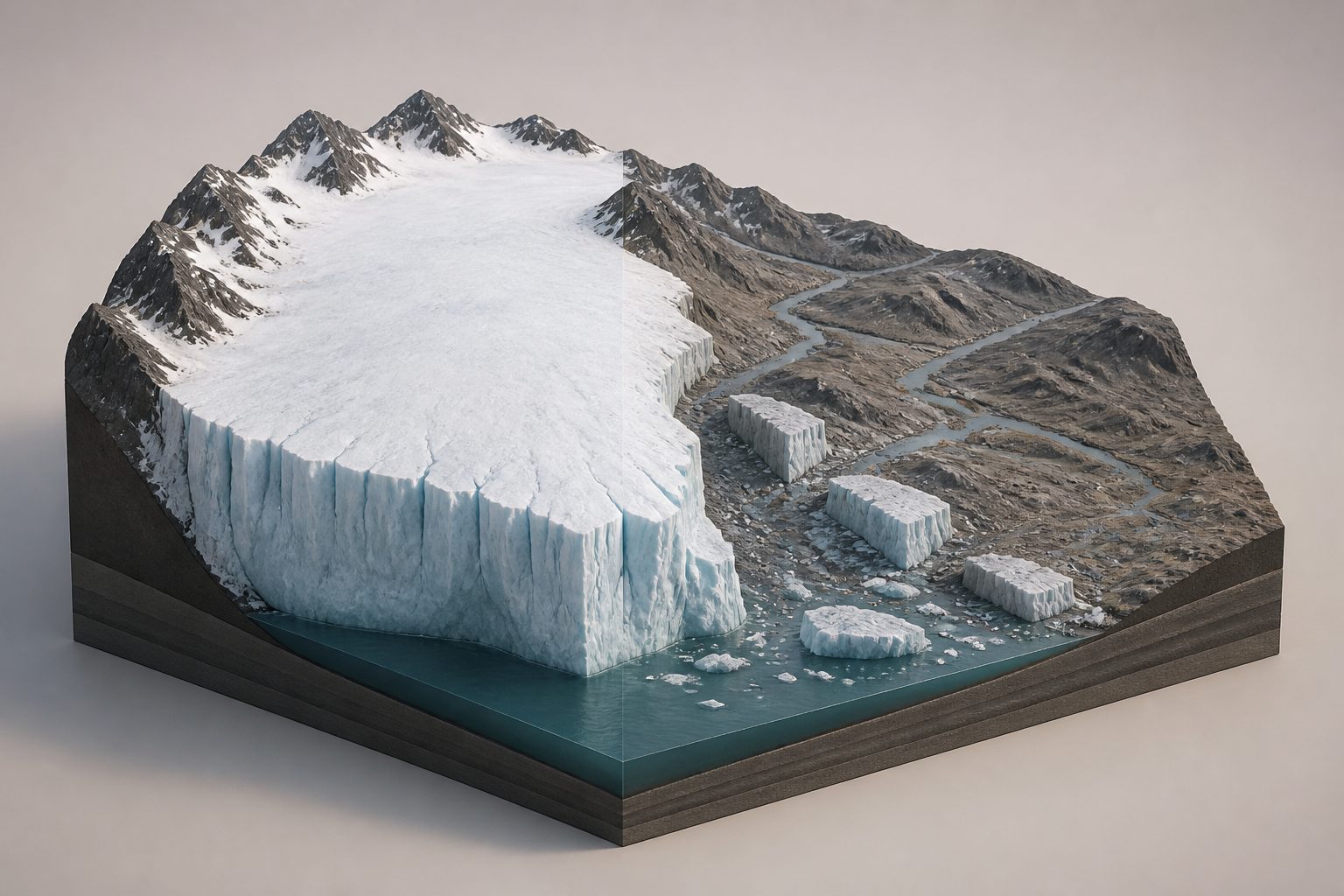
Researchers used an ice-sheet model to reproduce the Northern Patagonian Icefield’s conditions and observed changes around the start of the 21st century, then projected its evolution to 2200. The model included extra ice loss from calving at San Rafael Glacier, the icefield’s ocean-terminating glacier.
Under a lower-emissions pathway, the icefield’s remaining volume in 2200 ranged from 25% to 62% of its current volume. Under a higher-emissions pathway, it ranged from 6% to 19%. Even without additional future climate change, the model projected a loss of 36% of the icefield’s current mass by 2200.
Projected ice loss
The model projected that the Northern Patagonian Icefield would continue losing ice through 2200. Under the lower-emissions scenario, 25% to 62% of its current volume remained by 2200; under the higher-emissions scenario, 6% to 19% remained.
Ice loss accelerated from the middle of the 21st century under both climate-change scenarios and continued through 2200, even after the model held the climate constant during the final century. In a separate run representing already committed mass loss, the icefield lost 36% of its current mass by 2200. The researchers estimated the icefield’s response time at about 100 years.
Model evidence and limits
The study used the SICOPOLIS ice-sheet model, first adjusted to produce an icefield resembling conditions around the year 2000 and to reproduce observed changes in the early 21st century. It then applied present-day and projected surface mass balance under two emissions scenarios and represented calving at San Rafael Glacier by prescribing additional mass loss.
These are model projections, so the results depend on the climate pathways and modeling choices. The abstract notes that the climate was held constant during the final century of the scenarios, and calving was represented through a prescribed loss rather than a fully described evolving process. The projections therefore describe the outcomes of these assumptions rather than a single certain future.