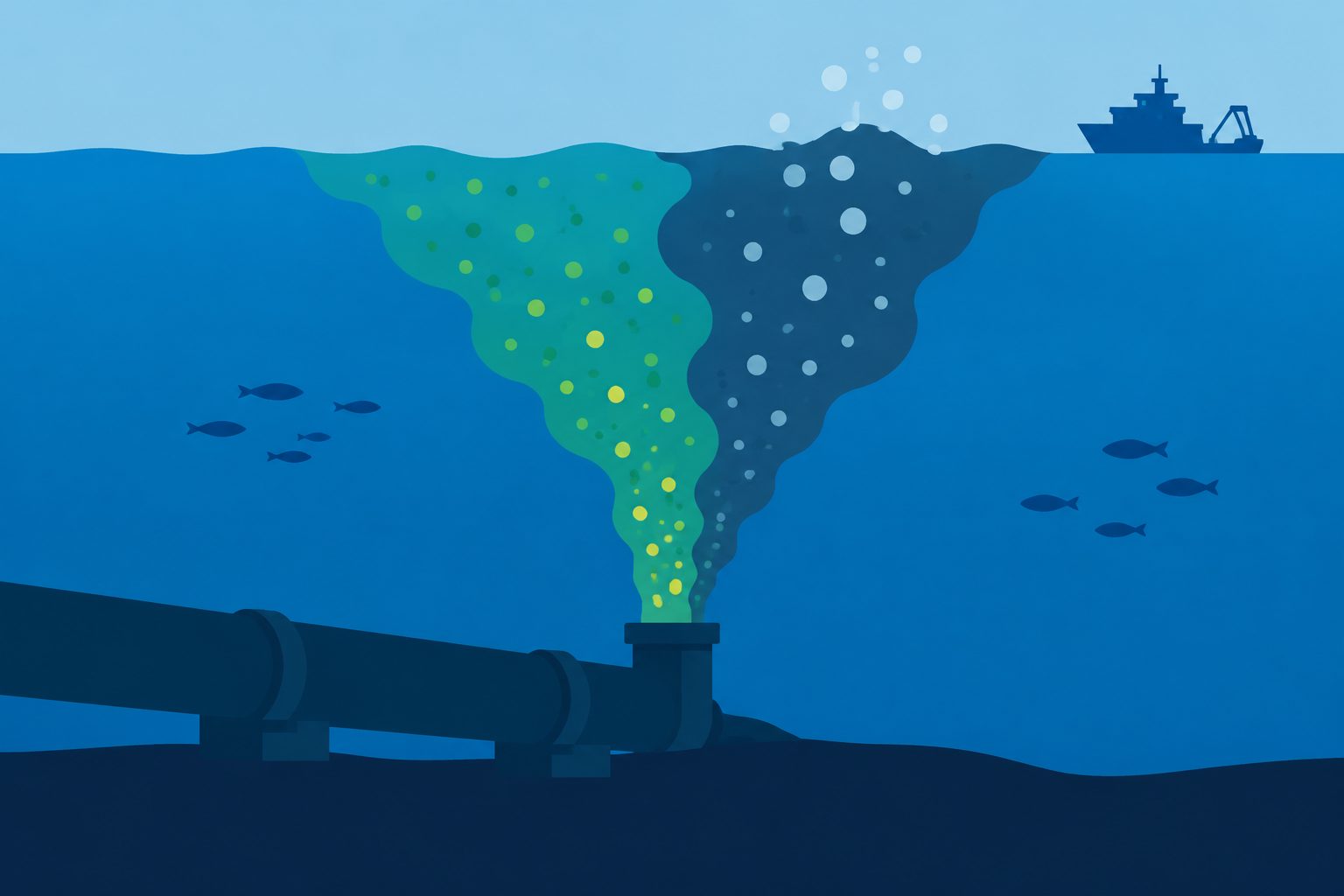
Earth system modeling suggests Stommel Pipes could increase marine productivity while causing region-specific carbon dioxide outgassing.
Researchers used an Earth system climate model to simulate a specific Stommel Pipe design with lengths of 303, 643 and 1,103 meters from 2025 to 2100. They tested the pipes under low- and high-carbon dioxide emission pathways and used a maximum technical potential approach to assess their effects on the ocean and climate system.
The modeled pipes produced sustained upwelling, increased ocean net primary production and did not directly disrupt the thermocline when heat exchange between the upward and downward flows was assumed to be highly efficient. However, the upwelling also brought dissolved carbon to the surface. This led to carbon dioxide outgassing in some regions, especially the South Pacific, while lower-intensity scenarios produced minor carbon dioxide uptake in the North Atlantic.
What the pipes did
The simulations produced sustained upwelling of up to 0.45 cubic meters per second per pipe in the centers of the Atlantic and Pacific subtropical gyres. Upwelling increased ocean net primary production overall, with the increase depending on the strength of the upwelling.
Under the study’s assumption of high heat-exchange efficiency, the Stommel Pipes did not directly disrupt the ocean thermocline. Instead, they increased regional ocean stratification, mainly through the redistribution of salt.
The pipes also brought deep-ocean nutrients and dissolved inorganic carbon to the surface. In the South Pacific, the model showed net carbon dioxide outgassing of up to 249.0 teragrams of carbon per year in 2030, depending on the emissions pathway and upwelling intensity. In the North Atlantic, lower-upwelling scenarios produced minor carbon dioxide uptake of 7.1 teragrams of carbon per year in 2030. The researchers conclude that Stommel Pipes could have region-specific low or negative marine carbon-removal potential when used as a stand-alone approach.
Why the carbon balance matters
The findings show that increasing ocean upwelling would not necessarily increase the ocean’s role as a carbon sink. Although Stommel Pipes could move nutrients upward and raise marine productivity without directly disturbing the thermocline under the modeled conditions, they could also expose dissolved carbon to the atmosphere and produce net carbon dioxide emissions in some regions.
That regional contrast matters for assessing artificial upwelling as a carbon-dioxide-removal method. The study suggests that its climate effect would depend not only on the amount of water moved, but also on where the pipes operate, how strongly they upwell water and how much carbon is brought to the surface.
Model evidence and limits
This is an Earth system model assessment, not a test of operating pipes in the ocean. The simulations covered 2025–2100 and compared low- and high-carbon-dioxide emission pathways using a specific Stommel Pipe design with three pipe lengths.
The results assume highly efficient heat exchange between the upward and downward flows and examine a maximum technical potential. The conclusions therefore depend on those assumptions and on the model’s representation of ocean circulation, carbon cycling and regional responses. The study compares the simulated Stommel Pipes with the expected effects of wave-driven pipes, but the abstract does not provide real-world performance measurements or evidence from a field deployment.