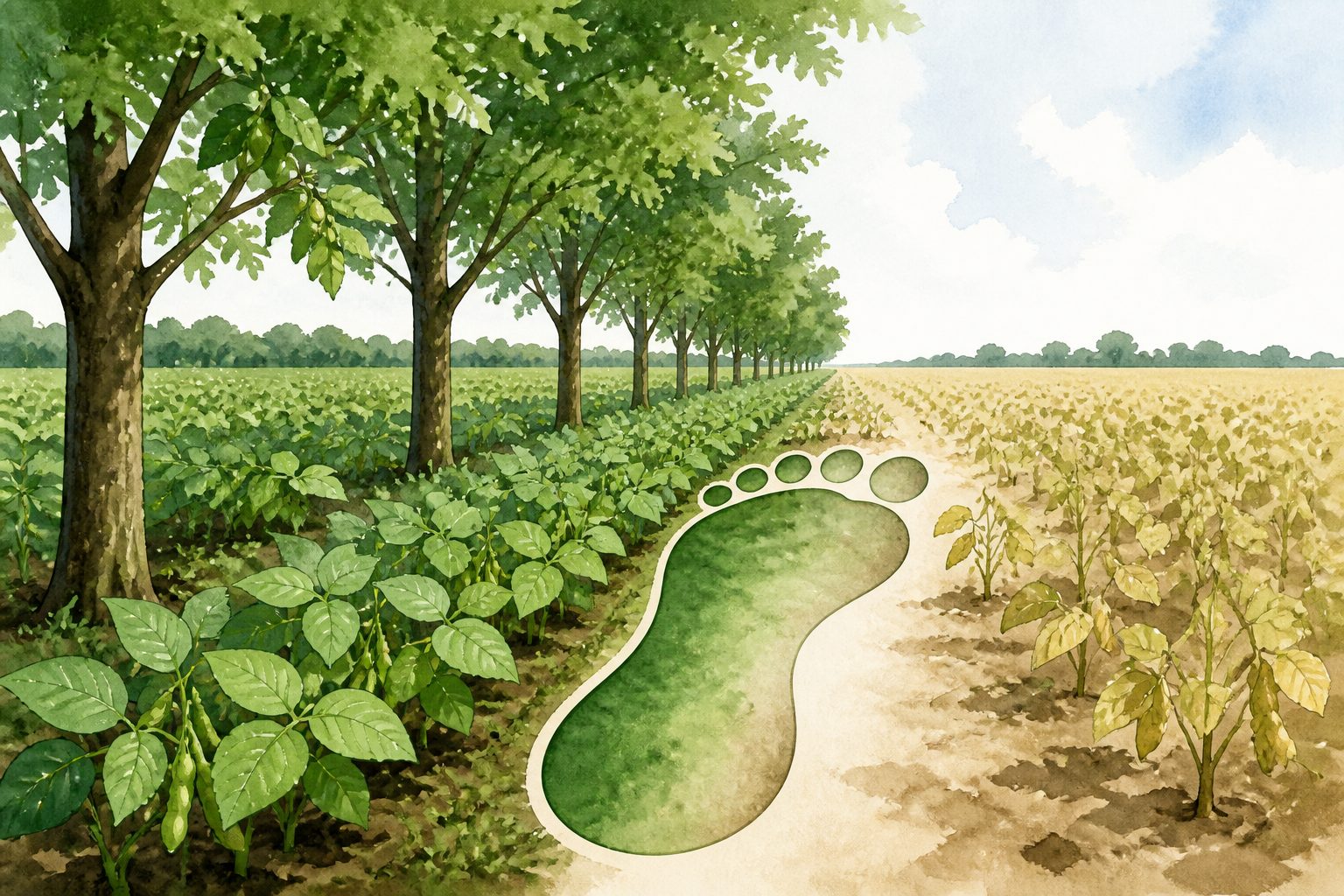
In the western Slovakia models, sweet chestnut delivered the largest climate reduction, while hazelnut systems kept more soybean production.
A life cycle assessment of farms in western Slovakia found that adding European hazelnut or sweet chestnut trees to soybean systems reduced their modeled net greenhouse gas emissions compared with soybean monoculture. The largest reductions came from chestnut systems, where carbon uptake in modeled woody biomass outweighed other emissions.
The modeled soybean yields were lower in the tree-based systems, falling by 61–83% compared with conventional soybean monoculture. Hazelnut systems retained more soybean production than chestnut systems, while chestnut systems produced the larger modeled reduction in climate impact. Nut harvests provided an additional farm output.
Soybean yields and tree carbon
The researchers compared conventional soybean monoculture with soybean systems that also included European hazelnut or sweet chestnut trees. All of the soybean–nut systems had lower modeled net greenhouse gas emissions than conventional soybean monoculture.
Total modeled climate impact ranged from −8.8 to −17,122 kilograms of carbon dioxide equivalent per hectare. Compared with conventional soybean monoculture, the modeled climate impact fell by 68–101% in hazelnut systems and by 1,020–1,265% in chestnut systems. The values below zero resulted from counting carbon uptake in tree biomass as a negative flow.
Modeled soybean yields ranged from 416 to 979 kilograms per hectare, with declines of 61–83% compared with conventional soybean monoculture. Sweet chestnut systems produced the largest modeled reductions because of woody-biomass accumulation. Soybean–hazelnut systems had higher modeled soybean yields but smaller climate-impact reductions. The nut trees also provided an additional agricultural product.
// Source
Agroforestry Systems · 2026 · DOI: 10.1007/s10457-026-01622-4
Authors: Seyedeh Masoumeh Hafezi, Martin Lukáč, Zlatica Muchová, Vladimír Mačejovský, Ehsan Moradi, Michal Pástor, Jaroslav Jankovič, Jakub Mankovecký
Institutions: University of Reading, Slovak University of Agriculture in Nitra, Trinity College Dublin, Czech University of Life Sciences Prague, National Forest Centre