Nearby “Little Red Dots” resemble their mysterious early-universe counterparts
A survey found 27 low-redshift objects with the compact shapes, unusual light and broad emissions seen in distant Little Red Dots.
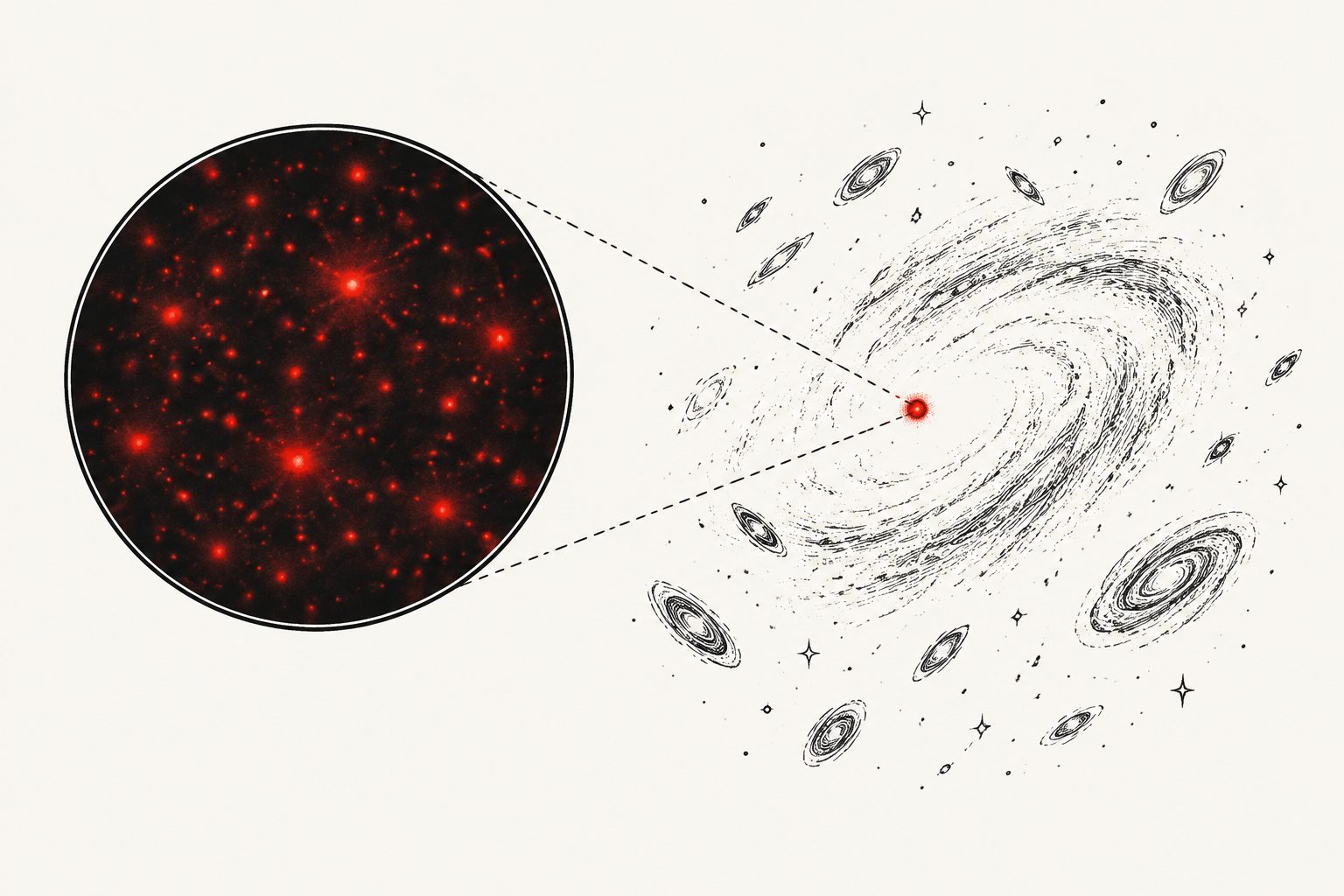
Editorial illustration — not from the study.
Using DESI’s first public data release, researchers selected 27 Little Red Dots between redshifts 0.2 and 0.9. Near-infrared spectra were obtained for 21 of them with three instruments, allowing the team to examine their light across a broader range of wavelengths and study their emission lines.
The low-redshift objects had compact appearances, V-shaped ultraviolet-to-optical light patterns, broad hydrogen emission and frequent hydrogen absorption. Their properties were broadly consistent with those of high-redshift Little Red Dots, although their relationship to ordinary active galaxies remains unclear and some showed cooler, more extended emitting regions.
What the survey found
The 27 objects had a lower-limit number density of 7.5 × 10⁻¹⁰ comoving cubic megaparsecs. Among the 21 with near-infrared follow-up, the objects showed compact morphologies, V-shaped ultraviolet-to-optical continua and blackbody-like optical-to-near-infrared continua. Their broad hydrogen emission had an unusually large median Hα-to-Hβ ratio of about 15, and 70% showed hydrogen absorption.
All of the low-redshift Little Red Dots had low metallicity and occupied the same regions of the standard emission-line diagnostic diagram as high-redshift examples. They had softer ionizing spectra than typical active galactic nuclei, and ionized oxygen outflows were found in 78% of the sample. The relationship between broad hydrogen-line brightness and the 5100-angstrom light differed from that seen in nearby type-1 active galaxies, limiting the direct use of local black-hole mass calibrations.
Their optical-to-near-infrared continua corresponded to temperatures of about 2,000–4,700 kelvin, with peaks between 0.6 and 1.4 micrometers. A subset had cooler and larger envelopes than high-redshift examples. One object, J1717+3807 at redshift 0.196, showed long-term changes in brightness in optical and infrared observations.
Why nearby examples matter
Low-redshift Little Red Dots can be studied in greater detail than their distant counterparts. Because the two populations share a range of unusual properties, the researchers say the comparison supports the possibility that similar physical processes operate in both.
These closer objects therefore provide a way to investigate the nature of Little Red Dots and to follow how this population may have changed from the early universe to the present. The findings also show that black-hole mass estimates developed for local type-1 active galaxies cannot be applied directly to these objects without accounting for their different emission-line behavior.
Evidence and caveats
This is an observational study based on a systematic selection from the first DESI data release, followed by near-infrared spectroscopy for 21 of 27 selected objects. The reported number density is a lower limit, not a complete measurement of the population’s abundance. The comparison with high-redshift Little Red Dots is based on shared observed properties and does not by itself establish the objects’ underlying physical mechanism.
The DESI pipeline models were used only for initial candidate selection because they are not designed for precise modeling of poorly understood populations such as Little Red Dots. The researchers remeasured the spectral properties with more tailored methods, but they describe the discussion as qualitative and defer detailed modeling and a fuller depth analysis to future work. Follow-up observations were also still ongoing, with more complete spectral data expected in later work.
// Source
The Astrophysical Journal · 2026 · DOI: 10.3847/1538-4357/aeac19
Experiments on KV₂Se₂O found momentum-dependent spin polarization even though the material has no net magnetization. Spin-sensitive tunneling and computer simulations linked the pattern to the crystal’s symmetry and a characteristic four-lobed form.
A new analysis finds that extra, self-interacting radiation in the early universe is more compatible with ACT observations when the pattern of primordial fluctuations is allowed to vary with scale. In the models tested, this reduces the Hubble tension from the standard model’s level to 2.2σ, or below 2σ in a version where the radiation was once coupled to dark matter.
Researchers used a tensor-network calculation to study how force-carrying strings break apart in a simplified model of particle interactions. The work links string breaking with energy transport, particle production, entanglement growth and the spread of correlations.