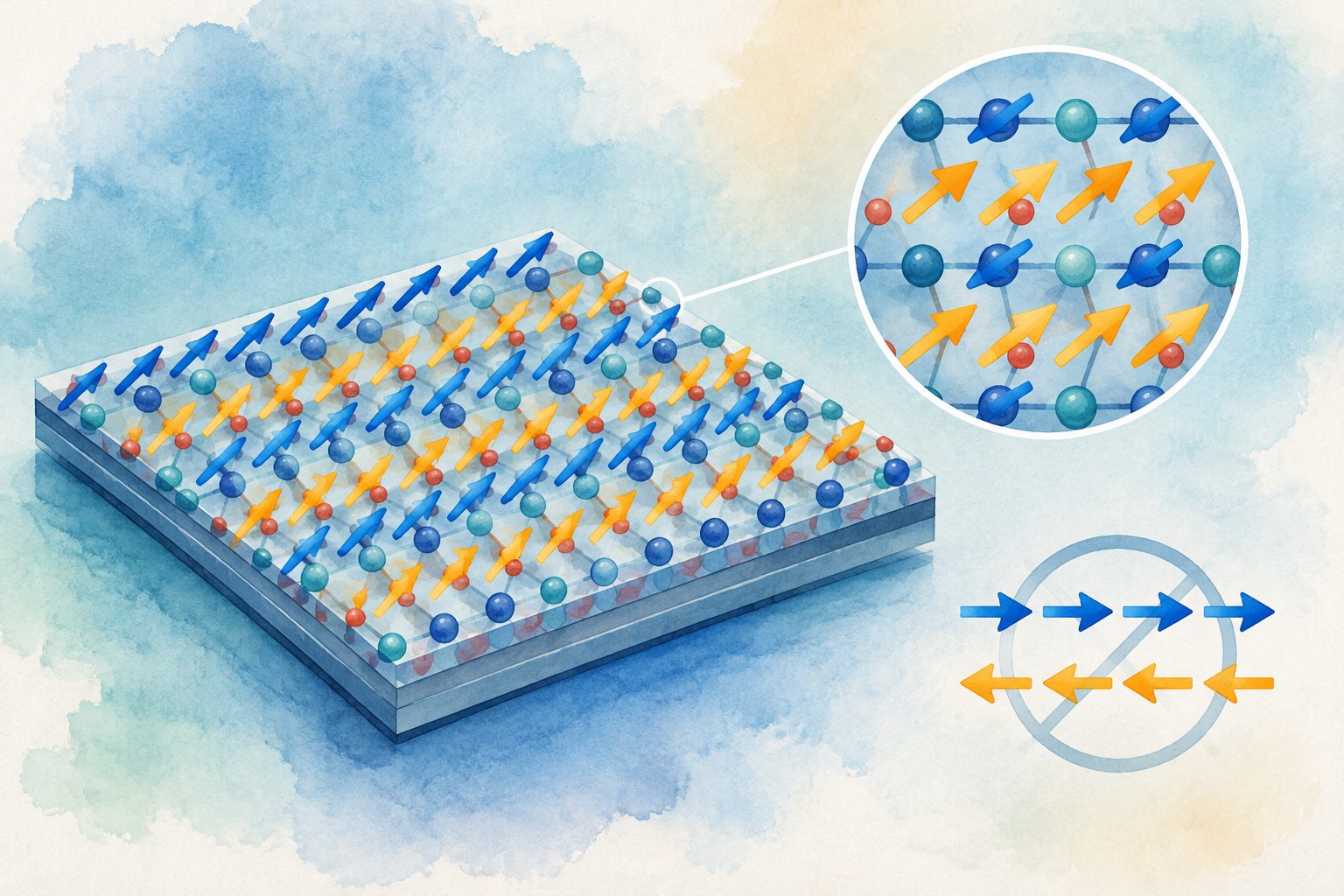
Spin-sensitive microscopy reveals a changing electronic pattern in the surface of this magnetic crystal.
Researchers used a spin-selective scanning tunneling microscope tip made from SmB₆ to examine the metallic surface of KV₂Se₂O. They measured how electrons scatter from atomic defects, comparing the results with measurements from a conventional tungsten tip.
With the SmB₆ tip, the impurity-related electronic waves differed in strength and phase along two perpendicular directions. Their Fourier-transformed patterns also changed anisotropy with the applied voltage, observations that simulations linked to momentum-dependent spin polarization with a d-wave form.
Directional spin patterns
The SmB₆-based tip revealed a strong directional contrast in the electronic waves around impurities: the signal was enhanced along one pair of directions and suppressed along the perpendicular pair, with a phase difference between them. The contrast changed with temperature and applied voltage. Measurements using a tungsten tip mainly showed in-phase oscillations and an anisotropy that did not reverse.
Together with numerical simulations, these results support a spin polarization that depends on electron momentum and follows the four-lobed pattern expected for d-wave altermagnetism. The measurements also showed the surface band splitting and were consistent with the symmetry of the KV₂Se₂O crystal.
Why the spin pattern matters
Altermagnets have compensated magnetic moments, so they can lack net magnetization while still having spin-dependent electronic states. The experiments provide microscopic evidence connecting KV₂Se₂O’s crystal symmetry, electronic structure and momentum-dependent spin polarization.
The work also demonstrates that spin-selective tunneling can probe these compensated magnetic textures locally without relying on a magnetic tip. KV₂Se₂O therefore offers a material platform for studying its links with spin-valley locking, Fermi-surface instability and unconventional magnetism.
Evidence and caveats
The evidence comes from spin-sensitive scanning tunneling measurements of impurity-induced electronic waves, comparisons with conventional-tip data and numerical QPI simulations. The observations support, rather than independently establish every part of, the proposed altermagnetic interpretation.
The study examines the surface of one material and relies on the behavior of specialized tunneling tips. The excerpts also note that a secondary spin-density-wave transition in KV₂Se₂O remains under debate. Defects can produce in-gap bound states, although those states were not the focus of this analysis.
// Source
Physical Review X · 2026 · DOI: 10.1103/jndg-x9tw
Authors: Guofei Yang, Chuang Li, Chengwei Wang, Xudong Zhao, Yifan Wan, Hengrui Gui, Guoqing Zeng, Saizheng Cao, Chuqiao Hu, Qihe Yu, Yujia Zhang, Dong Chen, Yu Liu, Yu Song, Yongjun Zhang, Fei Liu, Lun‐Hui Hu, Lin Jiao, Huiqiu Yuan