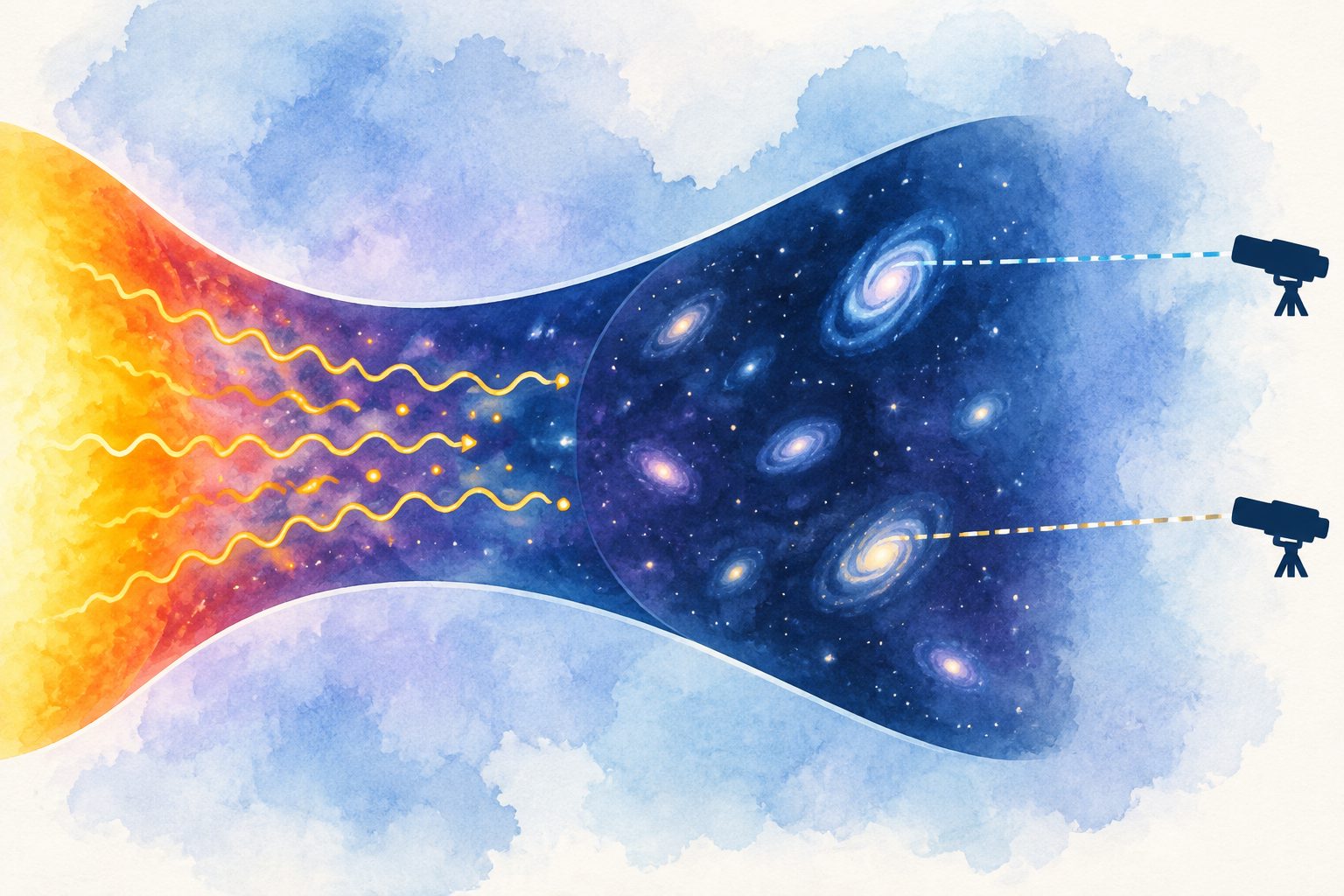
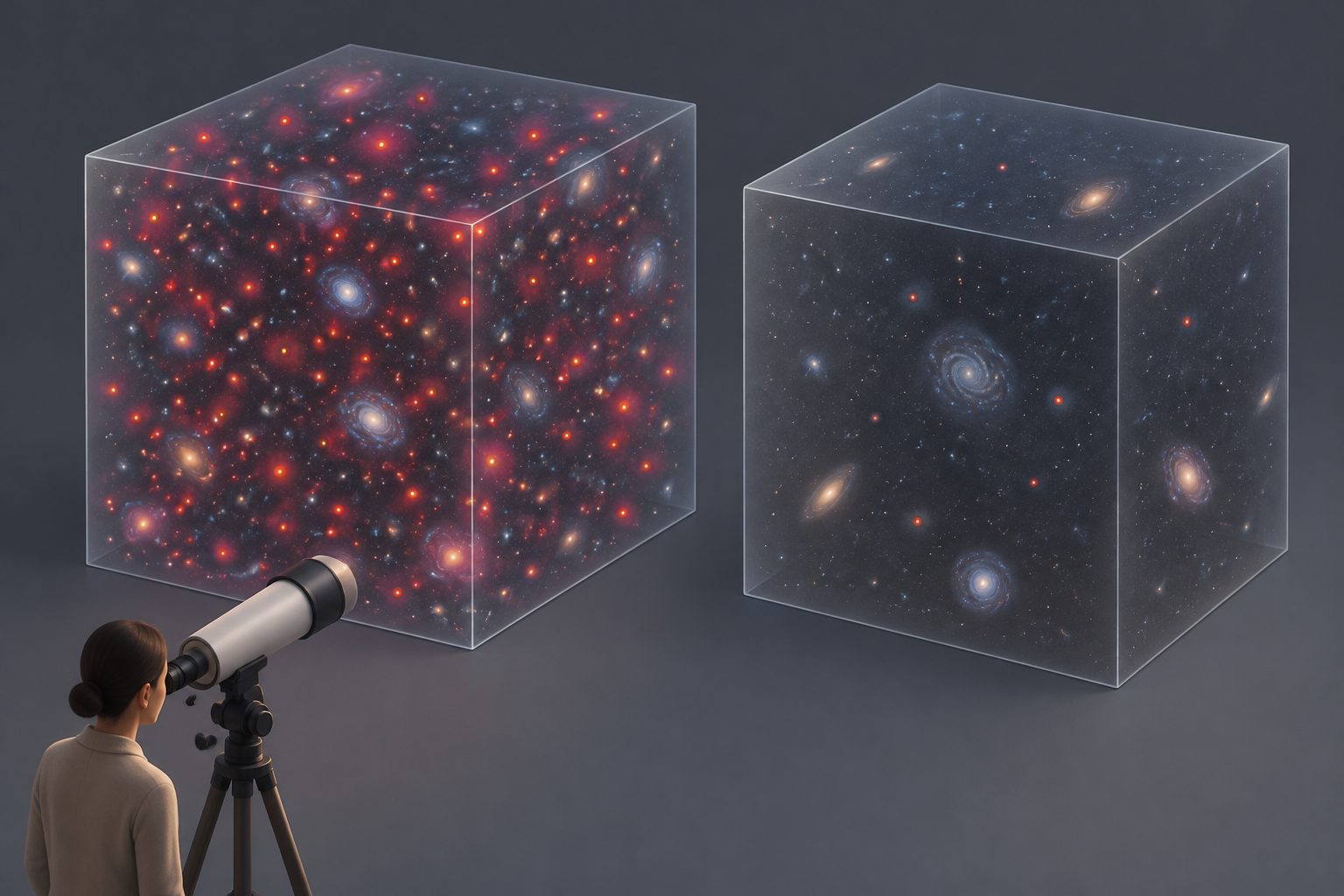
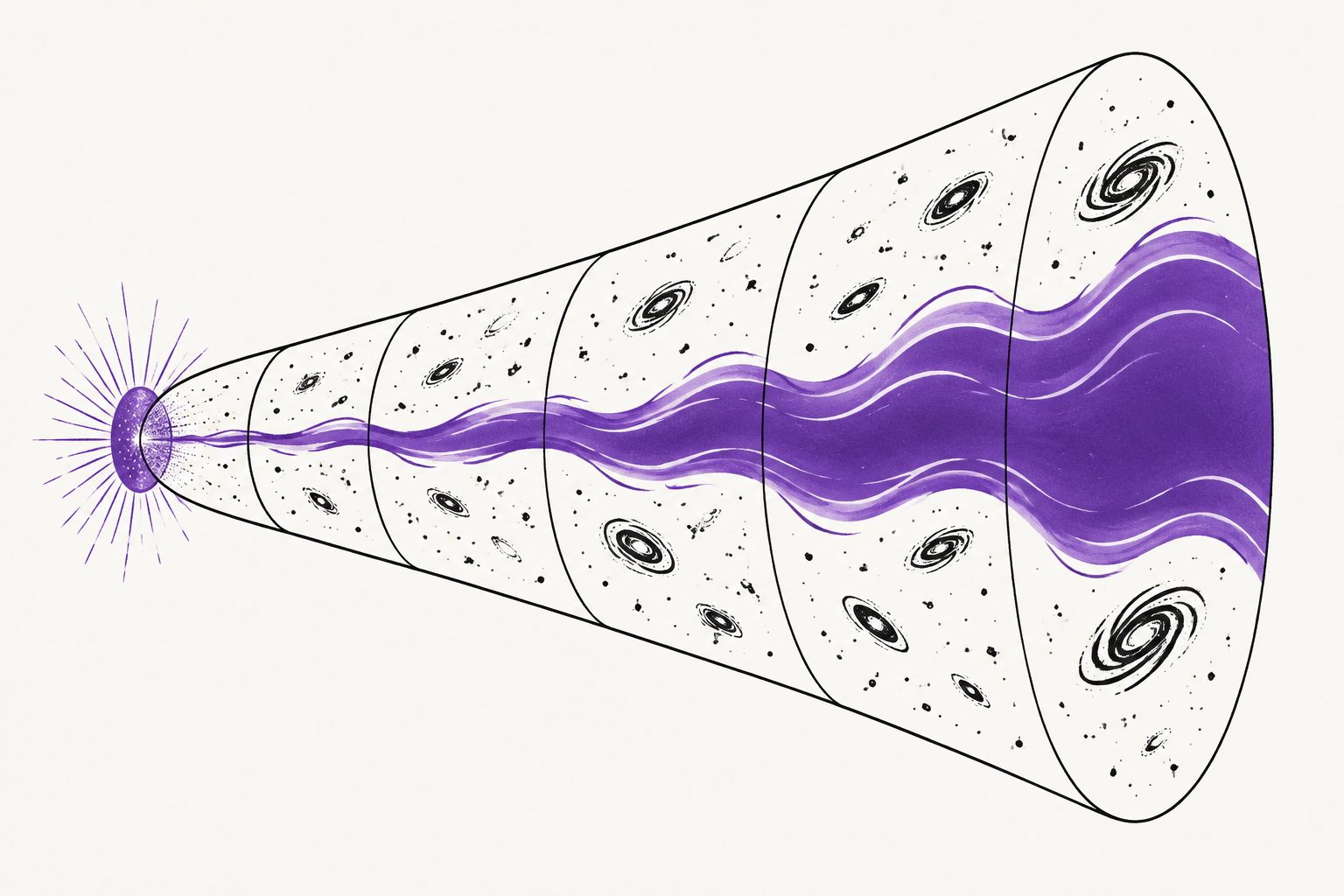
A study finds that allowing the universe’s earliest fluctuations to change with scale weakens limits on additional light radiation and brings expansion-rate measurements closer together.
The researchers combined data from the Atacama Cosmology Telescope’s sixth data release, the Planck satellite, DESI’s second data release and uncalibrated Pantheon+ supernova measurements. They tested models containing self-interacting dark radiation while allowing both the spectral index and its rate of change to vary with scale.
They found a preference for positive changes in the primordial spectrum, with 2.9σ significance for the first change and 2.6σ for the change in that rate. In the self-interacting-radiation model, the extra radiation was limited to less than 0.58 in the study’s effective measure at 95% confidence, while a model in which the radiation later decouples from dark matter relaxed the limit to 0.68 and reduced the Hubble tension to below 2σ.
What the analysis found
When the primordial power spectrum is treated as scale-dependent, the data allow more extra light radiation than analyses that keep the spectrum nearly fixed. For self-interacting dark radiation, the study finds an upper limit of ΔN_eff < 0.58 at 95% confidence and reduces the Hubble tension to 2.2σ. The analysis also finds a 2.9σ preference for positive running of the spectral index and a 2.6σ preference for positive running of that running.
In a second model, dark radiation is initially coupled to dark matter and decouples around the time matter and radiation become equally important. That model allows ΔN_eff < 0.68 at 95% confidence and brings the Hubble tension below 2σ. It predicts dark acoustic oscillations with a drag horizon of about 60 megaparsecs per h.
Why the result matters
The results show that conclusions about extra light particles and the Hubble tension depend strongly on assumptions about the universe’s initial fluctuations. A model with only a few additional parameters can make extra radiation consistent with the tested cosmological data while increasing the expansion rate inferred from early-universe observations, bringing it closer to direct measurements.
The findings do not establish that dark radiation exists, but they identify a way for such radiation to remain compatible with current data and give a specific prediction—oscillatory features on a scale of about 60 megaparsecs per h—for the model involving dark-matter coupling.