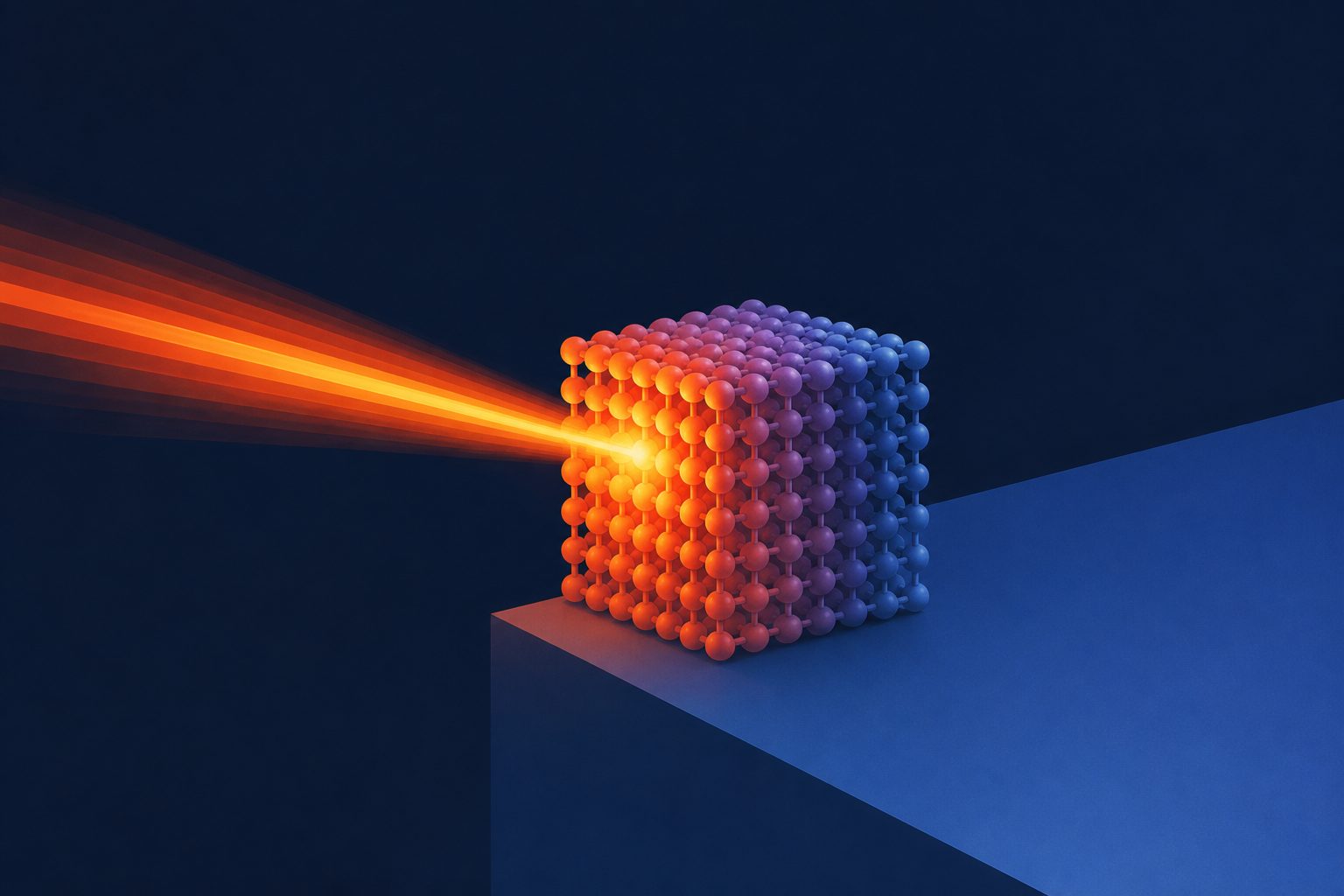
A new calorimetry method measures heat capacity in samples smaller than a grain of dust and can track sharp changes in their state.
The technique, called microsecond-pulsed nanocalorimetry, briefly heats a nanoscale sample and measures how its temperature changes. Restricting the heating to microsecond timescales limits heat spreading across the device and reduces the background heat capacity that can interfere with measurements.
The researchers report measurements with heat-capacity addenda below 10⁻⁹ joules per kelvin and noise densities as low as 75 pic joules per kelvin per square-root hertz per square millimetre. The method also works in a nearly steady thermal regime, allowing measurements while magnetic or electric fields are applied.
What the method measured
The method measured heat capacity in subnanogram samples covering areas as small as 30 × 30 micrometres. Microsecond heating reduced lateral heat diffusion and kept the unwanted heat capacity of the measurement setup below 10⁻⁹ joules per kelvin. The reported noise density was as low as 75 pJ K⁻¹ √Hz mm⁻².
The researchers found that the approach produced a uniform sample temperature and resolved the antiferromagnetic transition—a change in magnetic ordering—in ultrathin cobalt oxide films. Because the thermal diffusion length is limited during the short heating pulse, the method can be scaled to smaller lateral device dimensions. Its nearly steady operation is also compatible with measurements under magnetic and electric fields.
Why tiny heat measurements matter
Heat capacity carries information about how a material’s energy changes with temperature, including signatures of phase transitions. Measuring it in nanoscale and low-dimensional materials is difficult because the samples contain very little heat and conventional instruments can be dominated by heat from the surrounding device.
By reducing heat spreading and background heat capacity, this approach provides a way to study thermodynamic behavior in smaller areas and samples. Its compatibility with external fields could also support measurements of materials while they are being electrically or magnetically stimulated.
Evidence and limits
This is a journal article describing a measurement technique and demonstrating it with ultrathin cobalt oxide films. The abstract reports performance metrics for sensitivity, background heat capacity, sample size and spatial area, along with the observation of a magnetic transition.
The abstract does not provide the full experimental comparison with existing calorimetry methods, the number of samples tested, or results across a broad range of materials. It therefore supports the method’s reported capabilities and the cobalt oxide demonstration, but does not by itself establish how well the technique will perform for every nanoscale material or device.
// Source
Microsystems & Nanoengineering · 2026 · DOI: 10.1038/s41378-026-01426-7
Authors: Hugo Gómez-Torres, M. Molina-Ruiz, Simone Privitera, Enric Menéndez, Llibertat Abad, Jordi Sort, Olivier Bourgeois, J. Rodríguez‐Viejo, A. F. Lopeandía
Institutions: Université Grenoble Alpes, Universitat Autònoma de Barcelona, Centre National de la Recherche Scientifique, Institut Català de Nanociència i Nanotecnologia, Institució Catalana de Recerca i Estudis Avançats, Institut de Microelectrònica de Barcelona, Institut Néel