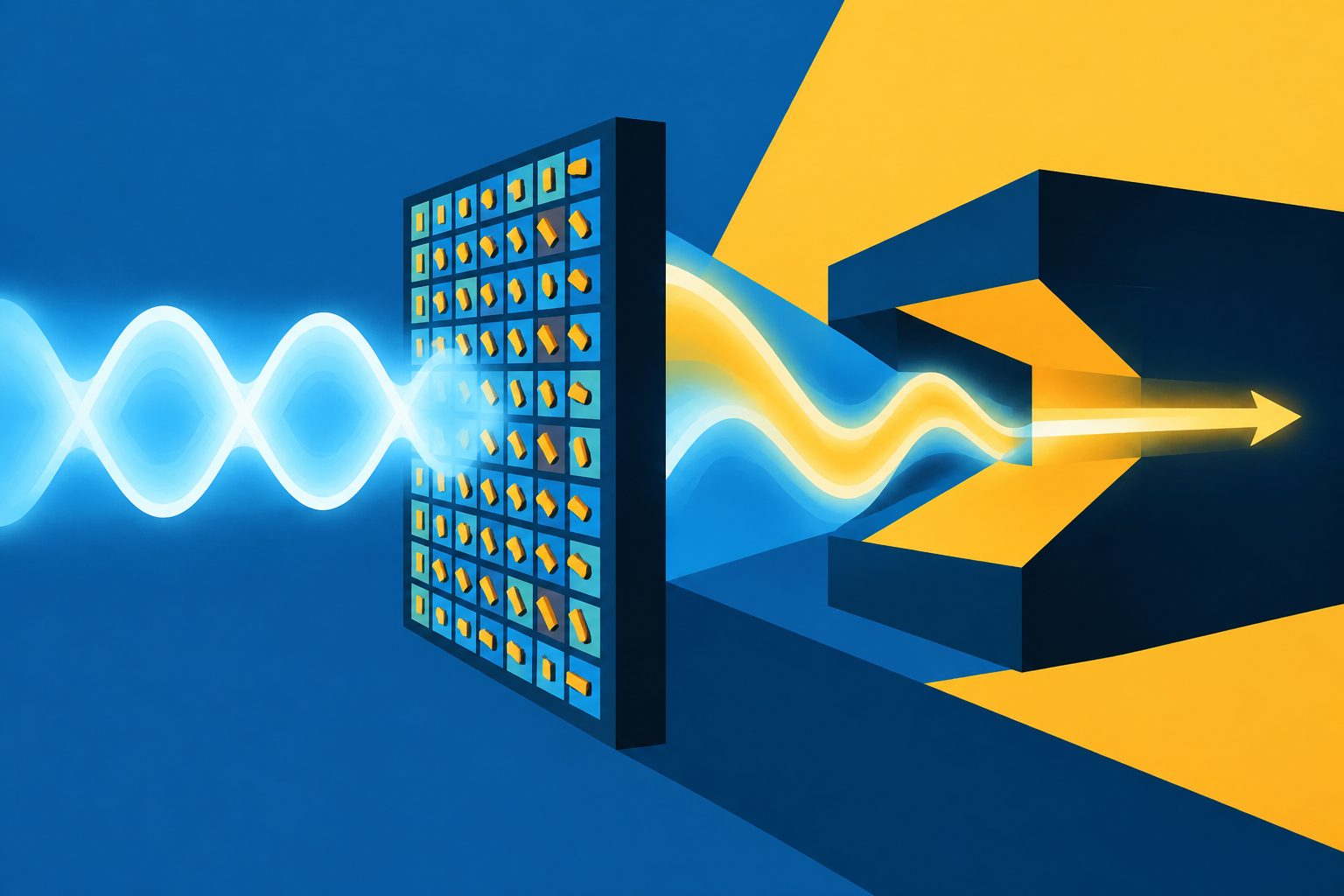
A theoretical study shows that carefully tuned scatterers can route and separate signals in systems where waves bounce along many paths.
The framework links perfect routing to the alignment of several complex wave frequencies on the real, operating-frequency axis. It predicts how many adjustable parameters are needed and uses destructive interference to make selected output channels inaccessible while directing waves to others.
In electromagnetic simulations, a small number of tunable scatterers enabled routing and demultiplexing in a multiport chaotic cavity. A grating coupler with a similarly small number of adjustable elements also routed signals through free space. The authors say the same approach could be extended to functions including mode conversion, isolation, power division and filtering.
How the routing works
The researchers describe critically constrained scattering processes in which interference prevents waves from entering specific outgoing channels. They show theoretically that perfect steady-state routing can be achieved at any frequency when geometric parameters are tuned so that multiple complex eigenfrequencies coincide on the real-frequency axis.
The number of tuning parameters required is predicted using codimension arguments and was supported by simulations. Those simulations demonstrated routing and signal separation with high discrimination in a multiport chaotic cavity, as well as free-space routing in a grating coupler. The study also finds that a particular class of perfect-reflection processes is enhanced when time-reversal symmetry is present.
Why adjustable routing matters
Many existing approaches to controlling waves in irregular, multiple-scattering structures rely on large numerical optimizations with very many design parameters. This framework instead provides a way to predict when exact routing solutions exist and how many adjustable features are needed, potentially allowing devices to be retuned in place.
The approach could support reprogrammable wave functions such as routing, demultiplexing, mode conversion and filtering. The framework is presented as applying to classical waves and quantum matter waves, although the reported demonstrations here focus on electromagnetic simulations.
Evidence and limits
The evidence is theoretical: a mathematical framework, codimension-based predictions and electromagnetic simulations. The excerpts do not report experiments or measured devices, and they give no numerical routing efficiencies or parameter counts beyond describing the required sets as small.
The method depends on multipath interference and on a scattering system at least a few wavelengths across. It is most directly demonstrated here for routing and demultiplexing; extensions to power distribution and other functions are described as ongoing work or possibilities. The claimed ability to operate at any frequency requires retuning the system's geometric parameters.