Electrical and thermal measurements point to ferroaxial order near the material’s 200-kelvin charge-density-wave transition, plus a lower-temperature transition.
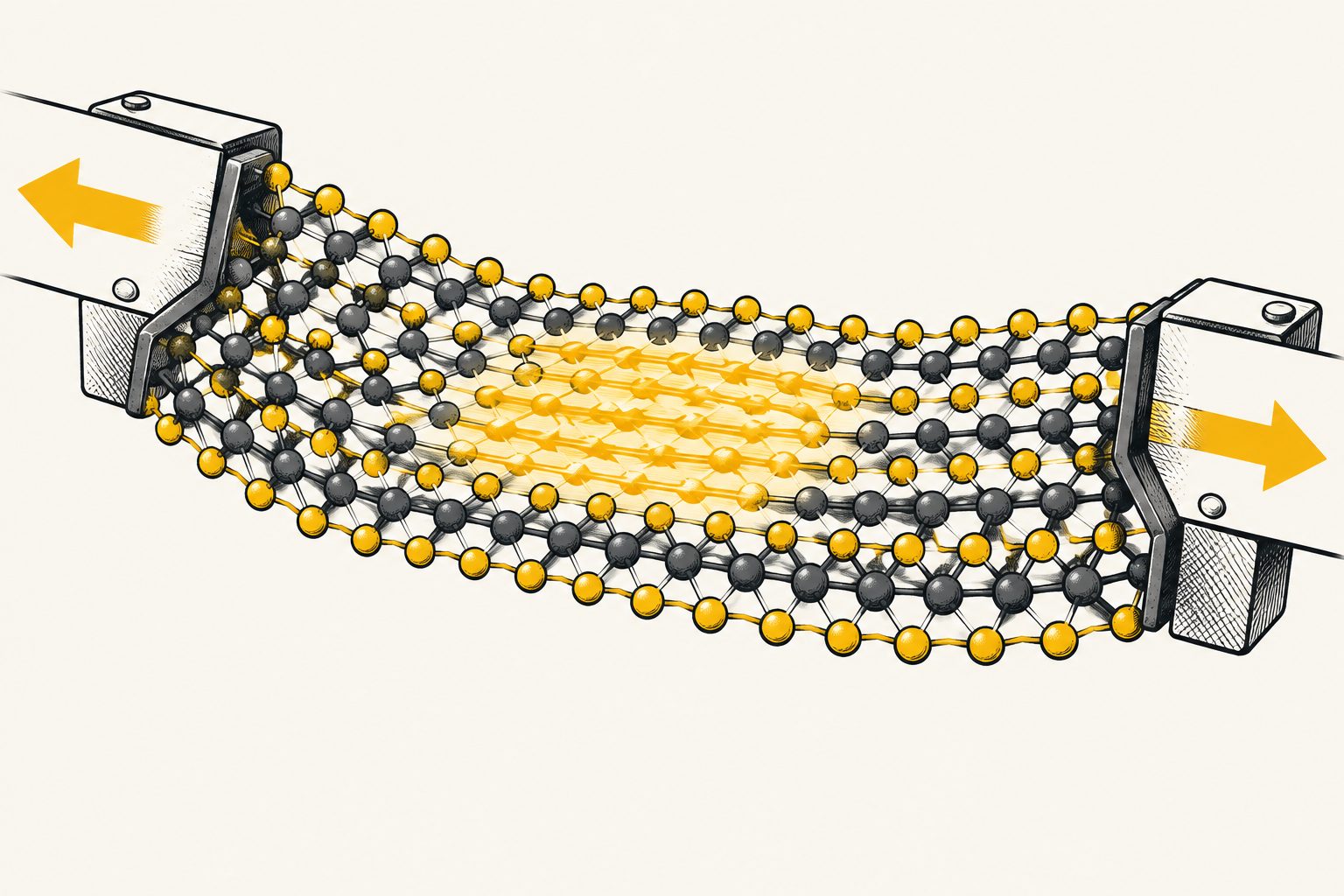
Researchers used elastoresistivity—tracking how a material’s electrical resistance changes under strain—to study 1T-TiSe₂. An unusual off-diagonal response appeared in the charge-density-wave state, and the response became hysteretic when the researchers varied a specially combined strain field. They associate this behavior with ferroaxial domains switching or moving.
Thermal measurements placed the main charge-density-wave transition near 200 kelvin and indicated another transition between about 140 and 190 kelvin, depending on strain. Optical measurements ruled out chiral order as an explanation considered in the study.
Signs of hidden order
The researchers observed an unusual antisymmetric off-diagonal change in resistivity after applying strain in the charge-density-wave state of 1T-TiSe₂. They argue that this response is strong evidence for a ferroaxial component of the ordered state—a form of order that breaks mirror symmetry while preserving time-reversal and inversion symmetry.
They combined two types of symmetry-breaking strain into an effective field for ferroaxial order. Sweeping this field back and forth produced hysteresis in the elastoresistivity, which the researchers associate with the movement of ferroaxial domain walls. Certain nonlinear elastoresistivity coefficients also grew sharply on approaching the charge-density-wave transition from above, consistent with a rising ferroaxial susceptibility near about 200 kelvin.
Elastocaloric measurements found at least two phase transitions: the charge-density-wave transition near 200 kelvin and a second, strain-dependent transition spanning roughly 140 to 190 kelvin for the strains studied. Optical second-harmonic-generation measurements excluded chiral order as the source of the higher-temperature symmetry breaking.
Why the result matters
The results provide evidence about the symmetry of the ordered state in 1T-TiSe₂, whose charge-density-wave phase has not been fully understood. They also show how measurements of resistance under carefully chosen strains can expose an order that is difficult to detect with conventional probes.
The approach may give researchers a way to investigate hidden order and its fluctuations in other materials. In this material, however, the microscopic origin of the proposed ferroaxial order remains unresolved.
Evidence and open questions
The evidence comes from elastoresistivity measurements on synthesized 1T-TiSe₂ crystals, supported by elastocaloric measurements and optical second-harmonic-generation measurements. The unusual resistance response, hysteresis under the effective strain field and temperature-dependent nonlinear response together support the ferroaxial interpretation; the optical measurements rule out chiral order as an alternative considered in the study.
The work does not establish the microscopic origin of the ferroaxial component. The lower-temperature transition is reported as an additional phase transition, but the provided excerpts do not identify its order or cause. The researchers also describe their conclusions about ferroaxial domain-wall movement and susceptibility as interpretations of the measured responses.