A modified microscope changes atoms on a tiny silicon probe
The technique lets researchers image a microscope probe and carry out controlled chemical reactions at its tip.
Editorial illustration — not from the study.
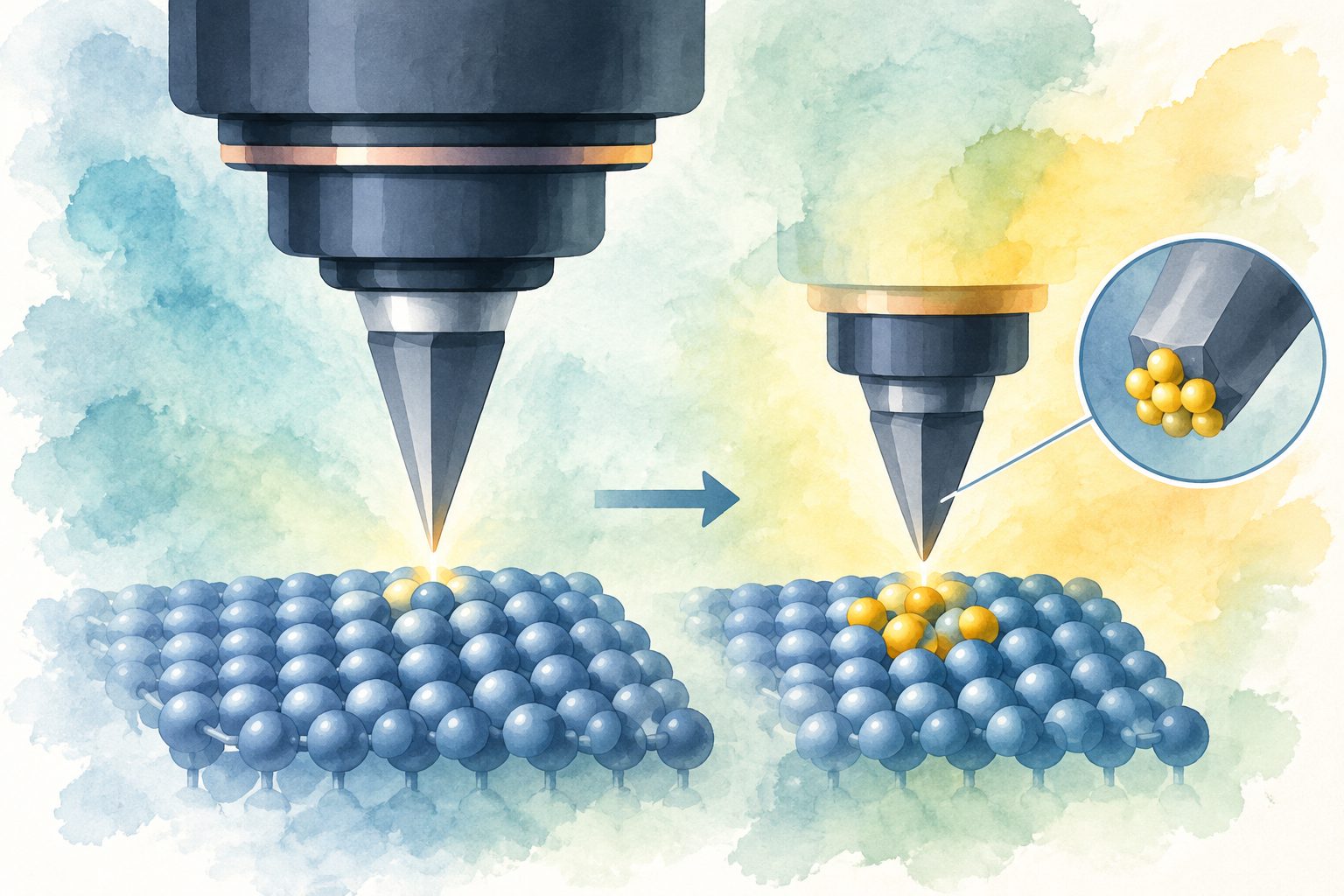
In conventional scanning tunneling microscopy, the atomic structure of the probe can be difficult to control. In the new approach, upright molecules attached to a silicon surface act as markers that image the probe’s apex, while also serving as chemical reactants.
The researchers brought the probe and molecules together with sub-angstrom precision. Using an alkynyl-terminated molecule, they removed hydrogen atoms from the probe at zero applied voltage. Successive reactions then replaced selected hydrogen atoms with iodine, followed by iodine removal and manipulation.
What the probe could do
The researchers prepared atomically clean, crystalline silicon probe apices by annealing silicon probe chips. The probes could be annealed repeatedly—at least a dozen times—to produce clean apices with similar dimensions and electronic properties. Molecules sparsely attached to a Si(100) surface produced images of the probe apex, allowing its atomic structure to be examined and aligned with atomic precision.
The same molecules could react with the probe when the two sides of the microscope’s tunnel junction were brought together mechanically. The team demonstrated reproducible hydrogen removal from the probe at zero volts using an alkynyl-terminated molecule. They then showed successive reactions that replaced specific hydrogen atoms with iodine, followed by iodine removal and manipulation.
Why probe control matters
Atomically precise fabrication requires control over both the material being shaped and the microscope probe that performs the manipulation. By providing a way to inspect and chemically address the probe itself, inverted-mode microscopy could make sequential, site-selective reactions more controllable.
The demonstrated chemistry involved hydrogen and iodine on a silicon probe, but the researchers expect the approach could be extended to other elements, molecular groups and materials. Those broader applications remain to be demonstrated.
Evidence and caveats
This is a journal article reporting direct experiments with prepared silicon probes, surface-bound molecules and mechanically controlled reactions in a scanning tunneling microscope. The work demonstrates hydrogen abstraction at zero voltage and subsequent iodine substitution, removal and manipulation.
The broader possibilities described by the researchers are prospective rather than demonstrated here. Alternative methods for preparing crystalline probe apices were less reproducible than the annealing procedure. The researchers also identify precise control of the true distance between probe and sample, and the use of more complex three-dimensional reaction paths, as continuing challenges.
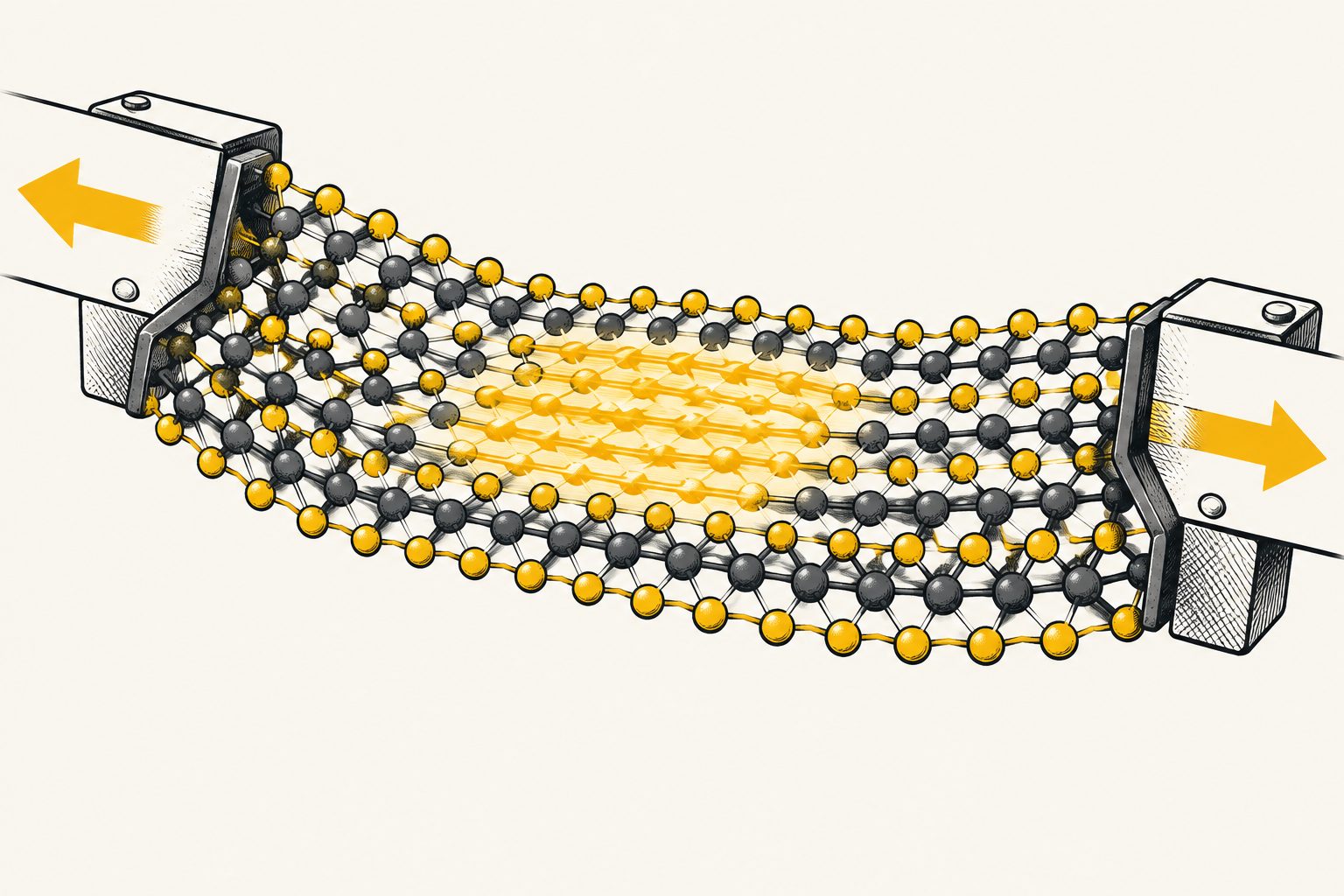
Measurements of titanium diselenide under strain found electrical responses consistent with hidden ferroaxial order in its charge-density-wave state. The study also identified a second, strain-dependent transition several tens of kelvin below the main transition.
Researchers developed an AI system that predicts crystal systems, space groups and lattice parameters directly from powder X-ray diffraction patterns. On the RRUFF experimental benchmark, it correctly identified the crystal system 81.7% of the time and the space group 66.2% of the time.
Researchers developed an AI framework that uses scientific knowledge graphs and specialized agents to suggest alternatives to PFAS-based biomedical tubing. The system produced several early design candidates, but the proposed materials have not yet been validated experimentally.