Methane surveys may miss rare high-emission events, study finds
A new way to estimate which methane plumes sensors detect shows that overlooked large releases can widen estimates of total oil-and-gas emissions.
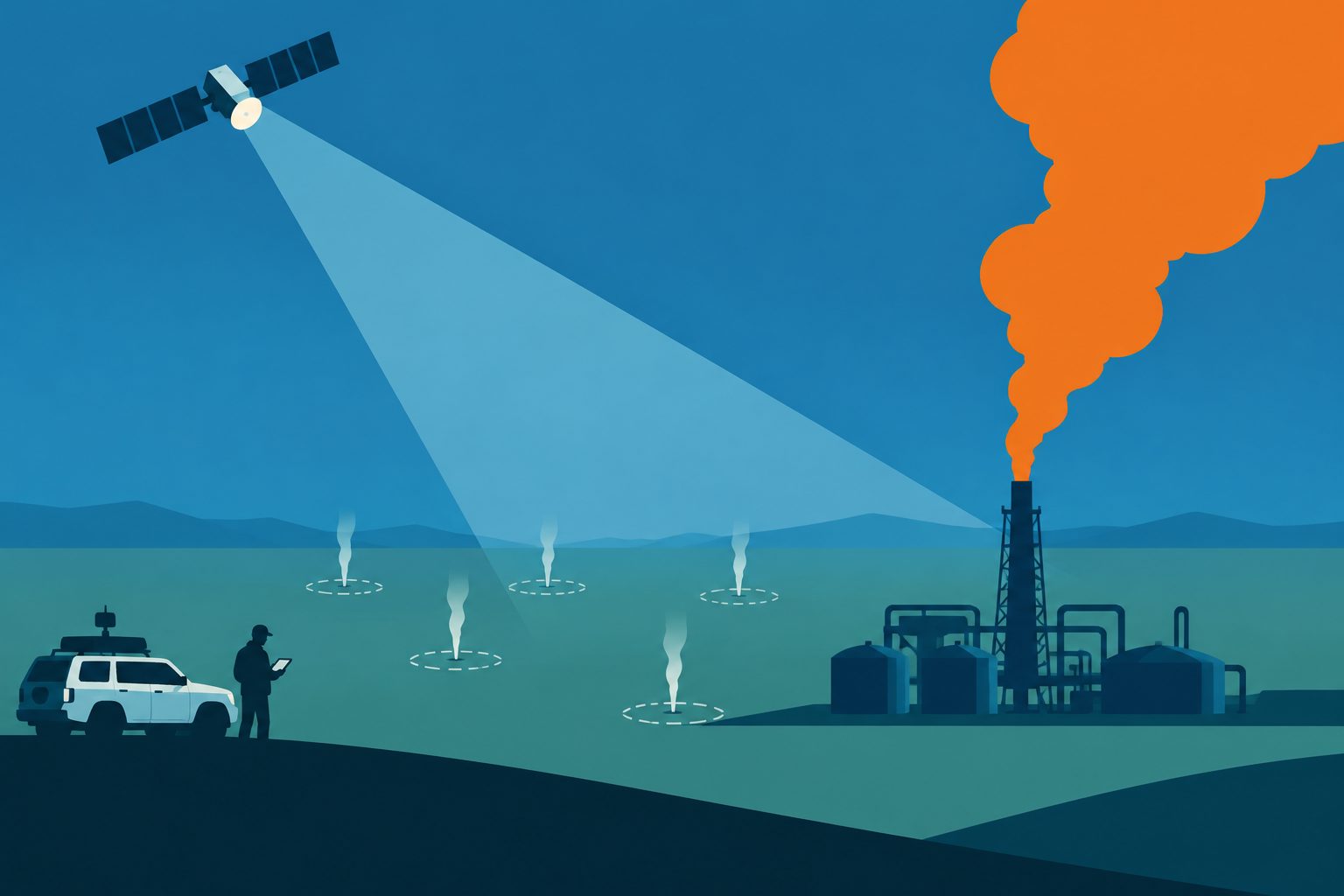
Editorial illustration — not from the study.
The study presents a model for estimating the probability that a remote-sensing system will detect a methane plume. It combines simulated plumes representing different weather conditions with data from controlled releases, and applies the approach to MethaneAIR, MethaneSAT and Insight M LeakSurveyor™.
Using simulations based on MethaneAIR observations from the 2023 MAIRX campaign, the researchers found that correcting for missed plumes is especially important when sensors have relatively high detection thresholds. The results also show that the frequency of rare, high-emission events creates substantial uncertainty in how emissions are distributed across source sizes.
What the surveys can miss
The researchers represented plume visibility with a single, unit-free measure that combines factors affecting detection. These include the sensor’s sensitivity and spatial resolution, the plume-detection software, weather and other scene conditions, and the source’s emission rate.
The model was trained on simulated plumes and checked against controlled-release experiments. The team used it to estimate detection probabilities for two airborne imaging spectrometers—MethaneAIR and Insight M LeakSurveyor™—and the MethaneSAT satellite system.
Monte Carlo simulations based on the 2023 MAIRX MethaneAIR campaign showed that detection corrections can change the inferred distribution of emissions, particularly for systems that miss smaller plumes. The analysis found that rare events emitting more than 500 kilograms of methane per hour can make a large contribution to uncertainty in total-emissions estimates. The researchers report that MethaneAIR and MethaneSAT can detect plumes small enough to examine the strongly uneven emission patterns found in the Permian Basin and other North American oil-and-gas basins. They also found that applying detection-probability weighting did not fully make the distributions produced by two MethaneAIR detection methods agree.
Why rare releases matter
Counts of detected methane plumes are not a direct picture of all emitting sources: a system is more likely to find some plumes than others. If those differences are not accounted for, surveys can misrepresent how emissions are spread across small, moderate and very large sources.
The findings indicate that surveys aimed at measuring the share of emissions from sources above 500 kilograms per hour need enough coverage to capture rare large events, as well as more dispersed emissions. A detection model that does not depend entirely on controlled-release data could also help assess systems such as satellites, for which such experiments may not be available.
Evidence and caveats
This is a modeling study supported by simulated plumes, controlled-release observations and an analysis of MethaneAIR data from the 2023 MAIRX campaign. The model was validated with controlled releases, but controlled experiments capture only some of the observing conditions found in nature; the researchers used simulations to represent additional variability.
The conclusions about emissions distributions come from Monte Carlo simulations and remote-sensing observations, rather than a direct census of all methane sources. The study also reports that detection-probability weighting did not fully reconcile the distributions from two MethaneAIR algorithms, showing that the correction does not remove every source of uncertainty. The excerpts do not provide overall sample sizes or error estimates for the campaign analysis.
// Source
Atmospheric chemistry and physics · 2026 · DOI: 10.5194/acp-26-15915-2026
An analysis of more than 20,000 auroral spectra found that the particles producing diffuse auroras generally become more energetic toward the morning sector. The change was seen across geomagnetic activity levels, although its timing was not fixed and also depended on conditions in the preceding hours.
A new forecasting method uses an AI system to identify important global temperature patterns, then finds similar states in climate-model simulations. Across five regions and lead times of one to 10 years, it produced temperature-distribution forecasts with skill similar to an ensemble of initialized Earth-system models.
Images from the European Space Agency’s JUICE mission show that small volcanic or subvolcanic features on a lunar highland are distributed in ways consistent with control by impact-generated and regional fractures. The same observations also reveal mafic, or iron- and magnesium-rich, material inside Langrenus crater, although its exact minerals remain uncertain.