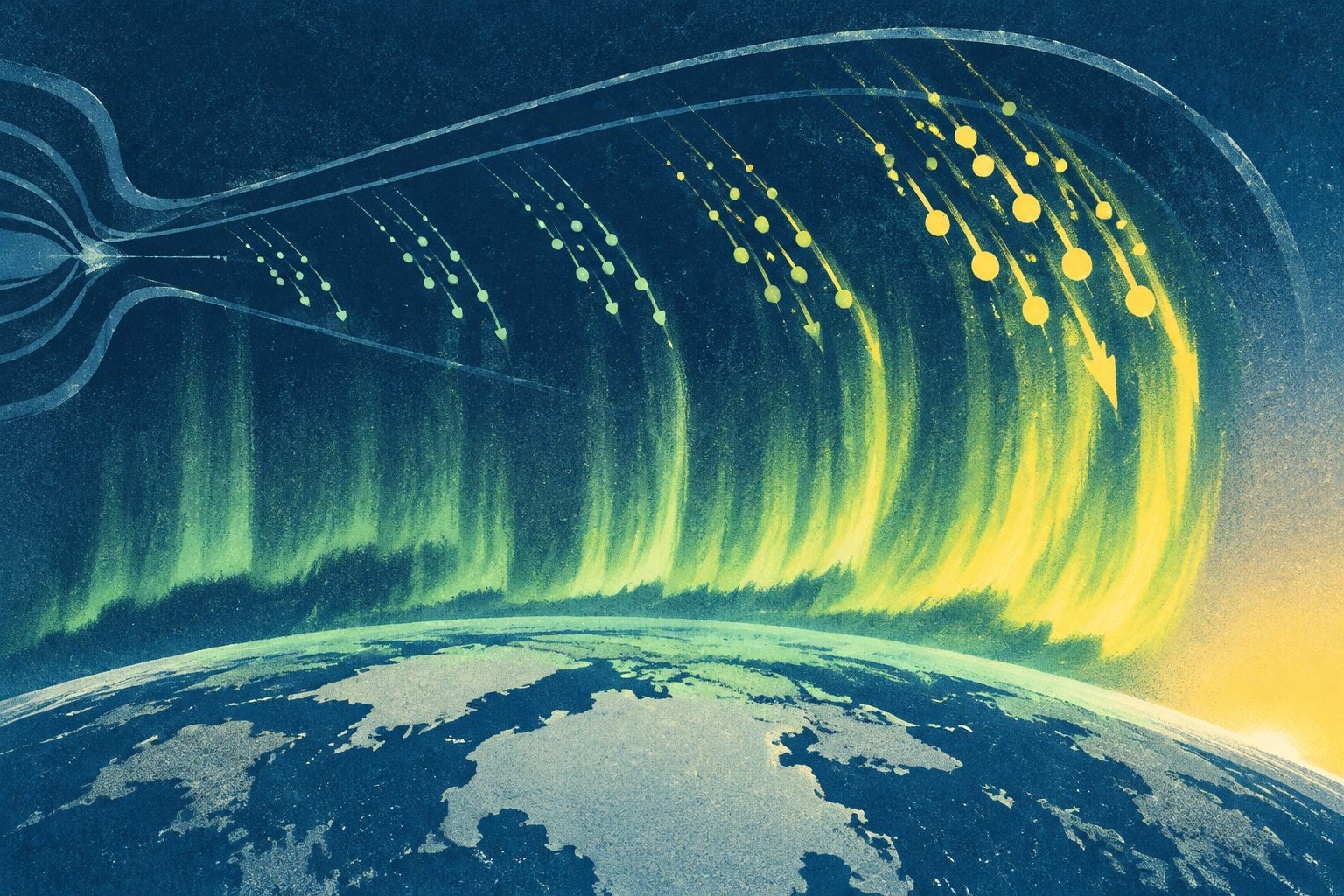
Spectrograph observations show that diffuse auroral precipitation generally hardens after midnight, but the timing varies between nights.
Researchers analyzed two winters of observations from the ASIS spectrograph, selecting diffuse auroras identified by an AI-based system. They estimated the characteristic energy of incoming particles from the relative strength of blue and red auroral emissions, using calibrated models to interpret the measurements.
The data showed a consistent increase in particle energy after midnight, from about 2–2.5 kiloelectronvolts near midnight to nearly 5 kiloelectronvolts toward dawn. Statistical analyses found that the pattern remained after accounting for differences between observing nights, while geomagnetic conditions in the hours before an observation influenced how strongly the pattern appeared.
How auroral energy changed
The diffuse auroral precipitation became systematically harder toward the morning sector. The median characteristic energy rose from approximately 2–2.5 kiloelectronvolts near midnight to values approaching 5 kiloelectronvolts toward dawn.
The strongest statistical support was for a transition near 04:00 magnetic local time, but nearby transition times were also plausible. The researchers therefore treated 04:00 as a representative part of the morning-sector change, not as a sharply defined starting point. The trend remained visible at different levels of geomagnetic activity, while activity during the preceding two and six hours affected its statistical strength.
Evidence and caveats
The findings are based on more than 20,000 spectra collected over two winters with the ground-based ASIS spectrograph. The researchers used red-to-blue emission ratios and forward-model lookup tables as proxies for particle energy, and analyzed the results with Bayesian and night-by-night hierarchical methods.
The observations covered a roughly 4-degree field of view and integrated light across the instrument's entrance slit, limiting spatial detail. A blue-emission intensity threshold removed background-dominated measurements and very faint auroras, so the sample does not represent all auroral activity. The study also notes that the method tends to bias retrieved energies toward lower values. Finally, the broad range of plausible transition times means the data do not identify one universal onset time for the morning-sector hardening.
// Source
Annales Geophysicae · 2026 · DOI: 10.5194/angeo-44-1423-2026
Authors: Gaël Cessateur, Keisuke Hosokawa, H. Lamy, Sota Nanjo, Mathieu Barthélémy, Magnar G. Johnsen, Romain Maggiolo
Institutions: Université Grenoble Alpes, Centre National de la Recherche Scientifique, University of Electro-Communications, Swedish Institute of Space Physics, Royal Belgian Institute for Space Aeronomy, Institut de Planétologie et d'Astrophysique de Grenoble