Methane is rising fast enough to approach the scenarios with most warming
Global atmospheric methane accelerated from 2001 to 2025, with microbial sources driving the long-term increase and much of its variation.
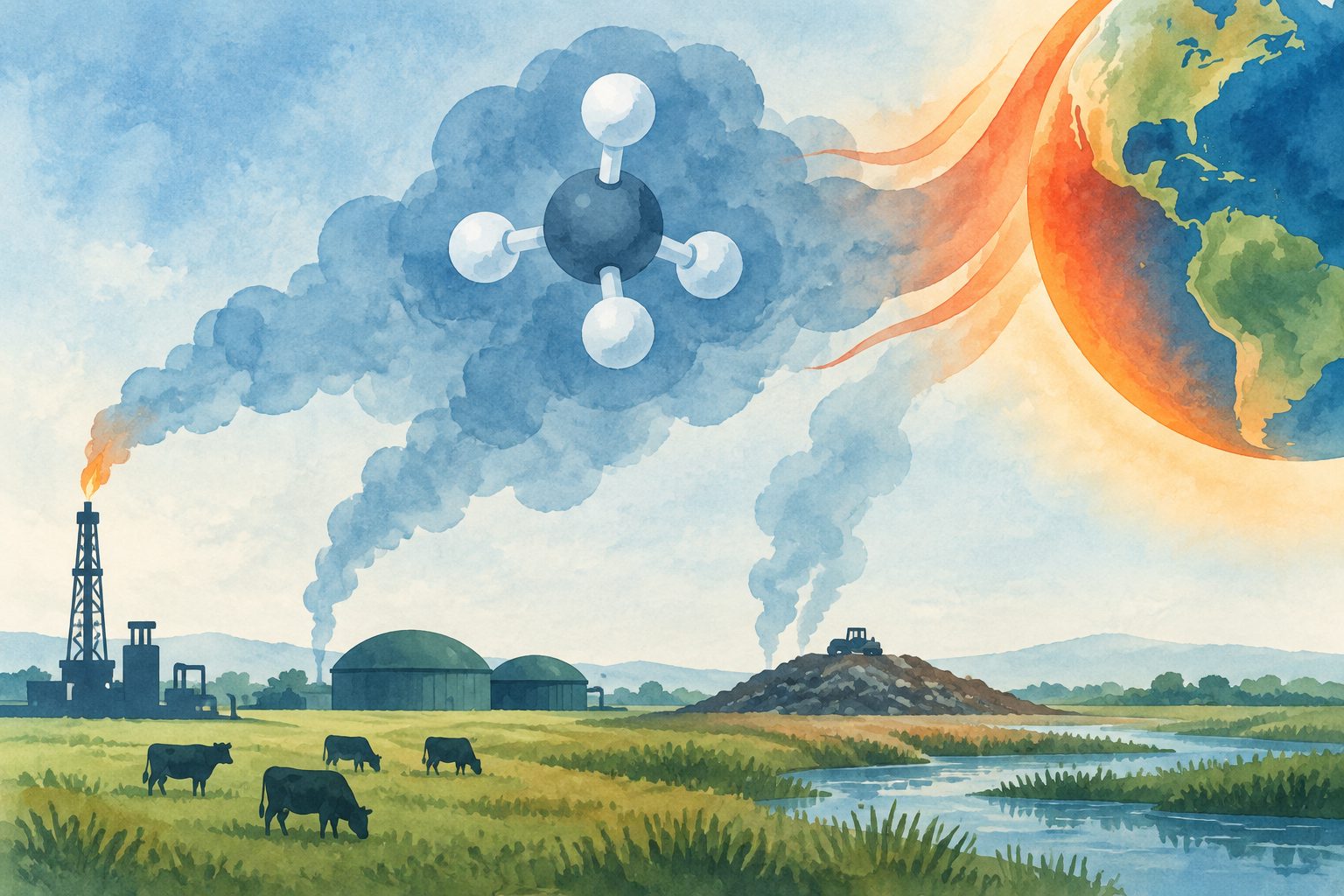
Editorial illustration — not from the study.
Researchers compared global methane concentration estimates from NOAA's Global Monitoring Laboratory with observation-constrained estimates from NASA's Goddard Earth Observing System model. They found that methane's growth rate increased over the study period, while concentrations also showed multi-year fluctuations.
The analysis attributed the long-term trend and most of the shorter-term variation to microbial sources. Agriculture and wetlands are possible contributors, but the study says more monitoring and investigation are needed to determine how these sources are changing.
Methane’s rising growth rate
Atmospheric methane accelerated from 2001 through 2025, despite substantial shorter-term fluctuations. A particularly large fluctuation peaked in 2021 and 2022, then declined, while total methane concentration continued to rise.
Current methane concentrations are consistent with the moderate-warming SSP2-4.5 and SSP4-6 pathways. If the current trend continues, concentrations are expected to surpass SSP2-4.5 and align more closely within the next decade with SSP5-8.5, the highest-forcing Tier 1 pathway, reaching an estimated range of about 2,200 to 2,500 parts per billion. By midcentury, the current trend is expected to be closest to scenarios associated with severe warming, although the study's uncertainty range includes both faster and slower growth.
The study found that microbial sources drove the decadal increase in methane growth and most of the shorter-term variation. The authors identify agriculture and wetlands as possible contributors, including wetland responses to climate conditions.
Why the pathway matters
Methane concentrations differ substantially among the climate pathways, especially during the first half of this century. A faster-than-expected rise would place atmospheric methane closer to pathways associated with greater warming, making accurate projections and effective mitigation more difficult.
The findings also point to microbial sources as an important focus for further research. Understanding contributions from agriculture and wetlands could improve future methane forecasts and help clarify which mitigation assumptions in climate scenarios remain realistic.
Evidence and uncertainties
The researchers analyzed globally distributed atmospheric observations used to estimate annual global methane concentrations, together with observation-constrained results from the NASA GEOS Earth system model. The reported uncertainty in annual average concentrations was 0.4 to 0.9 parts per billion, which the authors say is small compared with the observed trend and multi-year fluctuations.
The projection assumes that the recent long-term trend continues and that the large short-term fluctuation around 2021 and 2022 can be modeled separately from that trend. The authors note that conclusions would need updating if further observations show this assumption is wrong. The confidence range for the trend also allows for either acceleration or deceleration by midcentury, so the comparison with the highest-forcing pathways is not a firm forecast. The analysis indicates microbial sources but does not by itself establish the precise contributions of agriculture and wetlands.
Bacteria can significantly increase the algae-killing effect of viruses, a study of coccolithophore blooms finds. Alteromonas bacteria were drawn to infected algal cells and became more common in particles formed as blooms collapsed, potentially influencing how carbon is recycled or exported in the ocean.
Two atmospheric chemistry models produced similar oxidation pathways for simple hydrocarbons but diverged for larger, more complex compounds. The differences changed predictions of how easily oxidation products form secondary organic aerosol, or particles created in the atmosphere.
A synthesis of 326 dated sediment cores revises downward the estimated rate at which seagrass meadows bury organic carbon. Even so, the study estimates that seagrass sediments account for 3–6% of total oceanic organic-carbon burial.