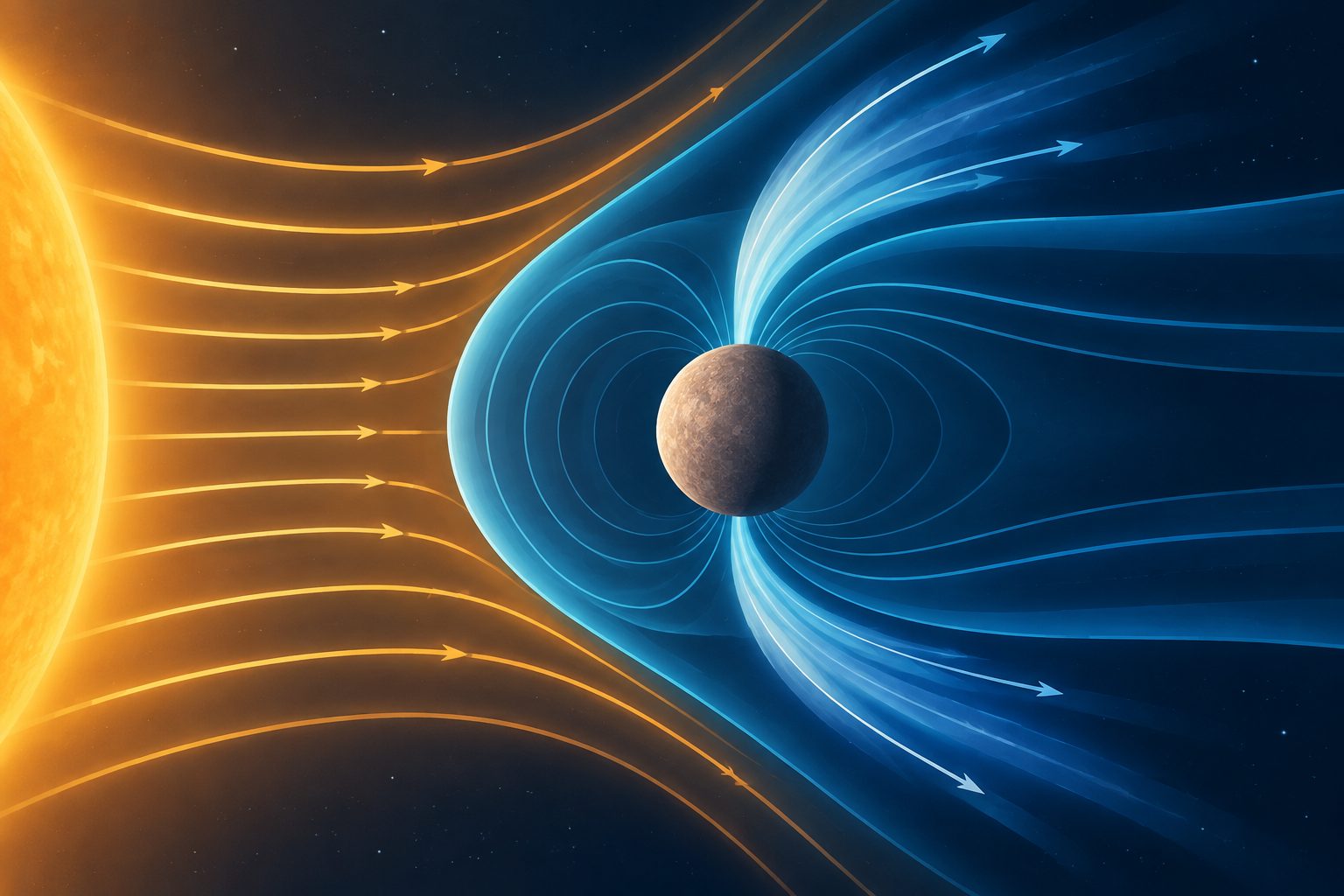
MESSENGER data point to 116 candidate layers near Mercury’s boundary, a pattern the BepiColombo mission can test.
Researchers examined magnetic-field and ion-flux measurements from the MESSENGER spacecraft across 4,019 crossings from the solar wind into Mercury’s magnetosphere. They identified 116 events with a sharp drop in magnetic-field strength and an increase in high-energy proton flux, features consistent with a long-lasting reconnection outflow region.
The candidate layers had a typical normalized thickness of 0.12, or about one-tenth of the surrounding magnetosheath thickness—roughly 132 kilometers. Their thickness was least variable around 30° north latitude, which the researchers interpret as a possible sign of more stable reconnection sites there.
Candidate layers at Mercury
The study identified 116 ARL-like events in MESSENGER data, representing about 3% of the 4,019 solar-wind-to-magnetosphere crossings examined. The events were selected because they combined two features: weaker total magnetic fields and greater fluxes of high-energy protons.
Their normalized thickness followed a log-normal distribution, with a mean of 0.12. This corresponds to about one-tenth of the local magnetosheath thickness, or approximately 132 kilometers. The thickness distribution reached a minimum near 30° north latitude, suggesting that stable magnetic reconnection sites may be concentrated around that latitude.
A test for BepiColombo
The findings support the idea that Mercury’s low-Alfvén-Mach-number solar wind may favor recurring reconnection-layer structures near its magnetopause. This offers a specific, testable picture of how the solar wind interacts with Mercury’s magnetic environment.
The pattern can be examined with observations from the upcoming BepiColombo mission, which may help determine whether these candidate layers are genuine reconnection outflows and clarify where reconnection occurs around Mercury.
Evidence and caveats
The researchers analyzed 1-second magnetic-field measurements and 9-second proton-flux measurements from MESSENGER’s magnetometer and fast imaging plasma spectrometer. They visually selected candidate events from a database of 4,019 magnetopause crossings, using the simultaneous presence of reduced magnetic-field strength and enhanced high-energy proton flux as the main criteria.
These are candidate ARLs rather than confirmed detections. MESSENGER did not measure the bulk velocity of the plasma, so the data could not directly demonstrate the outflow jets expected from magnetic reconnection. The study therefore reports structures consistent with reconnection outflows, not definitive proof that every selected event was one.
// Source
Earth Planets and Space · 2026 · DOI: 10.1186/s40623-026-02555-z
Authors: I-Hsiang Chiu, Jih‐Hong Shue, Hiroshi Hasegawa, Yasuhito Narita, Jun Zhong, Zhaojin Rong, Masafumi Hirahara
Institutions: Chinese Academy of Sciences, Nagoya University, National Central University, Institute of Geology and Geophysics, Technische Universität Braunschweig, Institute of Space and Astronautical Science