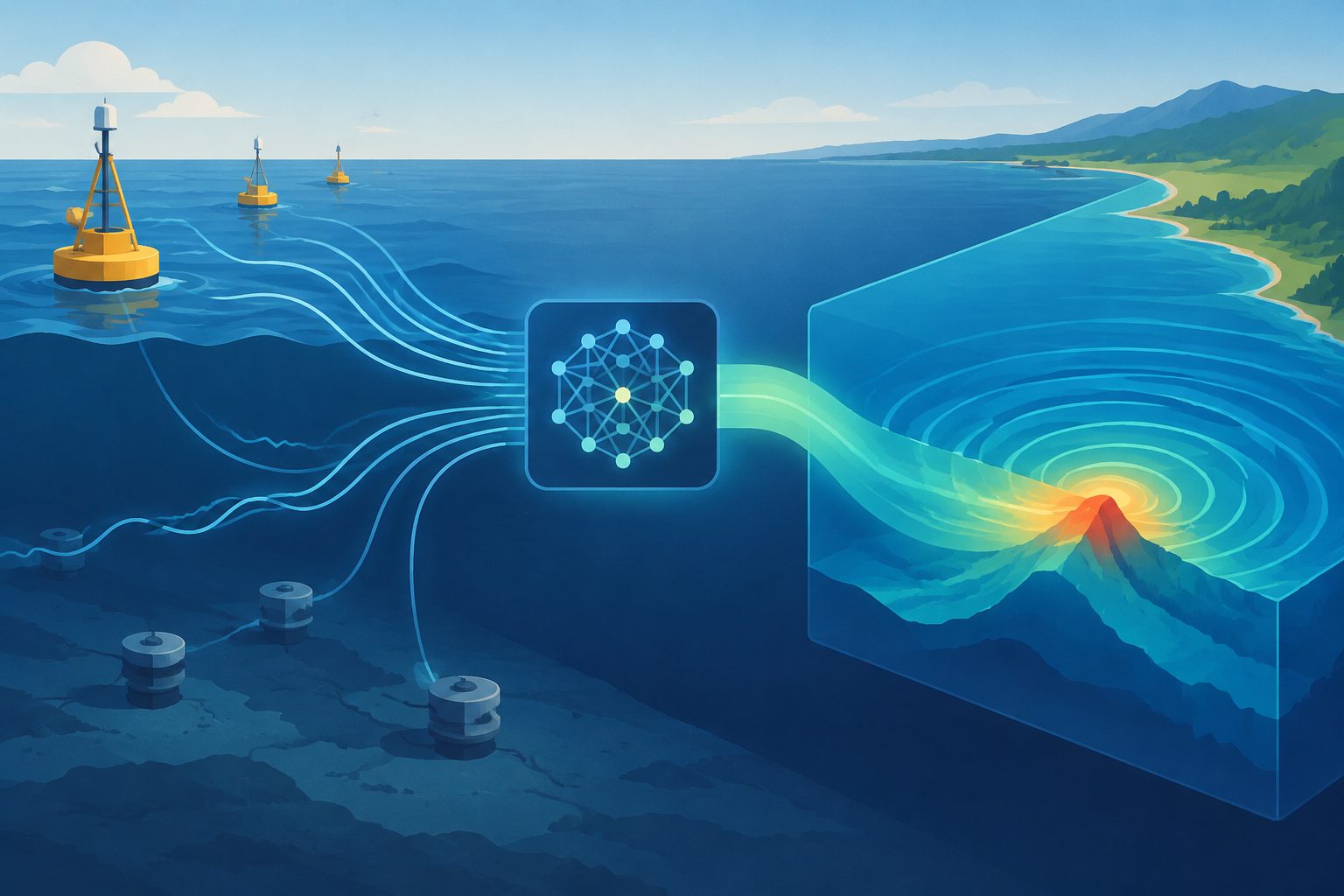
The system uses a Fourier Neural Operator, an AI method trained to approximate how tsunami waves move under standard long-wave equations. It can predict future wave fields much faster than repeatedly running conventional tsunami simulations, and it calculates the information needed for source estimation without separately writing the usual adjoint equations.
The researchers used the system to estimate both the initial sea-surface height and earthquake fault parameters. They tested the methods with synthetic data and tsunami observations recorded by Japan’s N-net system after the magnitude 7.1 Hyuga-nada earthquake in 2024.