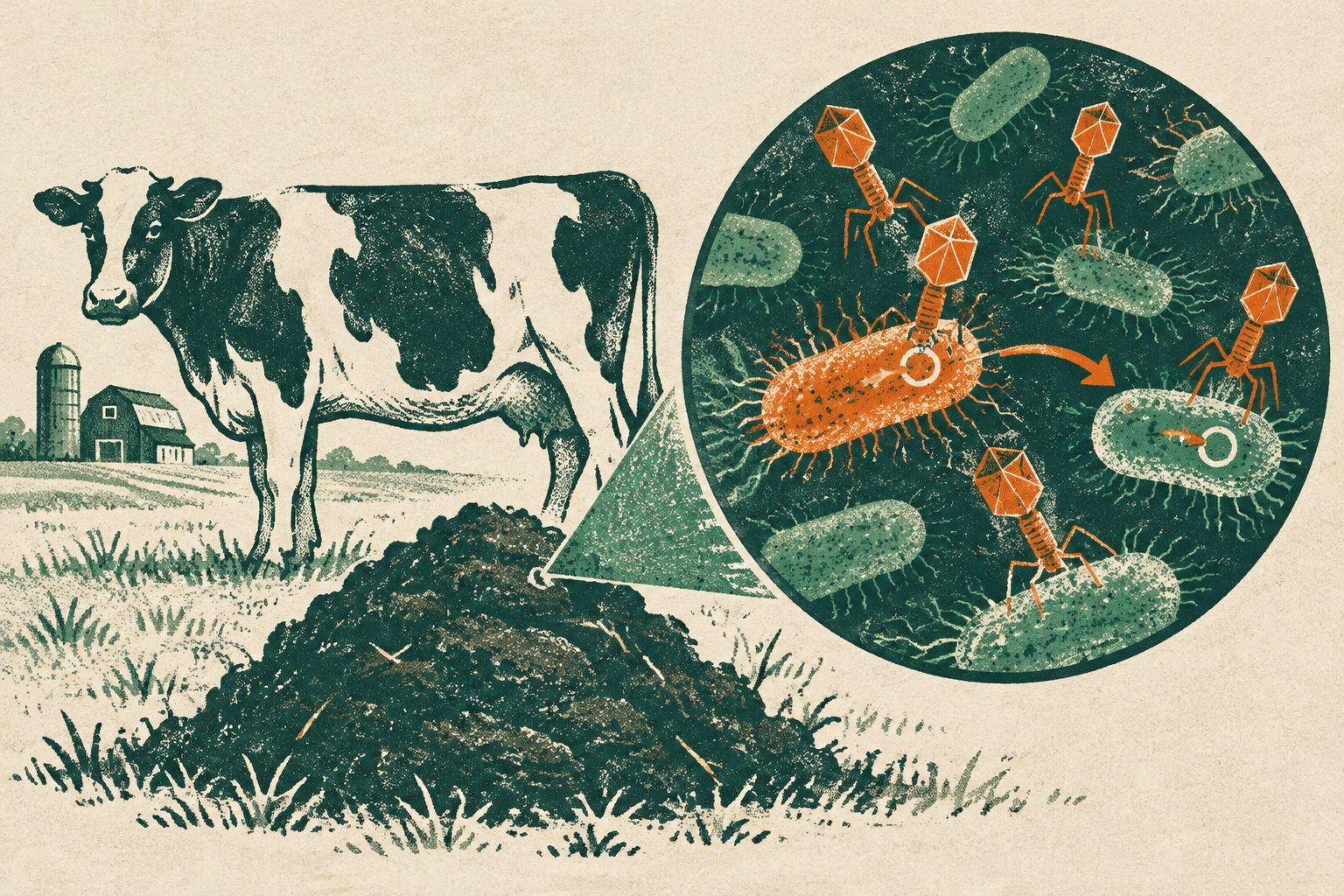
A global catalog suggests these viruses often interact with resistant bacteria rather than carrying resistance genes themselves.
Researchers compiled the Livestock Manure Virus Database from 4,017 metagenomes, creating a global catalog of 1,330,372 viral operational taxonomic units. They found that viral communities had restricted geographic distributions, while antibiotic use and farm size were the strongest predictors of viral diversity in the analysis.
The viral genomes contained 78 types of antibiotic-resistance genes, accounting for 9.1% of the resistance-gene diversity detected in livestock manure, but genes carried directly by viruses were infrequent. Instead, bacteriophages—viruses that infect bacteria—had predicted links to nearly all antibiotic-resistant bacteria, especially through temperate viruses, and these links were enriched among pathogenic resistant bacteria.
What the manure viruses showed
The study created the Livestock Manure Virus Database from 4,017 metagenomes and identified 1,330,372 viral operational taxonomic units. Livestock-manure viral communities showed restricted biogeographic distributions. Antibiotic use and farming scale had the highest relative predictive importance for viral diversity.
Viral genomes contained 78 antibiotic-resistance gene subtypes, representing 9.1% of resistome diversity in livestock manure. However, virus-encoded resistance genes were infrequent. Bacteriophages had extensive predicted links to bacterial hosts, with nearly all antibiotic-resistant bacteria linked to viruses. These links involved predominantly temperate viruses and were enriched among pathogenic antibiotic-resistant bacteria.
Why the viral links matter
The findings place limits on the apparent role of viruses in directly spreading antibiotic-resistance genes in livestock manure. They instead point to viral interactions with resistant bacteria—particularly interactions involving temperate viruses—as a possible way viruses may shape antibiotic-resistance risk.
This distinction matters because controlling resistance risk may require attention not only to resistance genes carried by viruses, but also to how viruses interact with bacteria that already carry those genes. The study does not establish that these interactions cause resistance to spread.
Evidence and caveats
This is a global catalog and metagenomic analysis, based on viral genomes reconstructed from 4,017 metagenomes. The links between viruses and bacterial hosts, and the effects of antibiotic use and farming scale on viral diversity, are predicted from genomic and environmental data rather than demonstrated in experiments.
The study therefore identifies associations and possible routes by which viruses could influence resistance, but it does not prove that the predicted viral interactions increase transmission of resistance genes. The abstract also does not specify how the metagenomes were distributed among livestock types or regions, which limits what can be concluded about particular animals or farming systems.
// Source
Nature Communications · 2026 · DOI: 10.1038/s41467-026-78855-5
Authors: Lan Jiang, Bintao Li, Liusheng Lei, Zishu Liu, Wei Sun, Liping Ma, Chang‐Jun Cha, Timothy A. Johnson, Jing Yu, Zeyou Chen, Yiran Zhang, Guangdong Wang, Chengcheng Yao, Xiaoyu Fan, Fengjia Liu, Wenshan Yang, Wenyan Wang, Haihan Zhang, James M. Tiedje, Xun Qian
Institutions: Chung-Ang University, Michigan State University, Northwest A&F University, Purdue University West Lafayette, East China Normal University, Nankai University, Xi'an University of Architecture and Technology, Ecologie microbienne