JWST finds signs of radiation-driven winds in some distant active galaxies
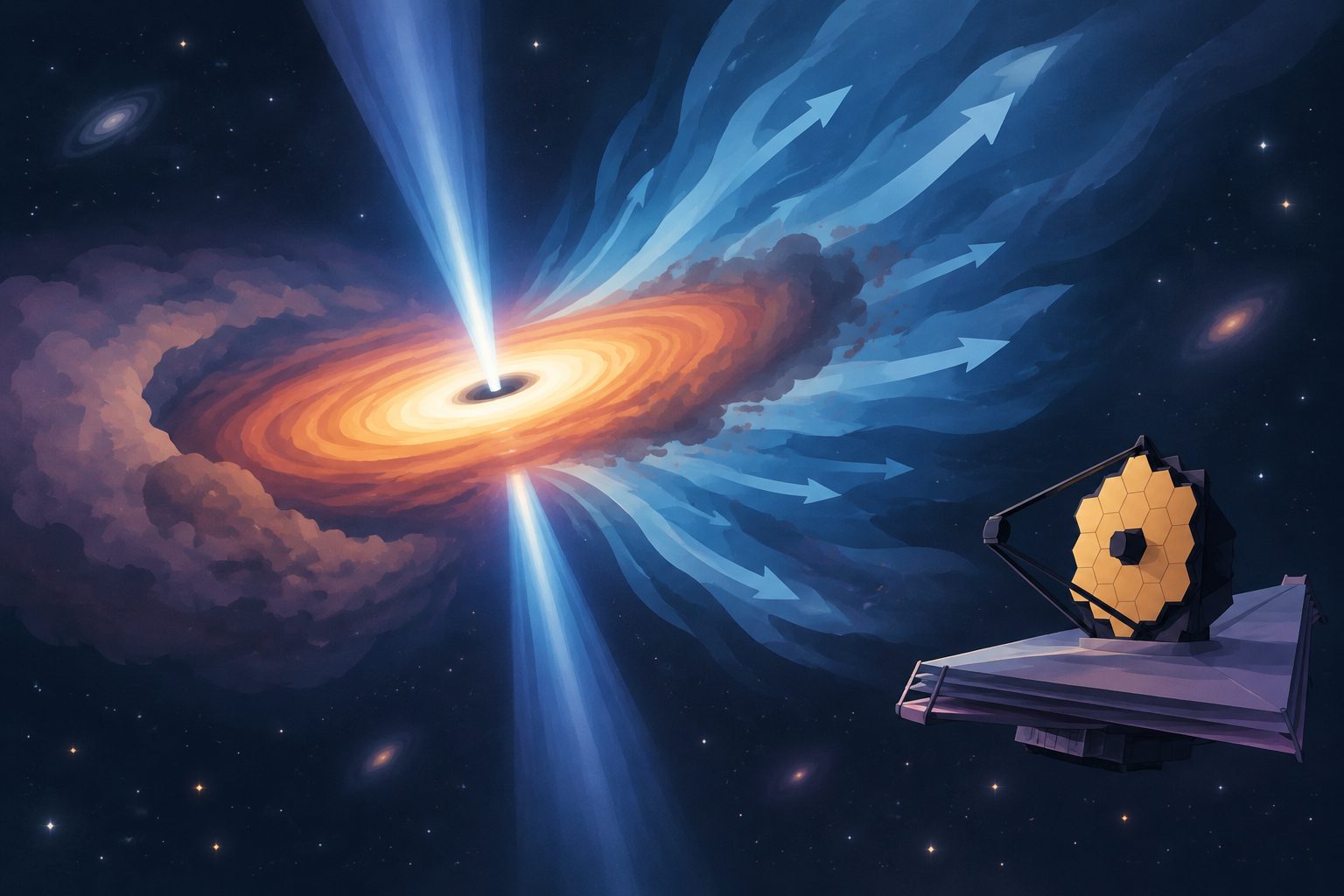
Balmer-line absorption in many Little Red Dots is consistent with gas being pushed outward by radiation from their central engines.
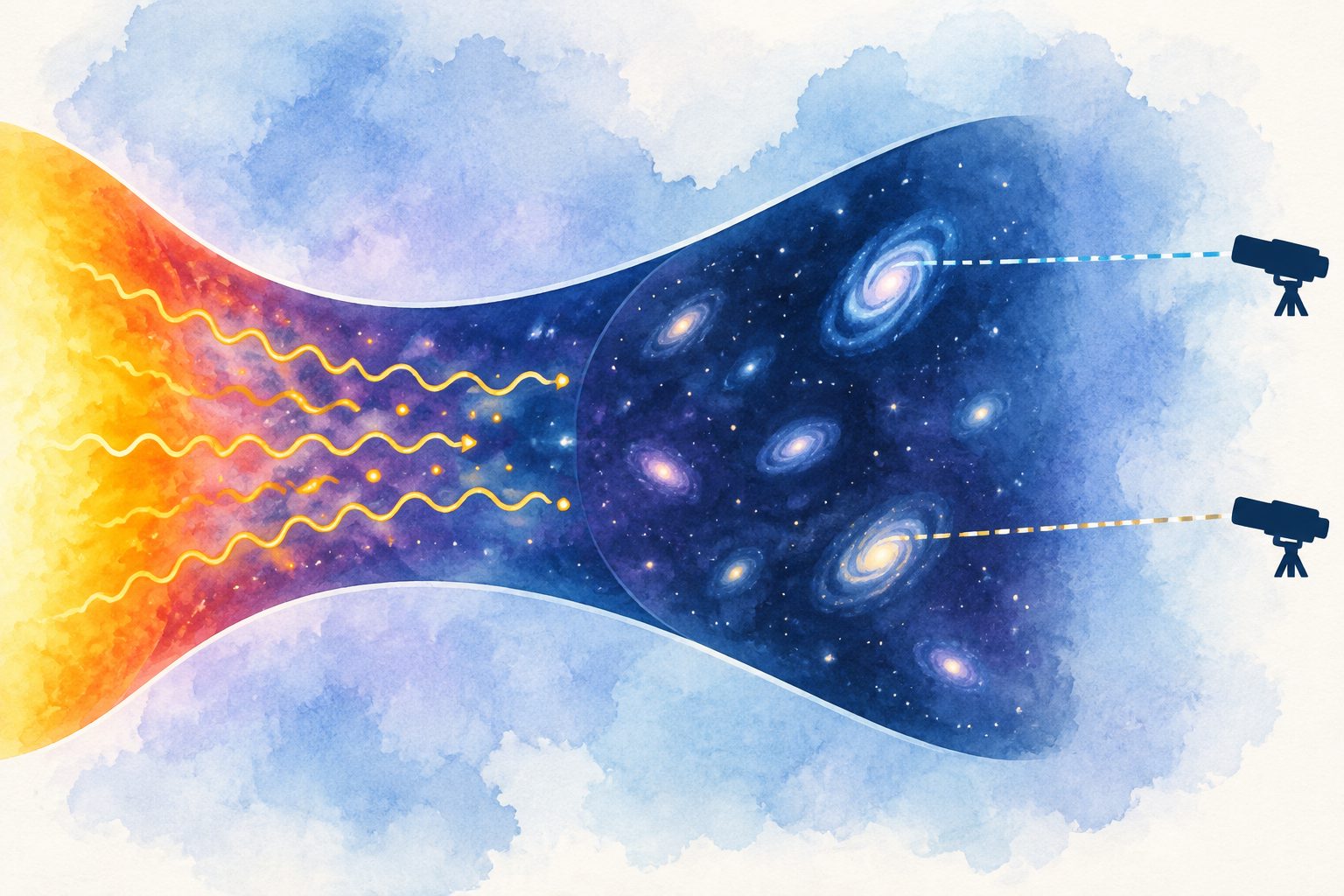
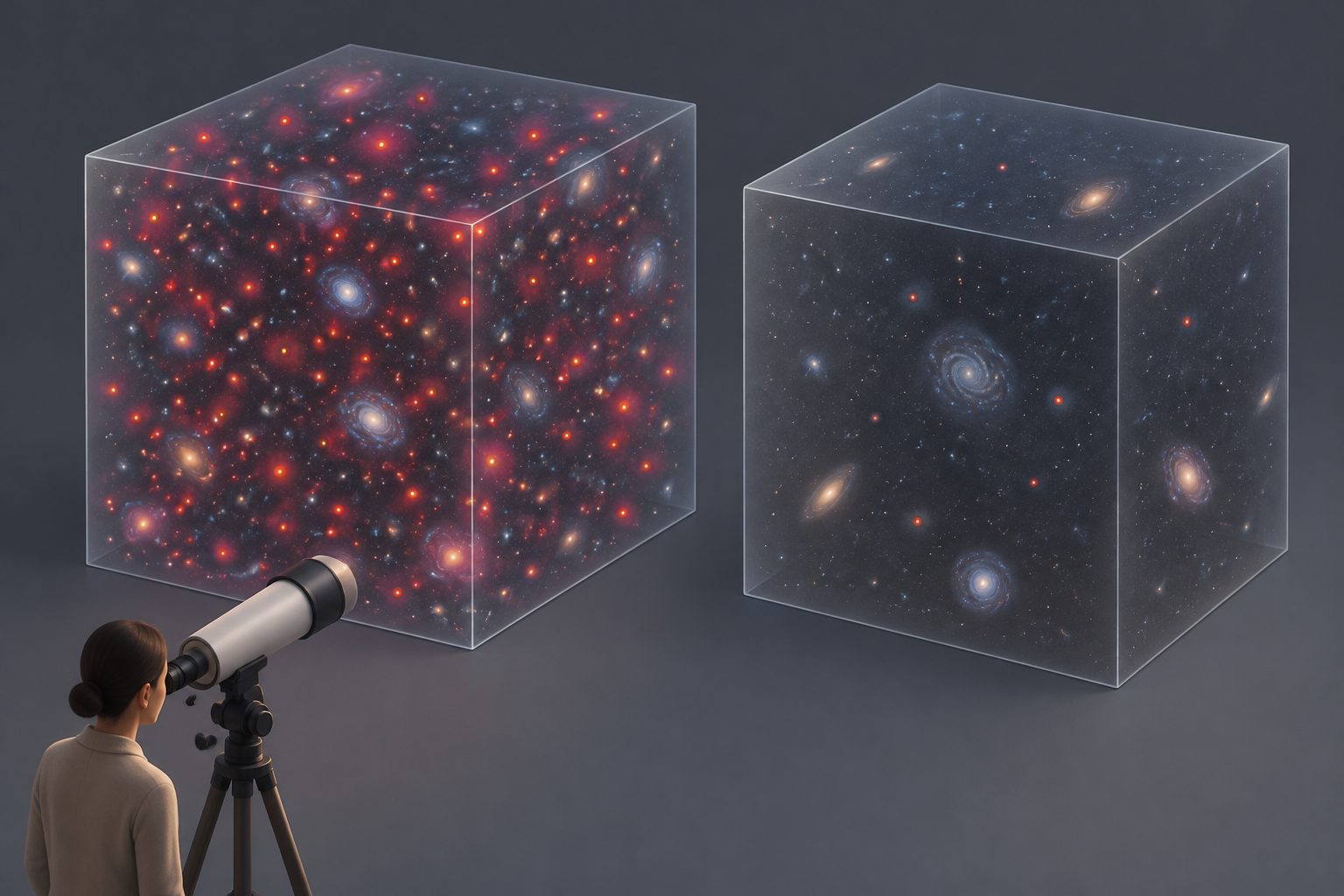
Editorial illustration — not from the study.
Researchers examined JWST/NIRSpec spectra of 47 Type 1 active galactic nuclei at redshifts between 2 and 7, focusing on absorption in broad hydrogen lines. After accounting for incomplete spectroscopic coverage, they estimated that 44% of Little Red Dots show H-alpha absorption, compared with an upper limit of 25% for Little Blue Dots.
The speed of the Balmer absorption was significantly related to the luminosity of a nearby oxygen emission line. The researchers say this points to a shared driving mechanism. Comparisons with quasars and stars also indicated that the absorption in Little Red Dots and broad-absorption quasars is consistent with outflows powered by radiation.
Where absorption appears
The estimated incidence of H-alpha absorption was 44% in Little Red Dots, with an uncertainty range of 38% to 65%. For Little Blue Dots, the incidence was below 25% at the 2-sigma level. The study therefore identifies strong H-alpha absorption as a feature of Little Red Dots rather than Little Blue Dots, although incomplete data mean that weaker or harder-to-detect absorption may have been missed.
The velocity of Balmer absorption was significantly correlated with the luminosity of the narrow [O III] 5007 emission line, suggesting that the two may be linked to the same driving process. The researchers found no other significant relationships between Balmer absorption and the tested spectral properties of Little Red Dots, apart from the expected relationship between the absorption velocities of H-alpha and H-beta.
Comparing Little Red Dots with quasars and stars that show H-alpha absorption, the researchers found that the patterns in Little Red Dots and broad-absorption-line quasars are consistent with radiation-driven outflows. The study also found that lower-resolution JWST spectra cannot reliably separate the effects of gas motion from the effects of optical depth, which describes how strongly material absorbs light.
Why the winds matter
The results connect unusual hydrogen-line absorption in a population of faint, high-redshift active galaxies with outflowing gas that may be pushed by radiation from the central source. The relationship between absorption speed and oxygen-line luminosity provides evidence that the outflow and the larger-scale ionized gas may share a driving mechanism.
The different absorption rates in Little Red Dots and Little Blue Dots also show that these visually distinct types of faint active galaxy do not display the same Balmer-line behavior. This gives researchers a way to test explanations for their unusual spectra and to compare gas flows around active galactic nuclei with similar processes seen in variable stars, but on very different scales.
Evidence and caveats
The study is based on JWST/NIRSpec observations of 47 Type 1 active galactic nuclei drawn from several surveys. The researchers refit the spectra and searched for absorption in broad H-alpha and other Balmer lines, while accounting for incompleteness in the observations.
The incidence estimates are affected by missing or difficult-to-detect absorption, especially features near zero velocity that can be filled in by narrow emission. Most of the available spectra were taken at the lower R1000 resolution, which limits measurements of absorber properties. Higher-resolution R2700 data reduce this problem but do not remove all ambiguities involving optical depth, gas motion, covering fraction and emission-line infill. The sample also has limited statistical power for detailed constraints, and the current data cannot rule out H-alpha absorption in all Little Red Dots.
// Source
Monthly Notices of the Royal Astronomical Society · 2026 · DOI: 10.1093/mnras/stag2131
A new analysis finds that extra, self-interacting radiation in the early universe is more compatible with ACT observations when the pattern of primordial fluctuations is allowed to vary with scale. In the models tested, this reduces the Hubble tension from the standard model’s level to 2.2σ, or below 2σ in a version where the radiation was once coupled to dark matter.
Researchers used a tensor-network calculation to study how force-carrying strings break apart in a simplified model of particle interactions. The work links string breaking with energy transport, particle production, entanglement growth and the spread of correlations.
Astronomers identified eight nearby examples of the compact objects known as “little red dots,” at distances corresponding to redshifts of 0.2 to 0.45. The objects showed broad hydrogen emission lines and little change in brightness, but their estimated abundance was about 10,000 times lower than that of similar objects in the universe’s first billion years.