A search of DESI data found eight compact red emitters with broad hydrogen lines but little of the high-energy light typical of many active galaxies.
Using spectra from the first data release of the Dark Energy Spectroscopic Instrument, researchers searched for nearby objects with the unusual emission-line features associated with little red dots seen by the James Webb Space Telescope. They found eight compact objects at redshifts between 0.2 and 0.45.
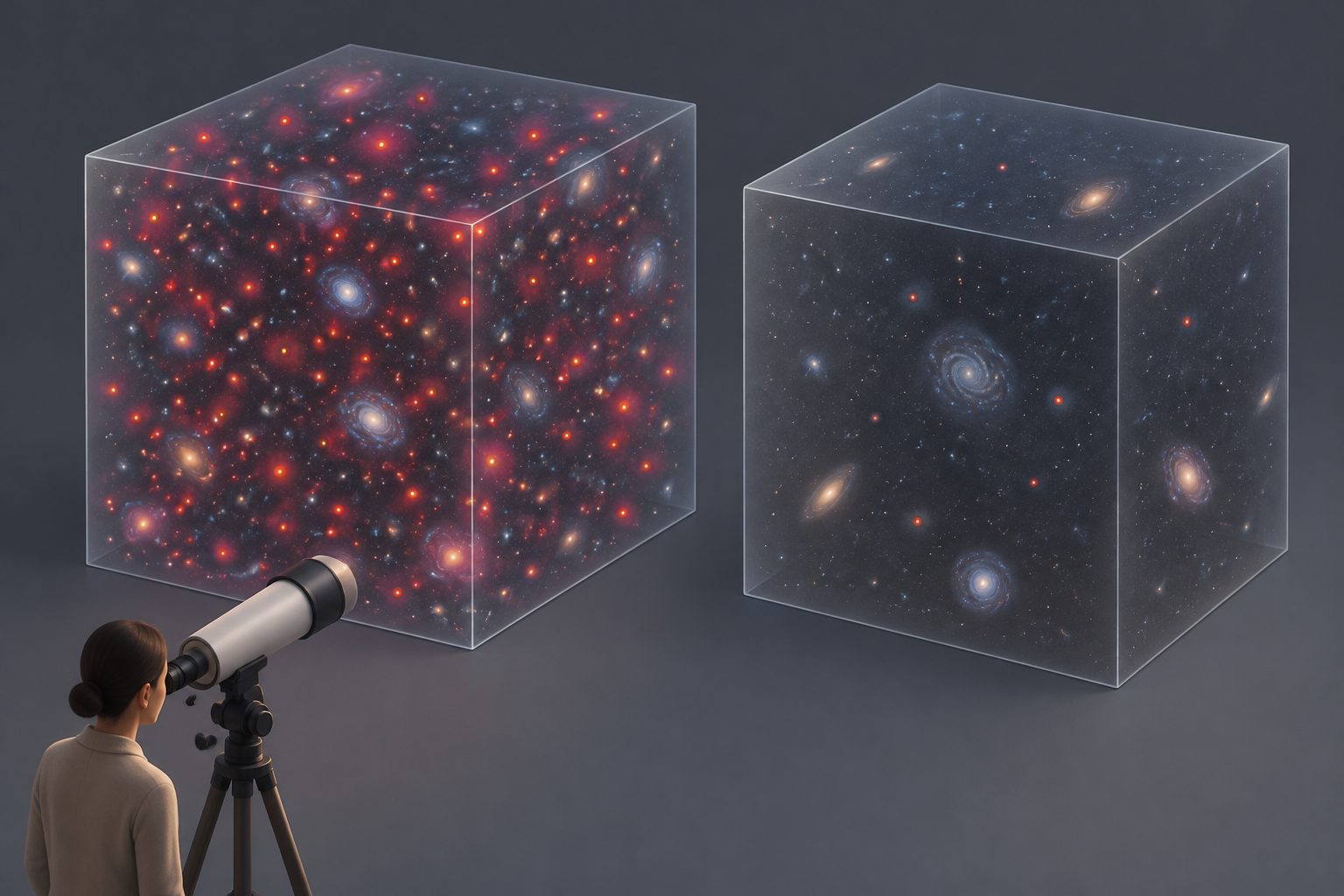
The objects had broad Balmer lines, steep changes in the relative strength of those lines, and weak or absent lines associated with highly energized atoms. Light curves were available for seven objects; most showed only weak or no intrinsic changes in brightness over 4–17 years in their own rest frames. The estimated number density was 1.6 × 10⁻⁹ per cubic megaparsec, roughly 10,000 times lower than reported for the early universe.
Eight nearby red dots
The eight objects shared several features with high-redshift little red dots: compact shapes, broad Balmer lines, steep Balmer decrements, Balmer absorption features and/or strong neutral helium emission. They generally had weak or absent ionized helium, neon and other high-excitation lines often seen in Type I active galactic nuclei.
For seven of the eight objects, the researchers obtained densely sampled light curves from time-domain surveys. Most varied by only about 0.0–0.1 magnitudes over 4–17 years in the rest frame. The estimated number density was 1.6 × 10⁻⁹ per cubic megaparsec, based on the effective volume covered by the survey. The study also identified a quasar with similar hydrogen-line profiles, but unlike the little red dots it showed a different Balmer decrement, substantial variability and high-ionization lines.
Why the rarity matters
Little red dots are common in observations of the early universe but have been difficult to find at lower redshifts, where they can be studied in greater detail with ground-based observatories. This sample shows that similar objects do exist nearby, while also indicating that they are much rarer there than during the universe’s first billion years.
The shortage of bright, red little red dots below redshift 1 could be consistent with less gas feeding the activity associated with these objects at later cosmic times. The findings provide nearby targets for studying the unusual gas and possible black-hole activity linked to little red dots, without establishing what powers them.
// Source
Astronomy and Astrophysics · 2026 · DOI: 10.1051/0004-6361/202660929
Authors: Kevin Park, Alberto Torralba, Jorryt Matthee, Sara Mascia, Zoltán Haiman, Rohan P. Naidu, Anna de Graaff