The result held in 11 of 18 impact categories under one accounting method, but reversed under another.
Researchers assessed the environmental impacts of producing oil and protein from locally cultivated Lagenaria siceraria seeds in Côte d'Ivoire, from farming through processing. They compared the results with imported soy protein across 18 environmental impact categories and used Monte Carlo simulation to represent uncertainty.
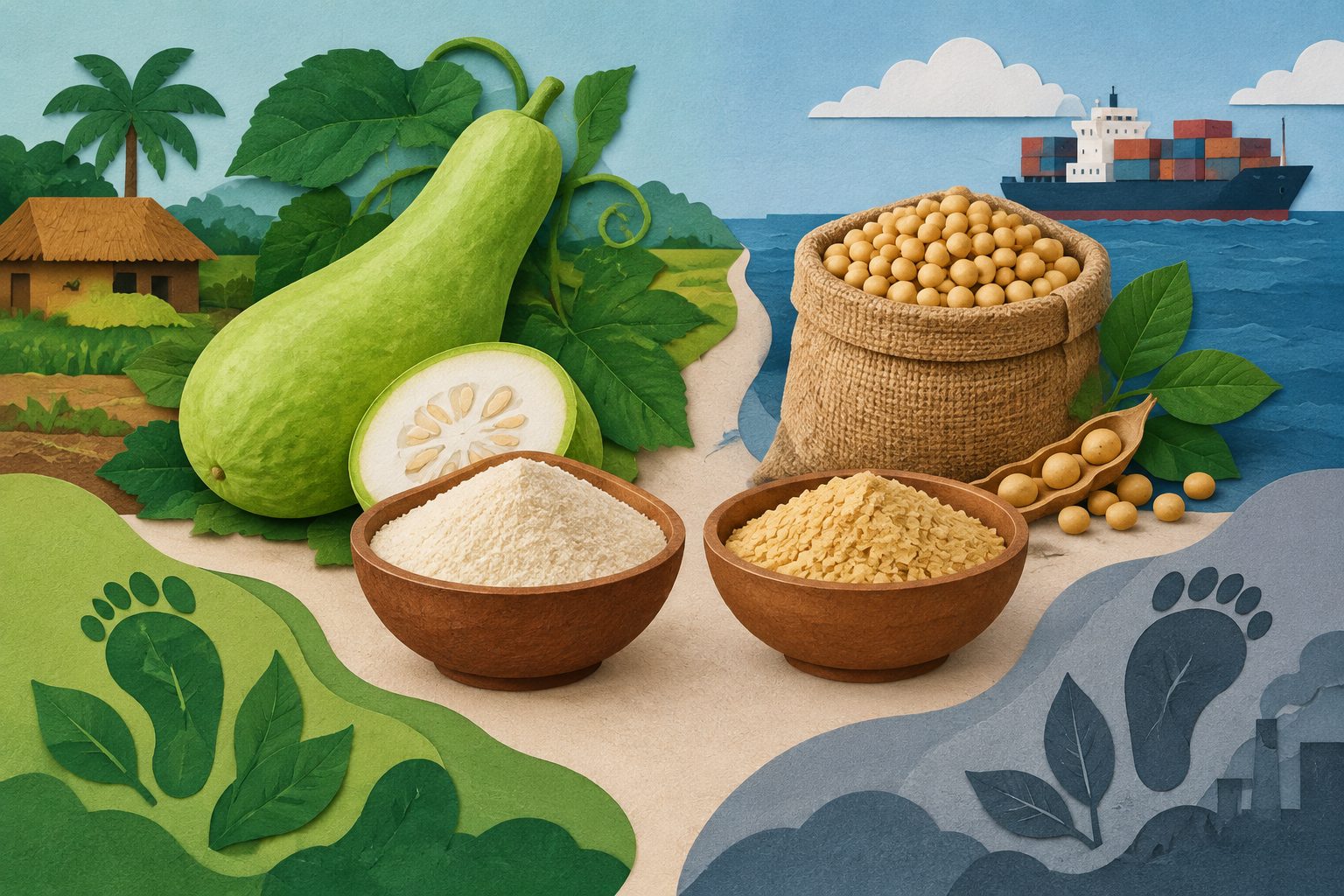
Under economic allocation, which assigns impacts according to the products' economic value, bottle-gourd protein had lower impacts than soy in 11 categories. The two were indistinguishable for climate change, while mass allocation reversed the ranking in most categories. Processing, especially protein drying and sodium chloride use, was more important than cultivation in the bottle-gourd system.
What the comparison found
Under economic allocation, the bottle-gourd system had lower impacts than imported soy protein in 11 of 18 categories. The two protein sources could not be distinguished for climate change. Under mass allocation, bottle-gourd protein had lower impacts in only three categories, while the ranking reversed in most categories; in three additional categories, the uncertainty prevented a definitive comparison.
For the bottle-gourd system, farming was a minor contributor under economic allocation. Fertilization at prevailing regional rates changed results by less than 0.2% in 17 categories. The main sources of impact were downstream processing, especially the electricity used to dry protein and the use of sodium chloride.
Why the result matters
The findings suggest that producing protein from a local Ivorian crop can have environmental advantages over imported soy, particularly for impacts linked to agricultural land use and long-distance transport. But those advantages are not inherent or fixed: they depend strongly on how impacts are divided between the bottle gourd's oil and protein products.
The study also points to processing as a practical focus for reducing impacts. The authors identify lower-energy drying, alternative heat sources, partial recovery of the saline extraction medium and improved residue management as potential ways to improve the local process.
Evidence and caveats
This was a cradle-to-gate life cycle assessment, a modeling approach that estimates environmental impacts from cultivation through processing rather than measuring impacts in a direct field experiment. The analysis covered 18 categories and used Monte Carlo simulation to account for uncertainty. Energy use for the laboratory-developed process was estimated using a scale-up framework.
The central comparison depended on the allocation method. Economic allocation reflects the system's current focus on fruit and oil, with protein treated as a lower-value co-product; mass allocation divides burdens according to physical amounts and represents a different way the system could be organized. Because these choices produced substantially different rankings, the authors say they should be reported explicitly. The comparison also involved a small-scale local processing route and a mature industrial soy process, so the differences include the effects of processing scale and technology.
// Source
Environmental Progress & Sustainable Energy · 2026 · DOI: 10.1002/ep.70736
Authors: Andrea Di Maria, Christelle Kouakou, Roua Lajnaf, Mohamed Ayadi
Institutions: Gembloux Agro-Bio Tech