A 14-day study found the most pronounced molecular thyroid effects at 10 micrograms per liter, alongside kidney changes at all tested doses.
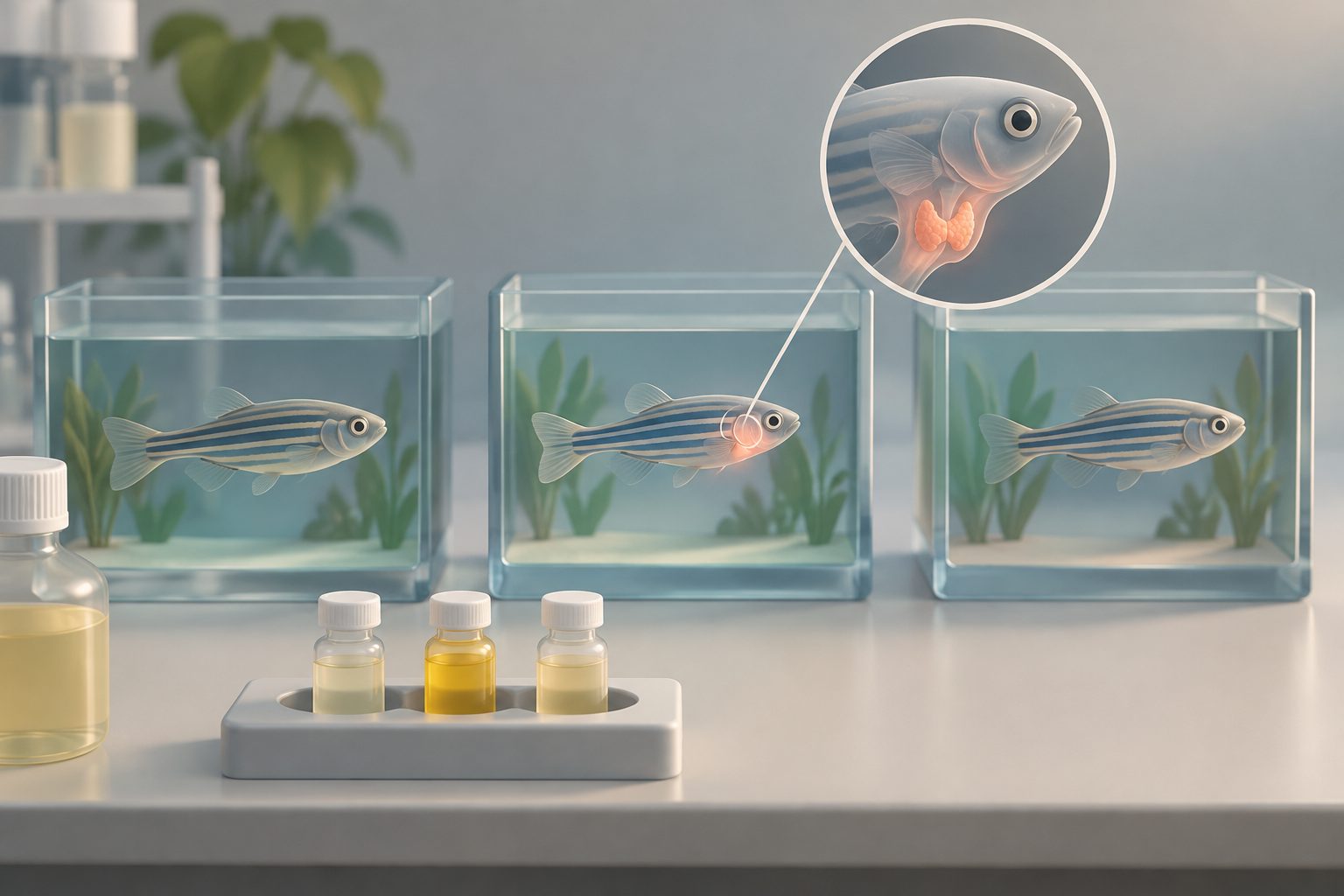
Researchers exposed adult female zebrafish to pyriproxyfen concentrations of 1, 10 or 100 micrograms per liter for 14 days. They examined tissue structure, hormones and gene activity in the thyroid, brain, liver and kidney.
The 10-microgram-per-liter group showed the most pronounced molecular changes in the thyroid, while kidney tubules were altered across all exposure groups. At 100 micrograms per liter, changes in thyroid-stimulating hormone and related genes suggested a possible compensatory response rather than a steadily worsening effect with increasing concentration.
The middle dose stood out
The response was non-monotonic, meaning the effects did not increase steadily as the pyriproxyfen concentration rose. At 10 micrograms per liter, the thyroid showed the strongest molecular disruption: slc5a5 (nis), nkx2.1, pax2a and tshr were more active, while thyroglobulin (tg) expression was lower. Thyroid epithelial cells were altered at 1 and 10 micrograms per liter.
At 100 micrograms per liter, plasma thyroid-stimulating hormone levels increased, as did expression of the pituitary gene tshb and the liver gene dio1. The researchers interpreted this pattern as a possible compensatory response by the hypothalamic-pituitary-thyroid system. Kidney measurements showed tubular alterations at all three exposure concentrations. Thyroxine (T4) levels did not change across the treatment groups.
Why the dose pattern matters
The 10-microgram-per-liter concentration was chosen because it is the World Health Organization’s reference application concentration for pyriproxyfen in drinking-water containers. The strongest thyroid changes occurring at this middle concentration show why risk assessments may need to account for non-linear responses rather than assume that higher exposure always produces greater effects.
The findings also support examining thyroid structure and gene activity alongside kidney endpoints. They do not by themselves establish effects in people or other vertebrates, but they identify biological changes that warrant further evaluation in ecotoxicological risk assessment.
Evidence and caveats
This was a controlled laboratory experiment in adult female zebrafish exposed for 14 consecutive days to a control solution or 1, 10 or 100 micrograms per liter of pyriproxyfen. The researchers combined tissue microscopy, hormone measurements and gene-expression analyses. Sample sizes differed by test: histology used three independent replicates with three animals per group; gene analyses used pooled tissue from 10 animals per group in three biological replicates; and hormone analyses used pooled blood from 50 animals per replicate across three independent experimental replicates.
The study was short-term and used only adult female zebrafish, so the results cannot be directly extrapolated to humans or other species. Several measurements were based on pooled samples. Although thyroid structure and gene activity changed, T4 remained unchanged, and the study did not measure the additional markers—such as T3, reverse T3 or deiodinase activity—that the researchers say are needed to assess thyroid function more fully.
// Source
Environmental Science and Pollution Research · 2026 · DOI: 10.1007/s11356-026-38319-1
Authors: Andressa Pereira Cabral, Fabricio Pereira dos Santos Maia, Damáris Barcelos Cunha Azeredo, Andréa Souza de Jesus Santana, Lycia de Brito‐Gitirana, John Lennon de Paiva Coimbra, Denise Pires de Carvalho, Paula Soares, Eduardo Rios-Morris, Leandro Miranda‐Alves
Institutions: Universidade do Porto, Universidade Federal do Rio de Janeiro, i3S - Instituto de Investigação e Inovação em Saúde, Universidade do Porto, Instituto de Biofísica Carlos Chagas Filho