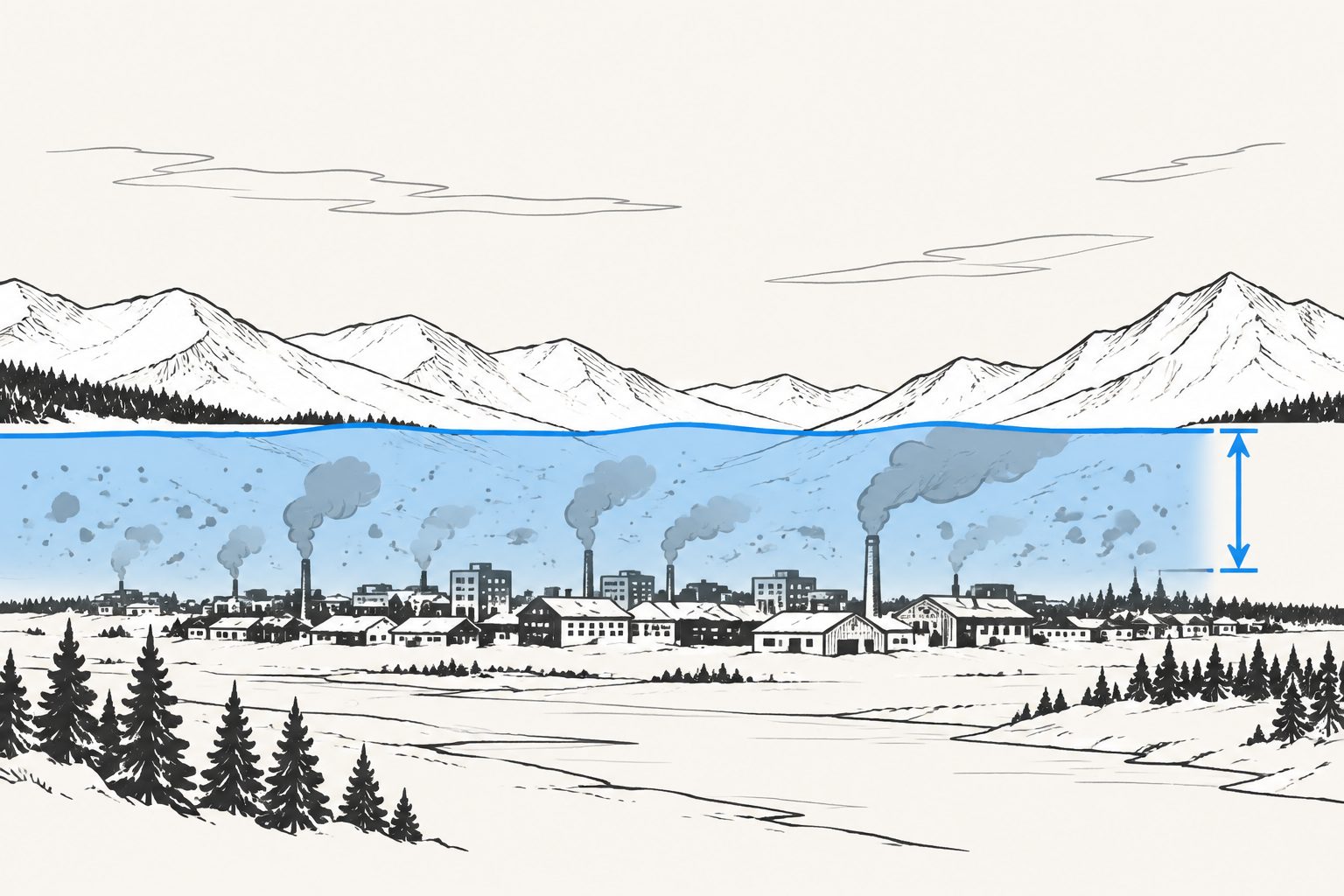
Measurements and modeling during a 2022 field study found that this shallow layer can persist for several days while mixing and chemical reactions change with height.
Researchers used vertical measurements of gases during the 2022 Alaskan Layered Pollution and Chemical Analysis experiment in Fairbanks, Alaska, to study polluted surface layers formed during cold, calm winter conditions. These layers frequently reached only 20–40 meters above the ground and sometimes lasted for several days.
The measurements and a chemistry-and-transport model showed that pollution was exchanged with the air above over residence times of 1–4 hours. Gas levels varied with height as mixing and chemical reactions interacted, including changes in ozone and nitrogen oxide chemistry.
Pollution in a shallow layer
The vertical gas measurements showed frequent polluted surface layers 20–40 meters high during Fairbanks winters. Within these layers, concentrations sometimes leveled off at up to 35 parts per billion of sulfur dioxide, 60 parts per billion of nitrogen dioxide, 2.5 parts per billion of nitrous acid and 7 parts per billion of formaldehyde. Ozone levels were low.
The layers formed from surface emissions combined with weak exchange with the air above. Some persisted for several days, although the estimated residence time of pollutants within the layer was 1–4 hours. A one-dimensional chemistry-and-transport model that used observed temperature gradients and wind speeds closely matched the measured gas profiles. The altitude-dependent behavior of ozone and nitrogen oxides showed that mixing and chemical reactions were closely linked.
// Source
Atmospheric chemistry and physics · 2026 · DOI: 10.5194/acp-26-14345-2026
Authors: J. Stutz, Jonas Kuhn, Sol Cooperdock, Sarah Johnson, Fangzhou Guo, James H. Flynn, Meeta Cesler‐Maloney, William Robert Simpson
Institutions: University of California, Los Angeles, Brown University, University of Houston, Planetary Science Institute, Aerodyne Research, University of Alaska Fairbanks