A proposed brain-circuit theory links future-focused neural activity with the ability to plan in changing environments.
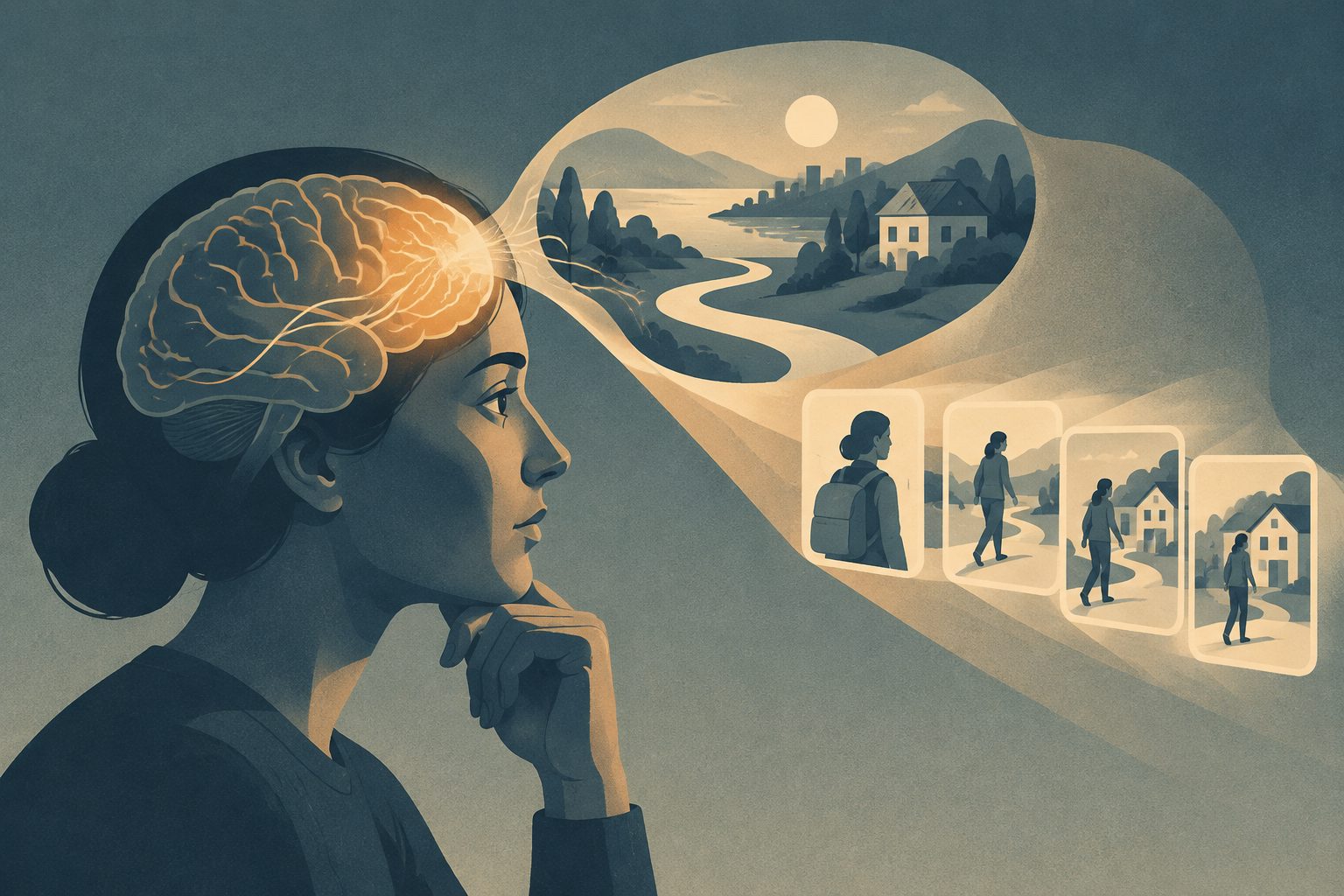
The theory combines two ideas: groups of prefrontal neurons can represent different points in the future, and neural networks can settle into stable patterns of activity called attractors. By storing the structure of an environment in their connections, these networks can infer desirable future states and use them to plan actions.
The researchers call this system a “spacetime attractor.” Recurrent neural networks trained on challenging planning tasks learned patterns of activity, dynamics and connectivity that closely matched the proposed system. The analysis also suggests that a network could rapidly change the internal world model it uses for planning without changing its synaptic connections.
How the model plans
The researchers developed a computational theory in which prefrontal circuits represent both locations in an environment and different points in time. Environment structure is embedded in the connections between neurons, allowing the circuit to settle on patterns that represent desirable possible futures.
In simulations, this “spacetime attractor” solved planning tasks known to depend on the prefrontal cortex. Recurrent neural networks trained on the same tasks learned a solution that matched the proposed attractor in its neural representations, activity over time and connectivity. Networks trained across different environment structures also showed a way to rapidly reconfigure the internal world model used for planning without synaptic plasticity, the process by which connections change with experience.
Why the circuit idea matters
Planning requires the brain to use information about the world to anticipate possible futures, especially when conditions change. This theory offers a specific account of how prefrontal circuits might do that: by using stable patterns of neural activity and connections that represent the structure of the environment and desirable future states.
Because the proposal makes predictions about neural representations, activity and connectivity, it provides a framework that could be tested in experiments. If those predictions are supported, the theory could help link prefrontal activity to the circuit mechanisms underlying adaptive behavior.
Evidence and open questions
This is a computational theory supported by neural-network simulations. The researchers report that recurrent networks trained on planning tasks reproduced the proposed system’s representations, dynamics and connectivity, and that the model performed well on challenging tasks described in the abstract.
The abstract does not report a direct test of the theory in living brains or establish that prefrontal cortex uses this mechanism. The proposed “spacetime attractor” is therefore a testable explanation of planning, rather than a demonstrated account of how human or animal neural circuits work.
// Source
eLife · 2026 · DOI: 10.7554/elife.109757.3
Authors: Kristopher Torp Jensen, Peter T. Doohan, Mathias Sablé-Meyer, Sandra Reinert, Alon Boaz Baram, Maneesh Sahani, Thomas E. Akam, Timothy E.J. Behrens
Institutions: University of Oxford, University College London, Wellcome Centre for Integrative Neuroimaging, Sainsbury Wellcome Centre, Gatsby Computational Neuroscience Unit