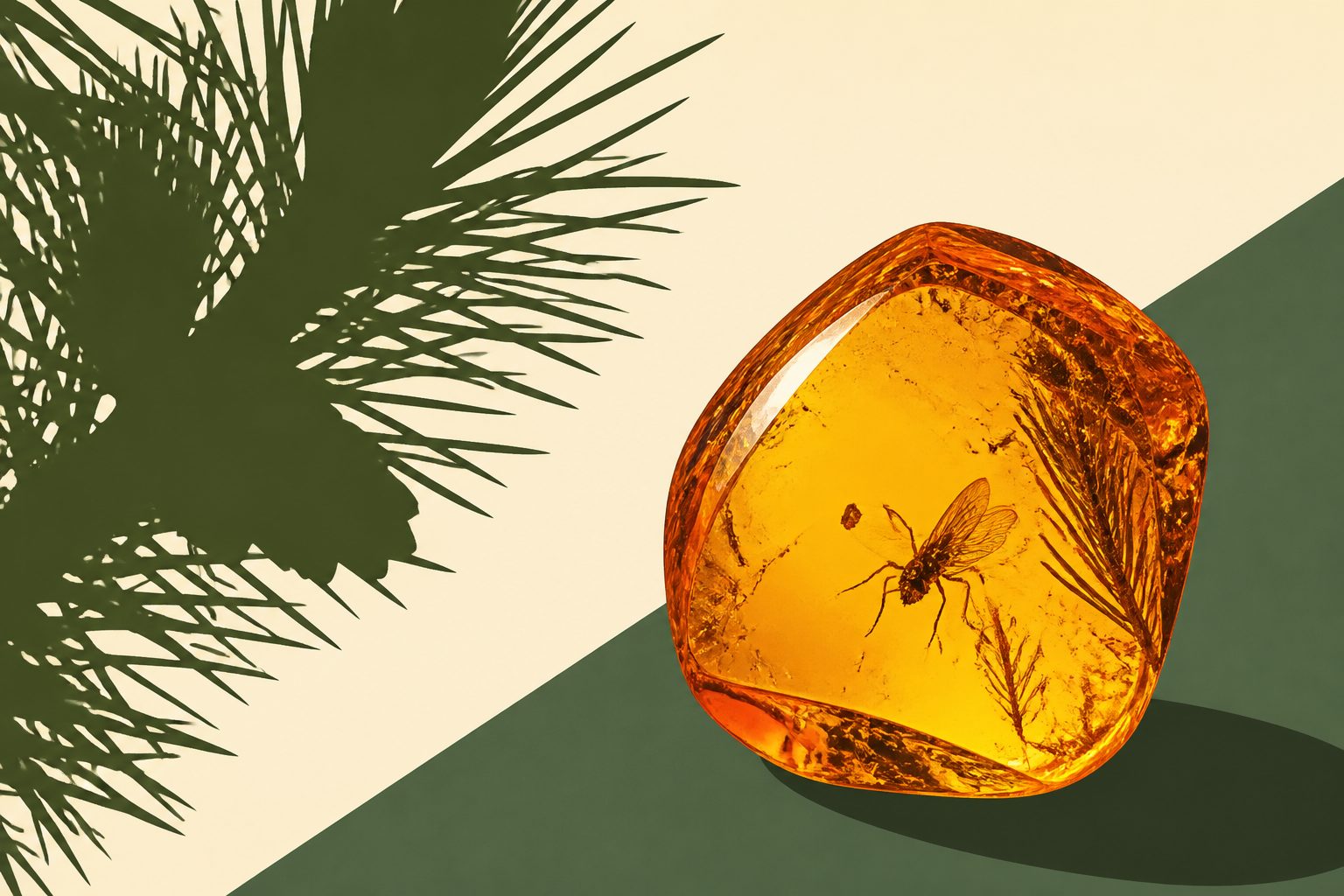
Infrared spectra place the amber from Russia’s Middle Urals in a widespread Cretaceous resin group and point to a source related to larch.
Researchers examined amber collected from the Iset River in the Middle Urals in the early 19th century and held by the Mining Museum. They compared its infrared spectrum with fossil resins from several other Northern Eurasian localities, including sites near the Barents Sea, the Yugorsky Peninsula and the Taimyr Peninsula.
The results indicate that “Kolchedan amber” is a distinct type of fossil resin, previously described under names including “krantzite” and “retinite.” Its spectrum is consistent with resins dominated by labdane-type compounds and most likely produced by plants in the Pinaceae, or pine, family.
What the amber reveals
The infrared spectrum of “Kolchedan amber” showed a distinctive group of three similarly sized absorption peaks at 936, 909 and 888 cm–1. Based on these and other diagnostic features, the researchers classified the resin as Class I in K. Anderson’s system, a group characterized by a predominance of labdane-type diterpenoids.
The researchers concluded that the amber belongs to an independent, widespread type of fossil resin whose occurrences are associated with Cretaceous deposits. The spectrum most likely points to plants in the Pinaceae family. Its diagnostic spectral region also resembled that of amber from Axel Heiberg Island in the Canadian Arctic, which has been attributed to the genus Pseudolarix.
Evidence and limits
The study is based on Fourier-transform infrared spectroscopy of museum samples and comparisons with fossil resins from other localities. The three-peak pattern and other spectral features support the proposed classification and the likely pine-family source.
The plant source is an inference from the chemical spectra, not a direct identification of the original tree. The abstract does not provide details about the number of samples examined or independent evidence such as preserved plant remains or molecular material. The comparison with Pseudolarix indicates a possible relationship, but does not establish that this genus produced the “Kolchedan amber.”
// Source
Journal of Mining Institute · 2026
Open access versionPublished 2026-08-31 Authors: П. И. Алексеев, E. A. Vasil’ev
Institutions: Saint Petersburg Mining University