Genomes clarify parts of the family tree of 5,000 freshwater fish species
A study of 316 species strengthens some evolutionary relationships while showing that several branches remain difficult to resolve.
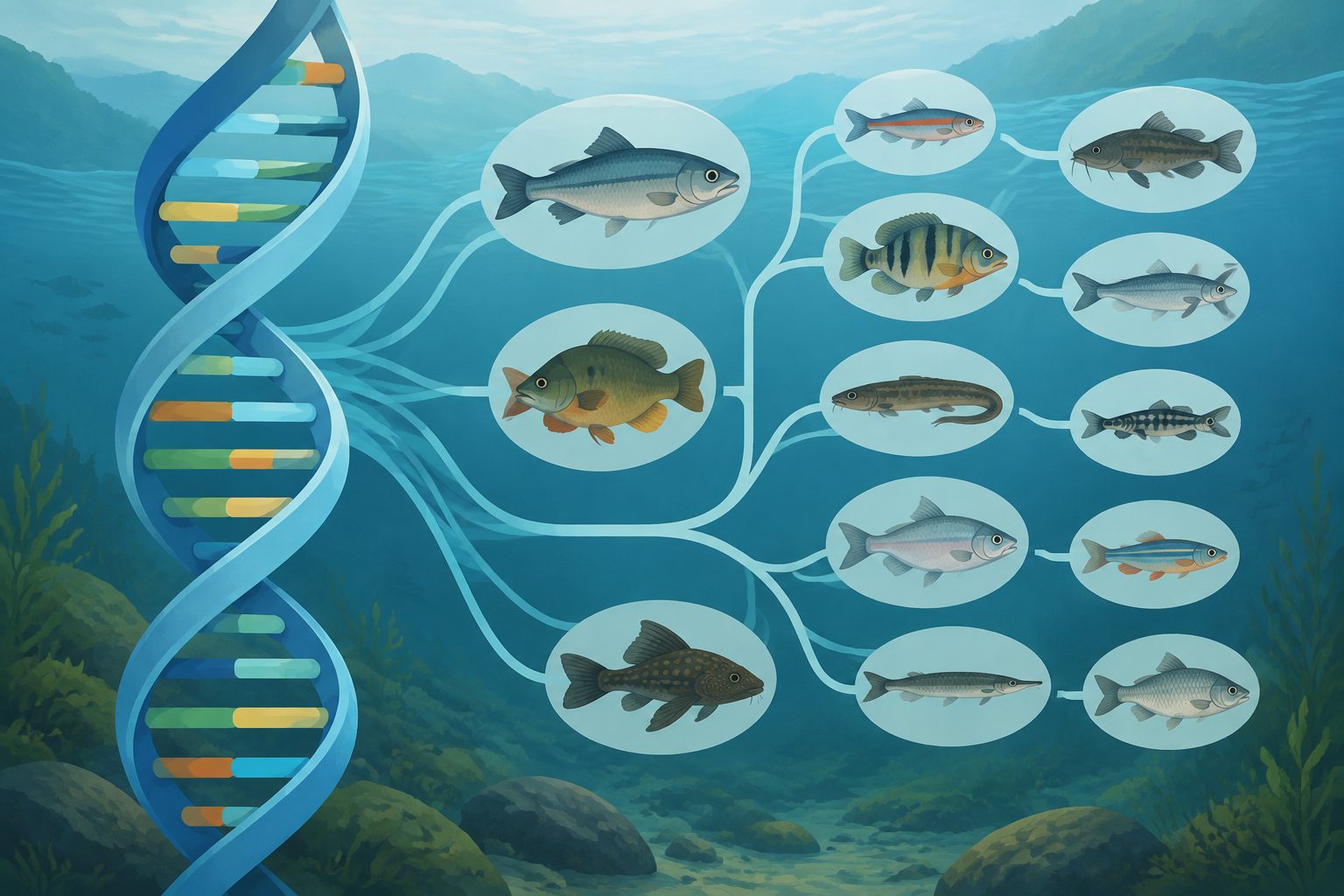
Editorial illustration — not from the study.
Researchers analyzed 316 species, representing about 30% of all described genera, in the first genomic study to include every Cypriniformes family. The dataset combined 257 newly assembled genomes with existing genomic data and used several methods to compare evolutionary relationships.
The analyses largely agreed on the order's main evolutionary structure. They also identified branches where results continue to conflict, including conflicts that may reflect genuine biological processes or problems with the models used to reconstruct the family tree.
What the genomes show
The study provides broad genomic support for the backbone, or main structure, of the Cypriniformes family tree. It strengthens the evolutionary placement of several miniaturized lineages, which have been difficult to study and whose relationships have remained contentious.
At the same time, some relationships remain unresolved. The researchers found that similar-looking patterns of conflict can arise from different sources, including biological processes and artefacts caused by analytical models. The work analyzed 316 species—about 30% of all described genera—and included 257 newly assembled genomes.
Why the family tree matters
Cypriniformes is the most species-rich order of freshwater fishes, with about 5,000 species. A clearer evolutionary framework can support future comparisons of their evolution, development and diversification, while identifying the branches that still need further investigation.
The study is especially relevant for miniaturized and understudied fish lineages whose positions in the family tree have been uncertain. Its results distinguish relationships that now have stronger support from those where the available evidence remains conflicting.
Evidence and remaining gaps
This is a comparative phylogenomic study based on genome-wide markers from 316 species, using both methods that combine data across species and methods that account for differences among individual genes. Agreement among these analytical approaches supports the main structure of the proposed family tree.
The sample covers all families but only about 30% of described genera, so it does not represent all roughly 5,000 species. Several relationships continue to show conflict, and the abstract indicates that both real evolutionary processes and model artefacts may contribute. The study therefore establishes a broad foundation rather than resolving every branch of the order's history.
// Source
Molecular Biology and Evolution · 2026 · DOI: 10.1093/molbev/msag261
A study of illicit alcohol in two Ugandan cities found that alcohol strength was inconsistent and sometimes under-declared, reaching 44.2%. Some spirits contained methanol above safe limits, while opaque beers showed bacterial contamination and many production and retail sites had poor sanitation.
Researchers found that bacterial surface-layer proteins can evolve through modular changes and gene transfer, producing different outer structures. In closely related bacteria with the same type of surface layer, only pathogens showed resistance to the antimicrobial molecules LL-37 and lysozyme.
Researchers traced how AlphaFold 3 turns evolutionary differences among related protein sequences into three-dimensional structure predictions. They found that evolutionary diversity matters more than simply adding more sequences, helping explain both the system’s strengths and some of its failures.