Arctic shrubs may be taking up more carbon than global models show
A model that separates deciduous and evergreen shrubs found that nitrogen limits could be causing models to miss part of their carbon uptake.
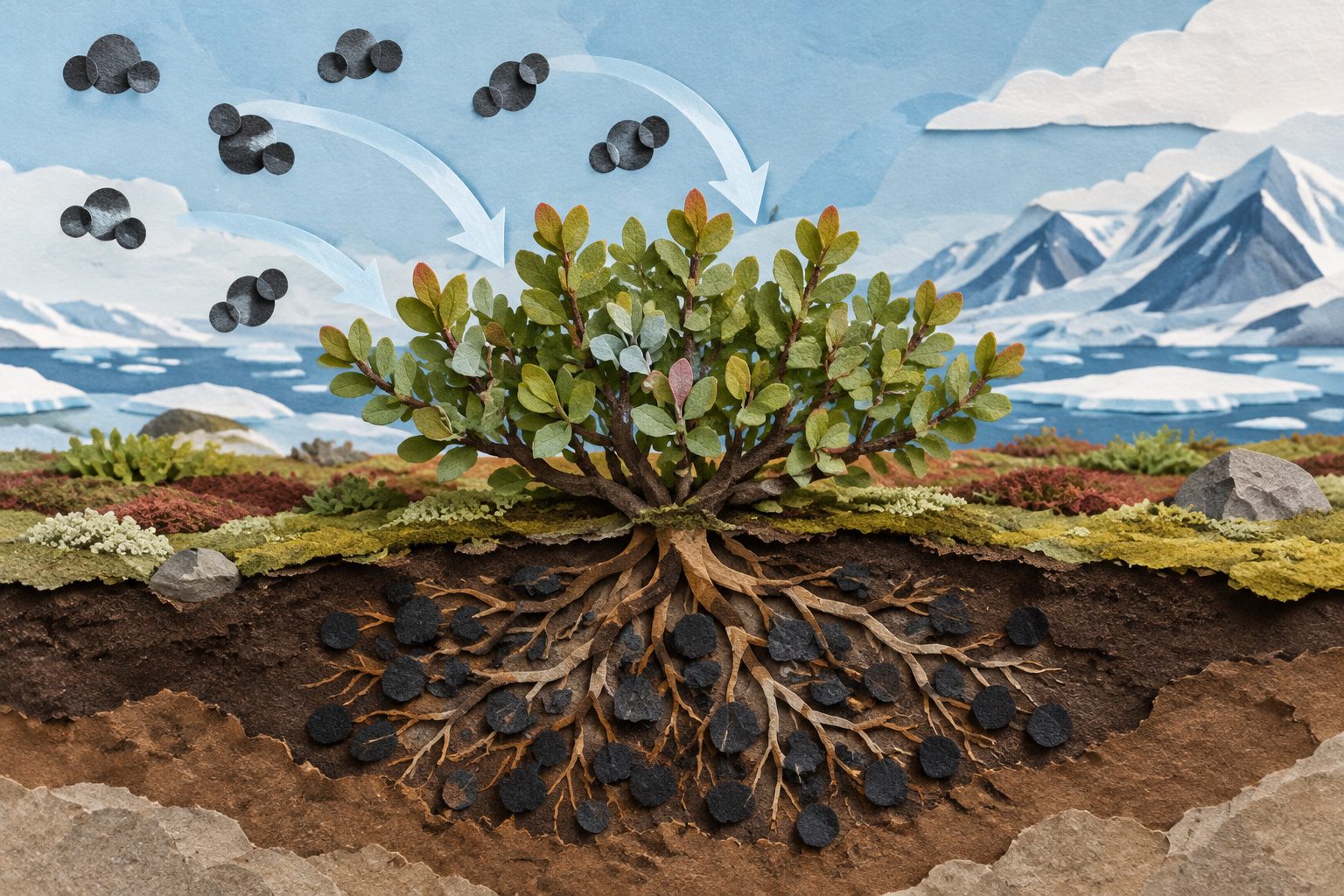
Editorial illustration — not from the study.
Researchers added separate deciduous and evergreen shrub types to the nutrient-enabled QUINCY terrestrial biosphere model. They simulated shrub, tree and grass-like plant growth at 16 Arctic sites from 1901 to 2010, examining carbon uptake, storage, climate effects, carbon dioxide fertilization and nitrogen availability.
The model reproduced shrub seasonal carbon uptake reasonably well at about half of the sites. Shrub carbon fluxes were 40% higher than those of graminoids in the simulations, while their gross primary production had a similar distribution to needle-leaved evergreen forest. Strong simulated nitrogen limitation led to underestimated uptake at many sites, suggesting that standard global models may understate the Arctic contribution to land carbon.
How shrubs changed the estimates
The researchers represented broadleaf deciduous and needle-leaved evergreen shrubs as separate plant types in QUINCY. The model's simulated gross primary production had mean R² values of 0.5 against field measurements and 0.6 against satellite-based estimates. It matched the seasonal cycle reasonably well at about half of the Arctic sites, but underestimated observed production at the others, where nitrogen limitation appeared too strong.
In the simulations, shrub carbon fluxes were 40% higher than those of graminoids. Shrubs produced less above-ground biomass than needle-leaved trees and had different seasonal growth patterns. Their gross primary production had a similar distribution to that of needle-leaved evergreen forest, with no significant difference in the median.
Higher carbon dioxide generally increased growth across plant types, and shrubs maintained a particularly strong response. Deciduous shrubs reduced their nitrogen sources more than evergreen shrubs, generally producing a 50% decrease in gross primary production. Giving plants unlimited nitrogen doubled simulated gross primary production at most sites and improved agreement with measurements by 15%. Initializing soil carbon and nitrogen using permafrost profiles also partly reduced the modeled nitrogen limitation. Across the 1901–2010 simulations, climate effects were more influential than other drivers of enhanced shrub growth; warming weakened nitrogen limitation, while carbon dioxide fertilization strengthened it.
Why nitrogen matters
Shrubs are represented as distinct plant types in this study, rather than being treated like trees or other vegetation. That changed the simulated Arctic carbon uptake and storage. The results indicate that strong nitrogen limitation in standard model settings may cause global land models to underestimate the Arctic contribution to land carbon, especially if they do not distinguish between deciduous and evergreen shrubs.
The study also points to soil nitrogen cycling as an important uncertainty in projections of Arctic carbon changes. Better information about nitrogen availability and shrub traits could improve those projections.
Model evidence and limits
This was a modeling study, tested against field measurements and satellite-based estimates at 16 Arctic sites; it was not a direct experiment manipulating shrub cover or nitrogen in the field. The model reproduced shrub seasonal gross primary production reasonably well at about half of the sites, with mean R² values of 0.5 against field data and 0.6 against satellite products.
The model underestimated observed production at about half of the sites, in part because its simulated nitrogen limitation was too strong. Comparisons were also affected by local differences in soil moisture, wetland and forest cover, vegetation composition and meteorological conditions. Some measurement sites included ecosystems that the model did not represent, and the permafrost initialization did not account for spatial variation in soil carbon and nitrogen. The researchers therefore call for more measurements to constrain soil nitrogen cycling and shrub traits used in the model.
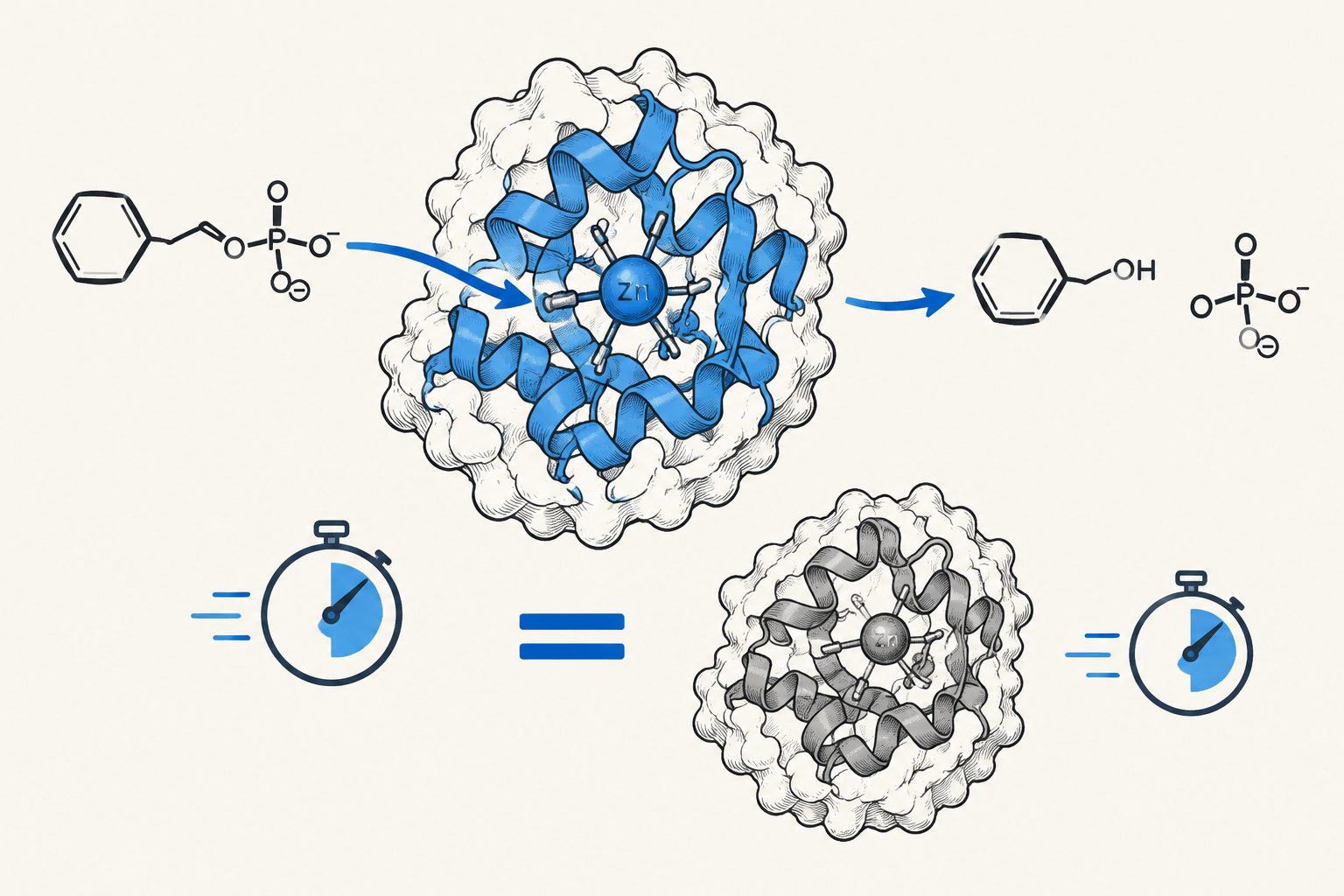
Researchers designed a zinc-containing enzyme from scratch, without a natural template, catalytic motif or evolutionary data. The enzyme showed activity against both phosphomonoesters and phosphodiesters, with rate enhancement comparable to characterized natural phosphatases.
A study of illicit alcohol in two Ugandan cities found that alcohol strength was inconsistent and sometimes under-declared, reaching 44.2%. Some spirits contained methanol above safe limits, while opaque beers showed bacterial contamination and many production and retail sites had poor sanitation.
Researchers found that bacterial surface-layer proteins can evolve through modular changes and gene transfer, producing different outer structures. In closely related bacteria with the same type of surface layer, only pathogens showed resistance to the antimicrobial molecules LL-37 and lysozyme.