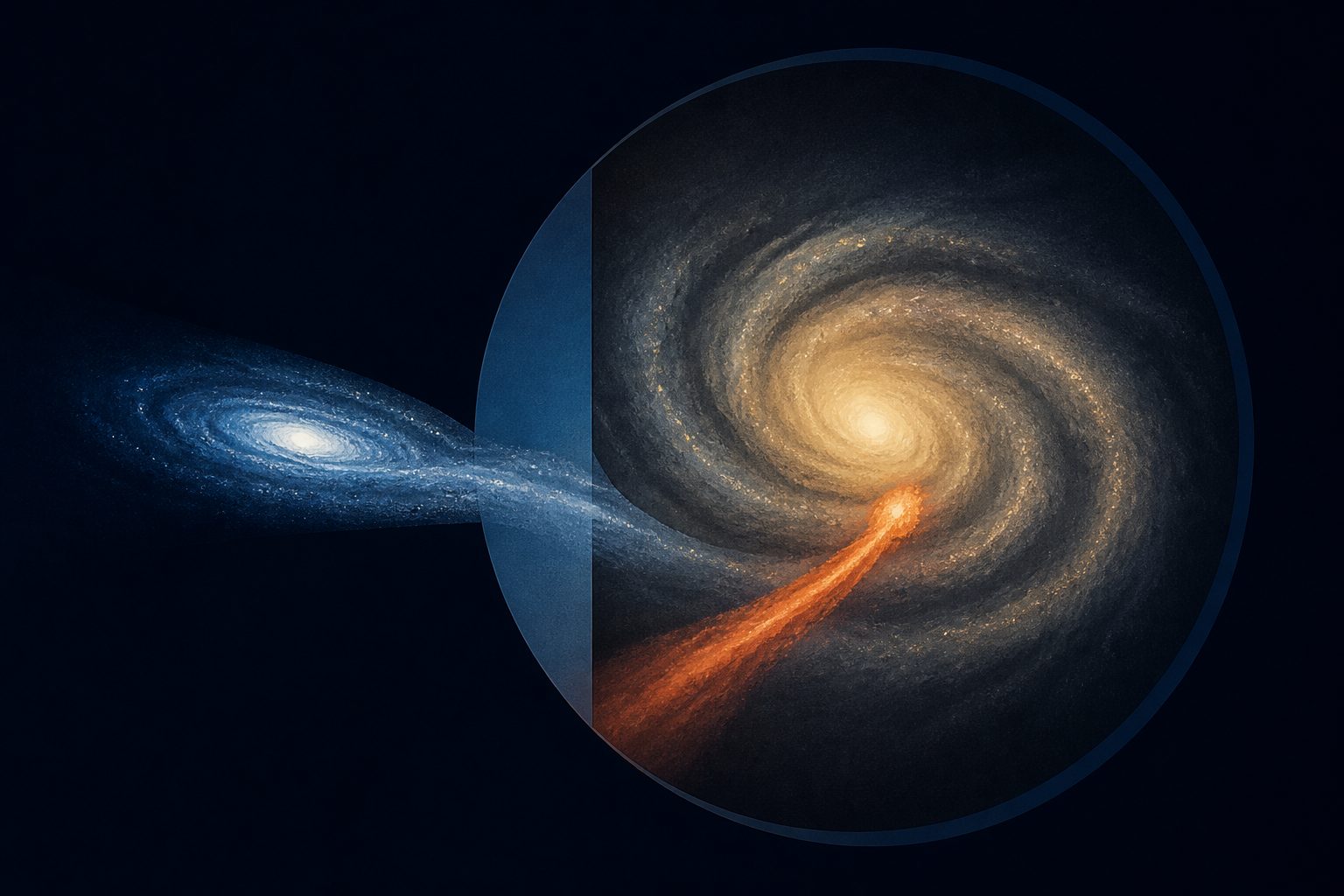
A study of globular clusters identifies a stellar system that merged with the Milky Way about 1.8 billion years before Gaia-Sausage-Enceladus.
Researchers found three distinct age–metallicity patterns among the Milky Way’s globular clusters. One is linked to the Milky Way’s original population, another to the Gaia-Sausage-Enceladus merger about 10 billion years ago, and a third to an earlier merger estimated to have occurred 1.8 billion years before it.
The researchers estimate that the earlier incoming system had about 5 × 10^8 solar masses in stars, similar to Gaia-Sausage-Enceladus. They name its progenitor Low-energy-Kraken-Heracles, or LKH, and conclude that it deposited most of its stars in the Milky Way’s inner 6 kiloparsecs.
Three merger signatures
Using precise relative ages for globular clusters, the researchers identified three distinct age–metallicity sequences. The third sequence is associated with a merger that took place about 1.8 billion years before Gaia-Sausage-Enceladus merged with the Milky Way.
They estimate that the incoming system had a stellar mass of about 5 × 10^8 solar masses, similar to that of Gaia-Sausage-Enceladus, and that most of its mass ended up within the Milky Way’s inner 6 kiloparsecs. The study names this progenitor system Low-energy-Kraken-Heracles, or LKH.
// Source
Nature Astronomy · 2026 · DOI: 10.1038/s41550-026-02931-5
Authors: D. Massari, C. Zerbinati, C. Fanelli, Helmi A, E. Ceccarelli, Fernando Aguado Agelet, S. Cassisi, Ewoud Wempe, M. Monelli, Andrea Bellini, Thomas M. Callingham, Hanneke C. Woudenberg, Roger E. Cohen, Carme Gallart, E. Pancino, Sara Saracino, M. Salaris, A. Mucciarelli
Institutions: University of Groningen, University of Edinburgh, Université Paris Cité, Sorbonne Université, Sorbonne Paris Cité, Universidade de Vigo, Rutgers, The State University of New Jersey, Liverpool John Moores University, Istituto Nazionale di Fisica Nucleare, Sezione di Pisa, Universidad de La Laguna, Instituto de Astrofísica de Canarias, Istituto di Astrofisica Spaziale e Fisica Cosmica di Bologna, Osservatorio di Astrofisica e Scienza dello Spazio, Collurania Teramo Observatory, Astronomical Observatory of Rome, Space Telescope Science Institute, Royal Observatory, Arcetri Astrophysical Observatory