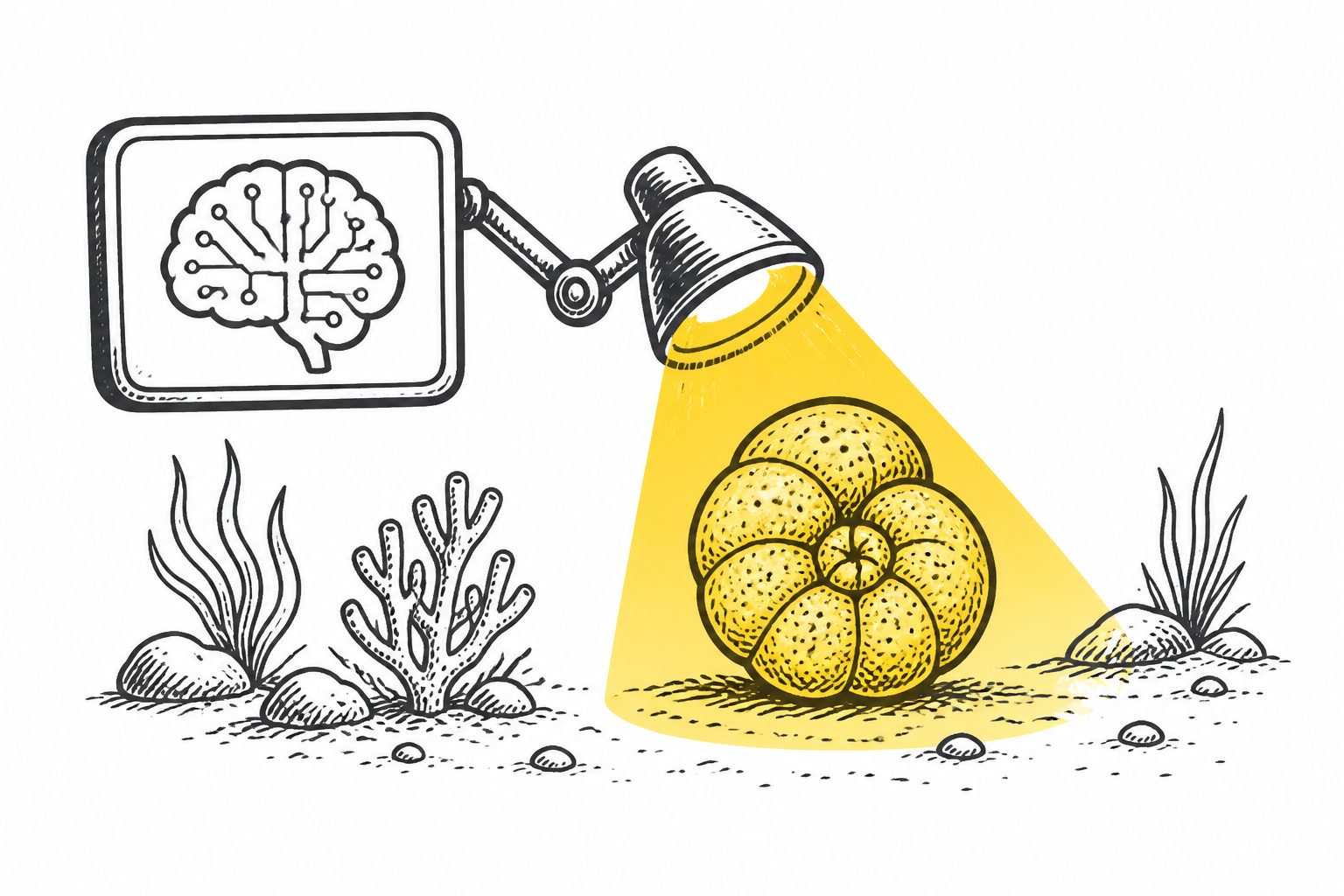
The image-recognition system could help process these tiny marine organisms faster in environmental monitoring studies.
The study tested three convolutional neural network models on Rose Bengal-stained benthic foraminifera from two French coastal environments: a low-diversity intertidal mudflat in Bourgneuf Bay on the Atlantic coast and high-diversity samples from the Mediterranean coast. The samples were photographed with a camera attached to a modified 3D printer, and the images were used to train the models to identify species automatically.
The models identified species in mixed samples of living and dead foraminifera with 96.0% accuracy in the low-diversity setting and 82.2% accuracy in the high-diversity setting. One model also identified both species and vital status in the low-diversity samples with 94.2% accuracy.
What the AI identified
The three AI models identified species in communities containing both living and dead benthic foraminifera. Accuracy was 96.0% for the low-diversity assemblage from Bourgneuf Bay and 82.2% for the high-diversity assemblage from the French Mediterranean coast.
A separate model identified both species and whether a specimen was living or dead in the low-diversity setting, with 94.2% accuracy. The authors report that the results compared well with published ecosystem-quality indices for high-diversity environments.
Evidence and caveats
This was an article reporting tests of three convolutional neural networks on images of Rose Bengal-stained foraminifera from two French coastal settings. The study examined a low-diversity intertidal mudflat and high-diversity Mediterranean assemblages, rather than a broad range of environments.
Performance varied by setting and task: species identification reached 96.0% in the low-diversity community and 82.2% in the high-diversity community, while identifying both species and vital status reached 94.2% in the low-diversity setting. The abstract does not establish how the models would perform on other species, regions or imaging conditions.
// Source
Journal of Micropalaeontology · 2026 · DOI: 10.5194/jm-45-623-2026
Authors: Tobias Walla, Christine Barras, Emmanuelle Geslin, Camille Godbillot, Louis Lanoy, Ross Marchant, Delphine Dissard, Thibault de Garidel‐Thoron
Institutions: Sorbonne Université, Institut National de Recherche pour l'Agriculture, l'Alimentation et l'Environnement, Centre National de la Recherche Scientifique, Queensland University of Technology, Université de Lille, Institut de Recherche pour le Développement, Commonwealth Scientific and Industrial Research Organisation, Centre de Recherche et d’Enseignement de Géosciences de l’Environnement, University of New Caledonia, Université Nantes Angers Le Mans, Institut de Recherche pour le Développement, Laboratoire d’Océanologie et de Géosciences, Data61