After a heatwave, Baja California reefs support fish and people unequally
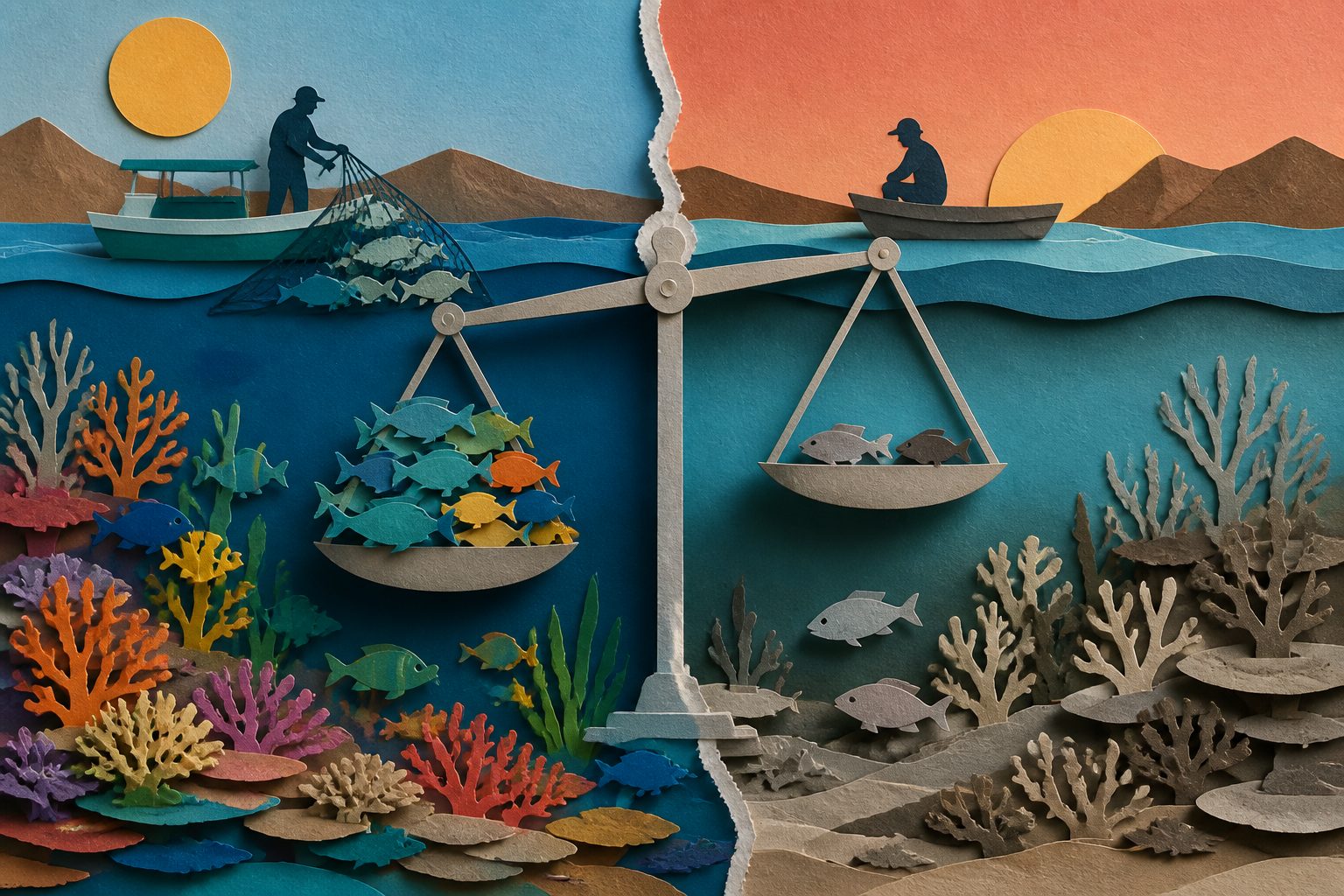
Kelp-covered reefs supported more ecological functions and fish-based nutritional benefits than reefs dominated by low-growing algae or urchin barrens.
Editorial illustration — not from the study.
Researchers analyzed 545 transect observations from 12 sites surveyed between 2017 and 2024, covering reefs in different states up to eight years after the heatwave. They examined fish biomass, productivity, biomass turnover and micronutrients within fish communities.
Most fish contributions remained broadly stable over time, but they differed among regions and reef conditions. Reefs with persistent kelp canopies were associated with higher contributions to nature and people, while reefs dominated by understory brown algae or urchin barrens showed reduced contributions. Total micronutrient supply per hectare largely followed fish biomass, while the nutritional quality of an average 100-gram portion changed for zinc, vitamin A and selenium as species composition shifted in fish not targeted by fisheries.
How reef states differed
Fish communities appeared to settle into regionally distinct configurations associated with the condition of the kelp forest. Reefs with persistent canopy-forming kelp were identified as ecological and social bright spots, supporting high contributions to both nature and people. Reefs with understory brown algae and/or urchin barrens supported fewer contributions.
Across the 2017–2024 study period, most measured contributions showed little change across regions and exploitation categories. Total micronutrient supply per hectare remained broadly stable and largely tracked fish biomass. However, the nutrients in an average 100-gram portion of fish changed over time for zinc, vitamin A and selenium, apparently because of species turnover among fish not targeted by fisheries.
Fish biomass and total micronutrient supply were mainly structured by spatial differences in sea-surface temperature and seafloor habitat composition. Nutrient concentrations in an average portion were largely unrelated to the environmental factors measured.
Why reef condition matters
The findings indicate that reefs recovering or reorganizing after the same heatwave can provide very different ecological functions and benefits for people. This challenges a single management approach for all post-disturbance kelp forests.
The study supports recognizing distinct reef states when managing biodiversity, fisheries and nutrition. It also points to preserving kelp-rich reefs and other ecological and social bright spots, while restoring habitat complexity in more simplified reefs, as approaches consistent with the study’s conclusions.
Evidence and caveats
The study is based on 545 field transect observations from 12 sites along a 600-kilometer stretch of the Pacific coast of Baja California, surveyed from 2017 to 2024. It combines measurements of fish biomass, productivity, biomass turnover, habitat condition and micronutrient content across reefs in different states after the 2014–2016 marine heatwave.
Because the analysis compares sites and reef conditions over time rather than assigning disturbances or management actions experimentally, relationships with temperature and habitat composition should not be treated as proof that those factors alone caused the differences. The observations cover one coastal region and an eight-year post-heatwave period, so the findings may not apply to all kelp forests or longer-term recovery patterns.
High-resolution drone maps detected early crop water stress before changes appeared in other plant measurements. The approach tracked evapotranspiration—the movement of water from soil and plants into the air—across sugar beet, potato and winter wheat fields.
A pilot-scale system removed long-chain PFAS, including PFOS and PFOA, from municipal wastewater and concentrated the compounds in a small volume of foam. Under the best-performing conditions, a subsequent treatment destroyed and removed more than 99% of measured PFAS in that concentrated foam.
Humpback whales in Monterey Bay fed more frequently when California sea lions were present. The whales appeared to spend less time searching and approaching prey, while the effort and movement of individual lunges showed no detectable increase.