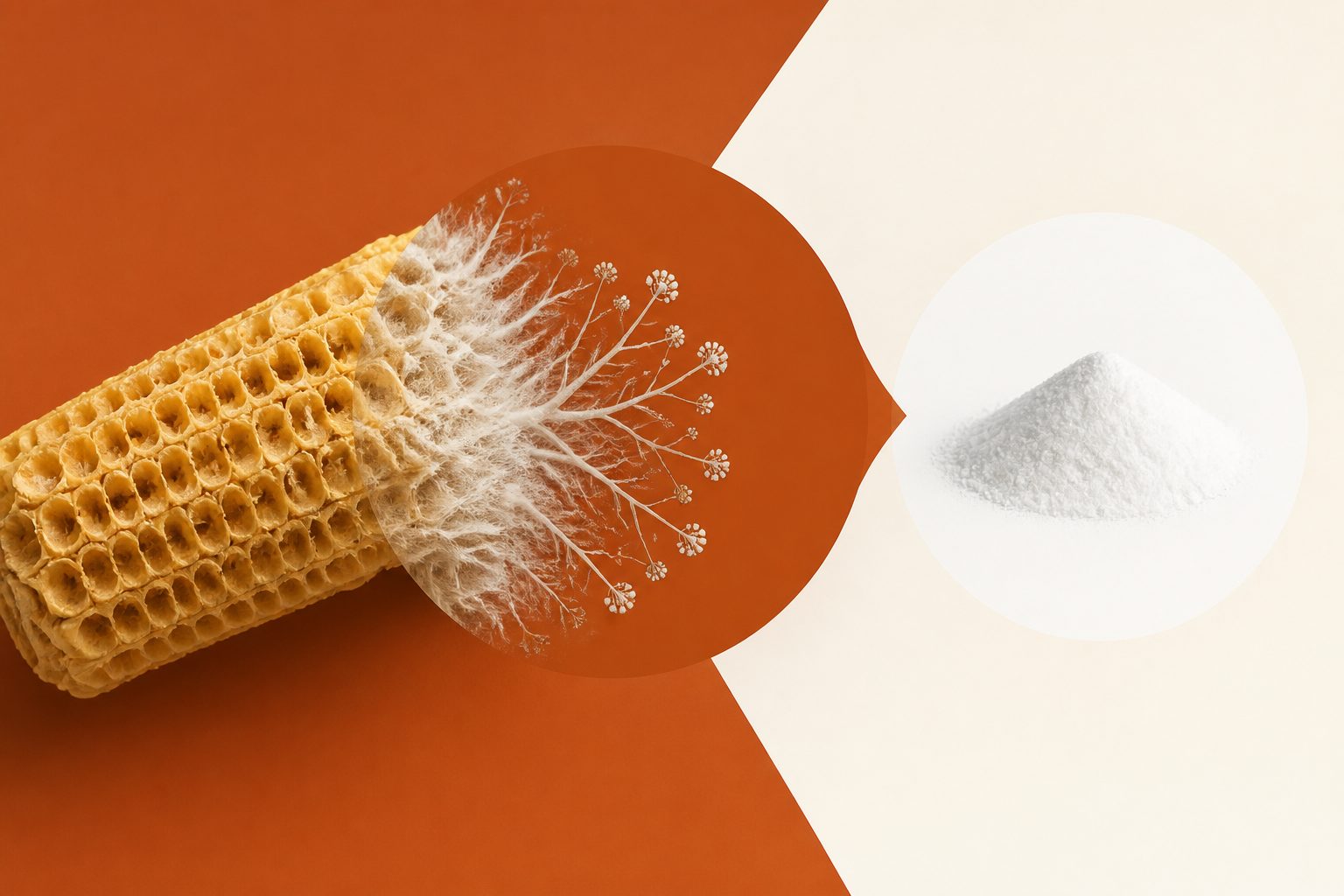
The single-process system used an engineered fungus to break down corncob material and make the organic acid.
Researchers engineered the thermophilic fungus Myceliophthora thermophila to break down raw corncobs and convert their sugars into malic acid in one process. They identified lignin, a tough plant material that helps make biomass difficult to break down, as a major barrier to the conversion.
Adding extra production of a dye-decolorizing peroxidase enzyme improved lignin remodeling and biomass deconstruction. The researchers also strengthened the fungus’s ability to break down cellulose and use the resulting sugars, allowing the engineered strain to produce malic acid from raw corncob as its only carbon source.
What the fungus produced
The researchers found that lignin-associated resistance was a major obstacle when Myceliophthora thermophila processed raw corncobs. Overexpressing a dye-decolorizing peroxidase enzyme improved lignin-side oxidative remodeling, malic acid production and biomass deconstruction; infrared analysis of the treated residues supported changes in lignin-associated structures.
The team also improved cellulose breakdown, cellodextrin uptake and the intracellular processing of these sugars. The final engineered strain produced 55.5 g/L of malic acid in shake-flask culture using 75 g/L raw corncob as its sole carbon source. In a 5-liter bioreactor, it produced 157.6 g/L, with a productivity of 1.17 g/L/h and a yield of 0.55 g per gram of total raw corncob input. After downstream processing, the recovered malic acid was 99% pure.
Evidence and open questions
The study reports transcriptomic and physiological analyses, infrared measurements of treated corncob residues, and production tests in shake flasks and a 5-liter bioreactor. The abstract does not report results at industrial scale, process costs, long-term stability, or environmental impacts, so the performance and practicality of the process beyond these experiments remain to be established.
// Source
Synthetic and Systems Biotechnology · 2026 · DOI: 10.1016/j.synbio.2026.07.011
Authors: Yuying Zhang, Yuhan Zhang, Likun Han, Jia Liu, Defei Liu, Tao Sun, Depei Wang, Ming Li, Jingen Li, Chaoguang Tian
Institutions: Chinese Academy of Sciences, Tianjin University of Science and Technology, Tianjin Institute of Industrial Biotechnology