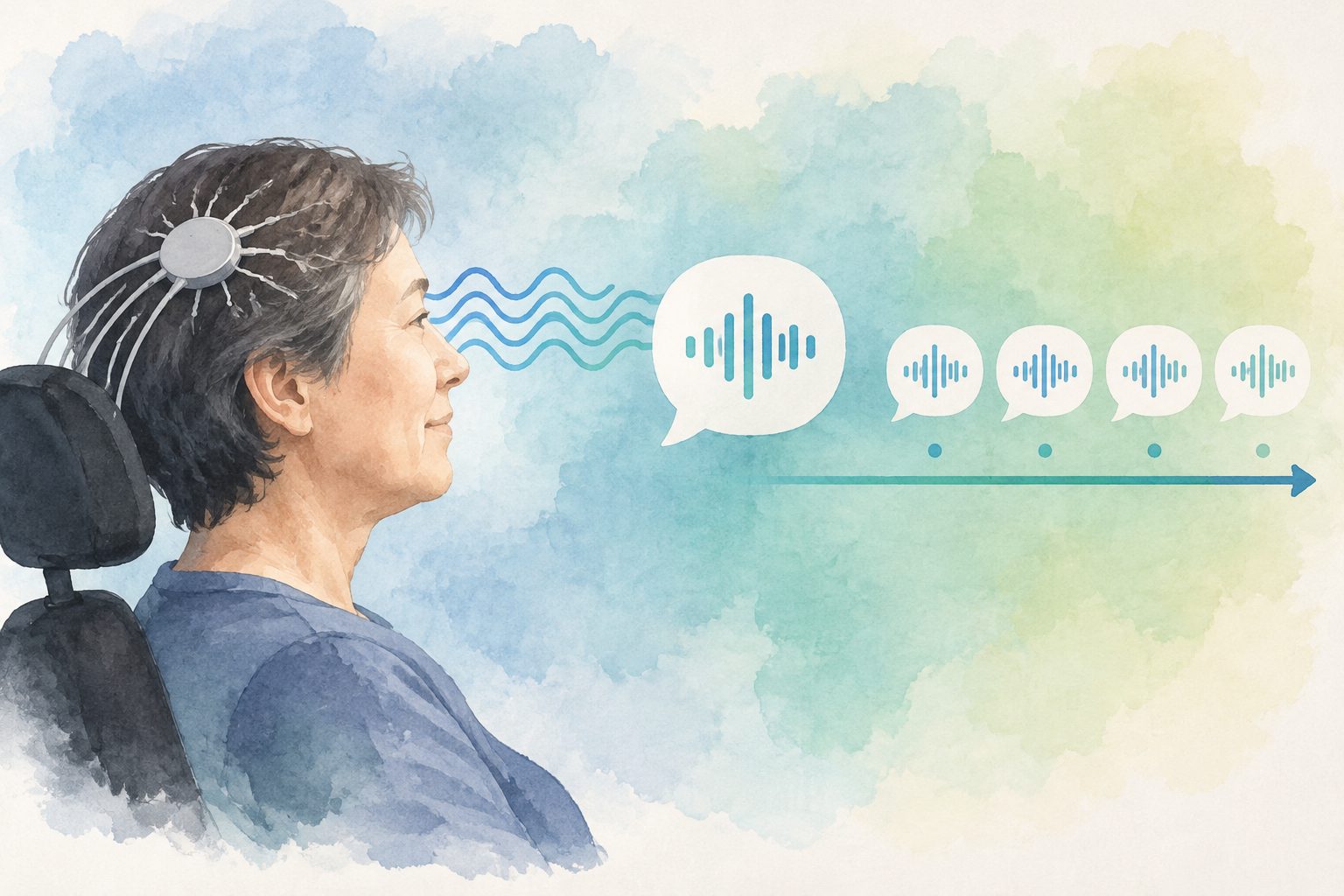
In one person with slowly progressive ALS, speech-related brain signals remained informative enough for stable offline decoding despite declining signal quality.
Researchers followed one participant with bulbar-variant ALS after implanting two electrode grids over the left sensorimotor cortex. Over 25 months, the participant repeated 12 consonant-vowel syllables while the system recorded brain activity and audio.
The strength and quality of some brain signals changed over time, with an early adjustment period followed by declining signal-to-noise ratio. However, models trained after this early period continued to decode the syllables from later recordings without a significant decline in performance, suggesting that useful speech-related information remained available despite disease progression and mild changes in speech acoustics.
Speech signals over time
The neural measures showed a shared transition about 180 days after implantation. Before that point, the measured high-frequency brain activity increased. Afterward, the activation ratio remained stable, while active signal-to-noise ratio declined by about 0.47 decibels per 100 days; normalized response peaks continued to rise slowly. The researchers said the falling signal-to-noise ratio did not correspond to a loss of speech-related population information.
Across 726 held-out train-test evaluations, mean decoding accuracy for the 12 syllables was 74.6%, compared with 8.33% expected by chance. For models trained on post-transition data, accuracy did not significantly decline as the gap between training and testing recordings increased. Neural class separability was associated with higher held-out accuracy, and decoded information remained above chance without a post-transition time-related decline. The triangular vowel space area also showed mild nonlinear reductions, consistent with some decline in speech intelligibility.
Evidence and caveats
This was a longitudinal study of one participant with slowly progressive bulbar-variant ALS, followed for 25 months. The participant used two implanted electrode grids and completed a repeated-syllable task across 166 sessions. The researchers evaluated offline decoding with chronological train-validation-test splits, rather than demonstrating a clinical communication system in this study.
The findings therefore show durability in this participant and task, not a general guarantee for people with ALS. The study also measured changes in brain signals and speech acoustics but does not determine their exact biological cause. The researchers note that the rise in normalized response peaks may reflect faster decline in baseline activity than in vocalization responses, rather than stronger neural activity.
// Source
Journal of NeuroEngineering and Rehabilitation · 2026 · DOI: 10.1186/s12984-026-02119-y
Authors: Ziwei Ouyang, Kalan Walmsley, Shiyu Luo, Donna Clark Tippett, Kimberley Wyse‐Sookoo, Matthew S. Fifer, Mariska J. Vansteensel, Miguel Angrick, Nick F. Ramsey, Nathan E. Crone
Institutions: Johns Hopkins University, Johns Hopkins Medicine, École Polytechnique Fédérale de Lausanne, University Medical Center Utrecht, Johns Hopkins University Applied Physics Laboratory