A spacecraft finds heavy molecular ions in a cold region around Earth
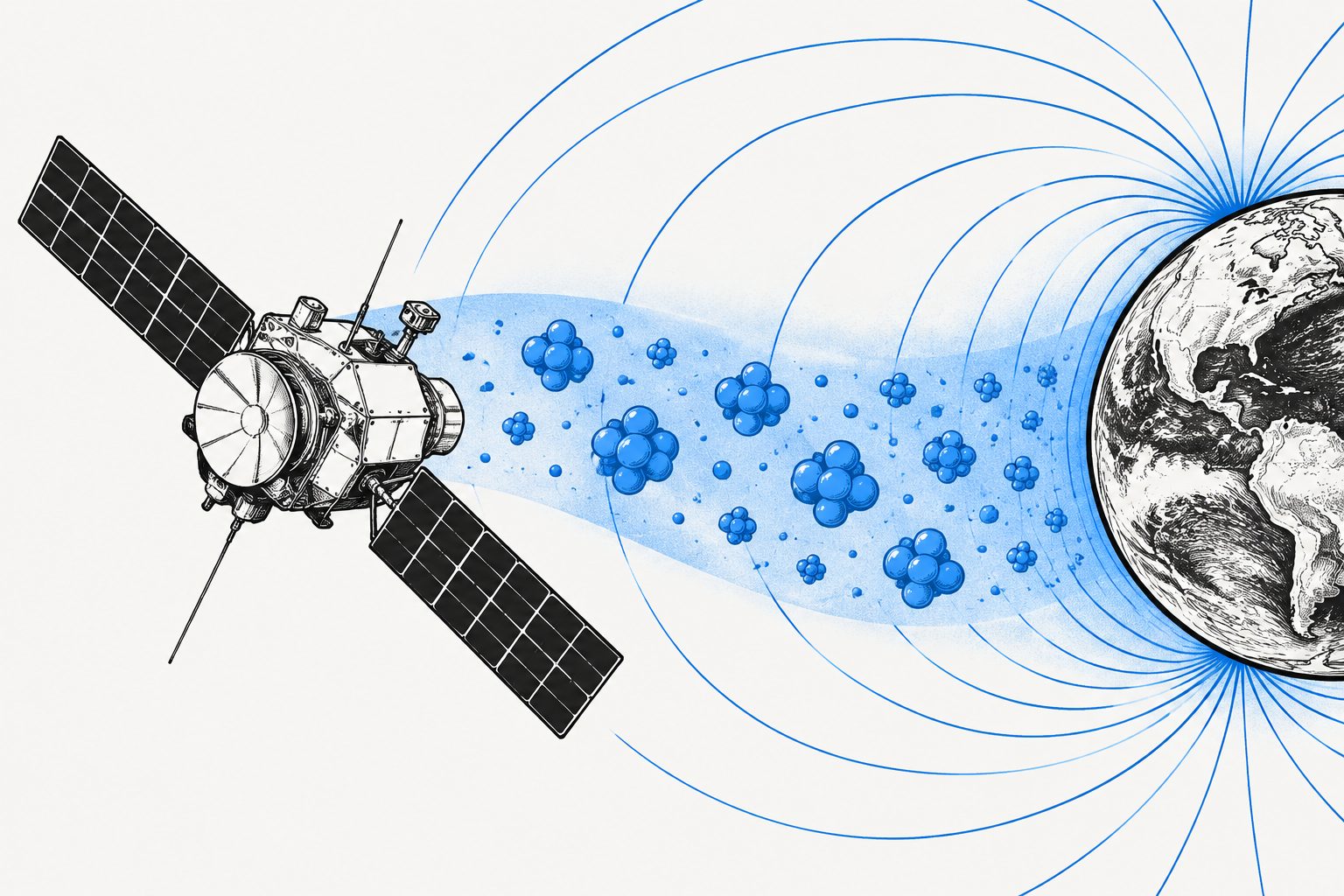
During a 2024 flyby, JUICE detected signs of unexpectedly abundant heavy ions in Earth's plasmasphere, a region of dense, cold plasma.
Editorial illustration — not from the study.
On 20 August 2024, the JUICE spacecraft spent about two hours passing through Earth's plasmasphere. Its Jovian Electron and Ion spectrometer was switched on for 40 minutes before closest approach, while a separate instrument measured a plasma density of about 3,000 particles per cubic centimetre.
The dense plasma caused the spacecraft to charge negatively, making it possible for the spectrometer to sample the normally difficult-to-measure cold ions. Because the spacecraft was moving much faster than the slowly corotating plasma, ions of different masses appeared at different energies, allowing the researchers to infer their composition.
Heavy ions in the plasma
The observations show that ions with masses greater than 4 atomic mass units per charge contributed at least 30% of the measured ion density. A strong peak near 15 electron volts cannot be explained by the light ions expected in the region and instead indicates heavy molecular ions with masses of about 30–32 atomic mass units per charge. The sharp decline above 15 electron volts suggests that molecules heavier than about 32 atomic mass units per charge were not present in the measured population.
The signal was recorded while JUICE was about 2.1 Earth radii from Earth. The spacecraft was travelling at about 8 kilometres per second, while the plasma's corotation speed was about 1 kilometre per second, so the spacecraft's motion dominated the ions' observed speed.
Why the ions matter
Molecular ions have been detected only rarely in the outer plasmasphere. These measurements provide a new direct look at the composition of its cold, dense plasma, which earlier instruments had difficulty observing. The results also indicate that the JUICE ion sensor could be used to study ion composition in the thin outer atmospheres of Jupiter's moons.
Evidence and caveats
The result comes from a 40-minute test-mode observation by JUICE's ion spectrometer, supported by plasma-density and spacecraft-potential measurements from its radio and plasma-wave instrument. The researchers modelled how the sensor and the spacecraft's negative electric charge would respond to ions of different masses.
The spectrometer measures ion energy rather than mass directly, so the composition is inferred from the energy and angular distributions. Its ion-detector efficiency at the unusually low post-acceleration voltage used in this test is not yet well calibrated; further laboratory measurements are needed to quantify the relative abundance of each species. The researchers also used a spacecraft potential of about -5 volts in their calculations, compared with an independently measured value of about -6.5 volts, and note that some reported ion temperatures may be underestimated because of the instrument's energy binning.
A new analysis finds that extra, self-interacting radiation in the early universe is more compatible with ACT observations when the pattern of primordial fluctuations is allowed to vary with scale. In the models tested, this reduces the Hubble tension from the standard model’s level to 2.2σ, or below 2σ in a version where the radiation was once coupled to dark matter.
Researchers used a tensor-network calculation to study how force-carrying strings break apart in a simplified model of particle interactions. The work links string breaking with energy transport, particle production, entanglement growth and the spread of correlations.
Astronomers identified eight nearby examples of the compact objects known as “little red dots,” at distances corresponding to redshifts of 0.2 to 0.45. The objects showed broad hydrogen emission lines and little change in brightness, but their estimated abundance was about 10,000 times lower than that of similar objects in the universe’s first billion years.