A protein loss in mouse brain vessels raised inflammation and hurt memory
When mice lacked the vessel protein NMIIA, a buildup of VCAM-1 was linked to activated immune cells, neuron loss and memory problems.
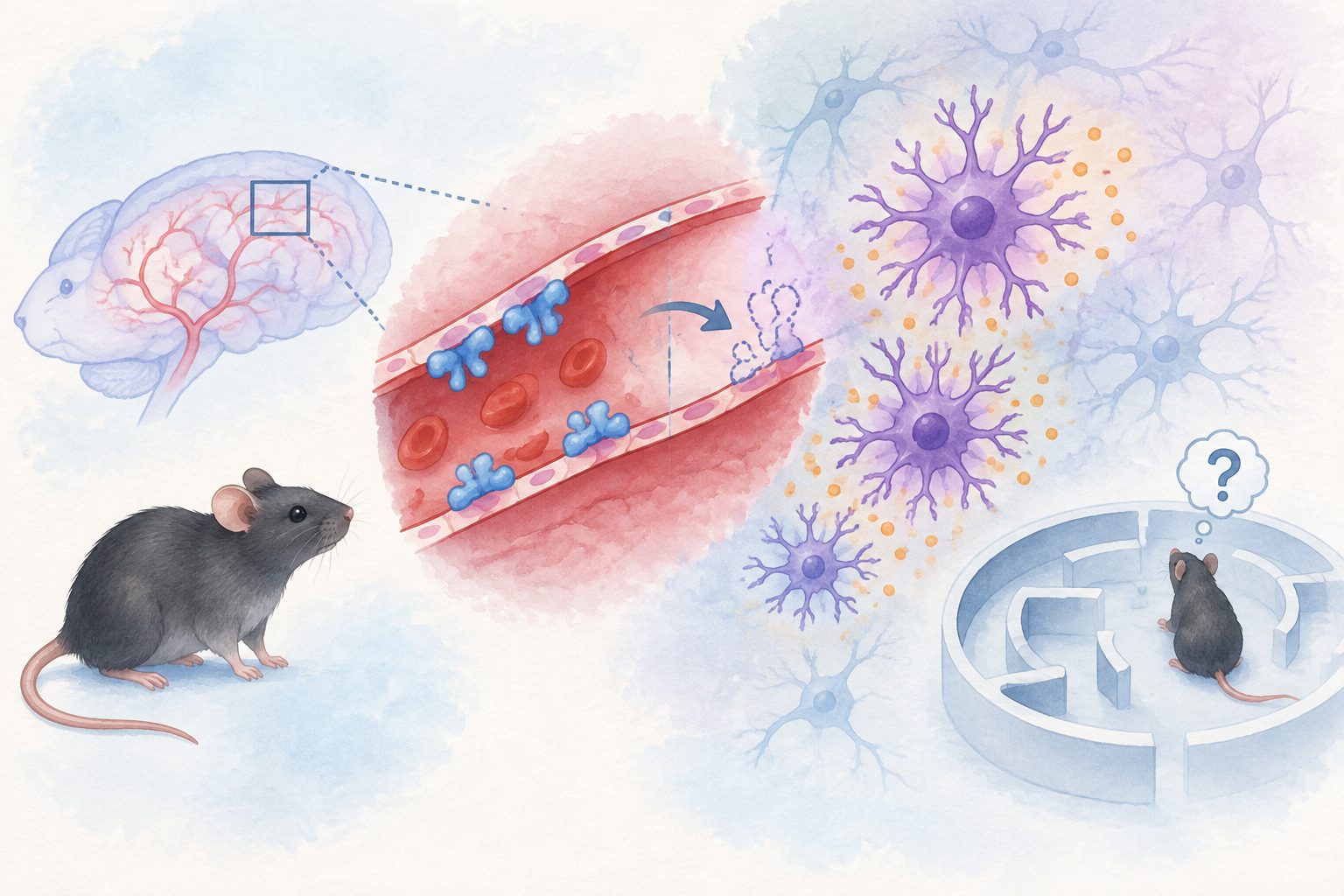
Editorial illustration — not from the study.
The study examined how aging-related loss of NMIIA in brain microvascular endothelial cells may affect inflammation in the brain. In cell experiments and mice engineered to lack NMIIA specifically in these vessel-lining cells, the protein VCAM-1 increased because it was not being broken down efficiently, even though its messenger RNA did not rise.
The researchers traced this effect to impaired autophagy, the cell’s waste-recycling system. NMIIA loss altered its interaction with Caveolin-1 and disrupted steps involved in autophagosome formation and fusion with lysosomes. Soluble VCAM-1 from the affected cells promoted inflammatory microglia and neuronal death in laboratory tests; the mice showed increased microglial activation, reduced hippocampal neurogenesis, neuron loss and poorer learning and memory.
What NMIIA loss changed
NMIIA levels were lower in brain microvascular endothelial cells from 15-month-old mice than in cells from 2-month-old mice. In cultured endothelial cells, NMIIA knockdown increased VCAM-1 protein but did not increase VCAM-1 messenger RNA or the other inflammatory factors examined.
The experiments indicate that NMIIA loss disrupts autophagy, including the joining of autophagosomes with lysosomes, which normally helps dispose of cellular material. Proteomic and biochemical tests identified Caveolin-1 as a binding partner of NMIIA. Without NMIIA, the autophagy protein ATG5 shifted into Caveolin-1-rich membrane regions associated with reduced autophagy initiation.
Conditioned medium from NMIIA-deficient endothelial cells promoted a pro-inflammatory state in microglia and triggered neuronal apoptosis in cell experiments. In endothelial-specific NMIIA knockout mice, researchers observed more activated microglia, reduced hippocampal neurogenesis, neuronal loss and significant deficits in learning and memory behavior.
Why the pathway matters
The findings describe a possible biological link between changes in brain blood-vessel cells and inflammation, neuron damage and memory problems. They place NMIIA in a pathway that controls how endothelial cells remove VCAM-1, an inflammatory adhesion protein, through autophagy.
Because NMIIA levels declined in the brain microvasculature during aging in the study, this pathway may help explain how age-related vascular changes contribute to neuroinflammation. The work also identifies the NMIIA–Caveolin-1–autophagy–VCAM-1 pathway as a possible target for future research, but it does not show that targeting it can treat disease.
Evidence and caveats
The evidence comes from cultured brain endothelial cells, protein and biochemical analyses, and an endothelial-specific conditional knockout mouse model. The mice were 15 months old when NMIIA loss was induced, allowing the researchers to examine effects in an aged animal model.
The study did not test the pathway in people or show that an NMIIA-, autophagy- or VCAM-1-targeting treatment improves outcomes. Some functional links, including the effects of soluble VCAM-1 on microglia and neurons, were tested in vitro, while the learning, memory and brain changes were observed in genetically modified mice. The findings therefore establish a mechanism in these experimental systems rather than demonstrating a human therapy.
A study of illicit alcohol in two Ugandan cities found that alcohol strength was inconsistent and sometimes under-declared, reaching 44.2%. Some spirits contained methanol above safe limits, while opaque beers showed bacterial contamination and many production and retail sites had poor sanitation.
Researchers found that bacterial surface-layer proteins can evolve through modular changes and gene transfer, producing different outer structures. In closely related bacteria with the same type of surface layer, only pathogens showed resistance to the antimicrobial molecules LL-37 and lysozyme.
Researchers traced how AlphaFold 3 turns evolutionary differences among related protein sequences into three-dimensional structure predictions. They found that evolutionary diversity matters more than simply adding more sequences, helping explain both the system’s strengths and some of its failures.